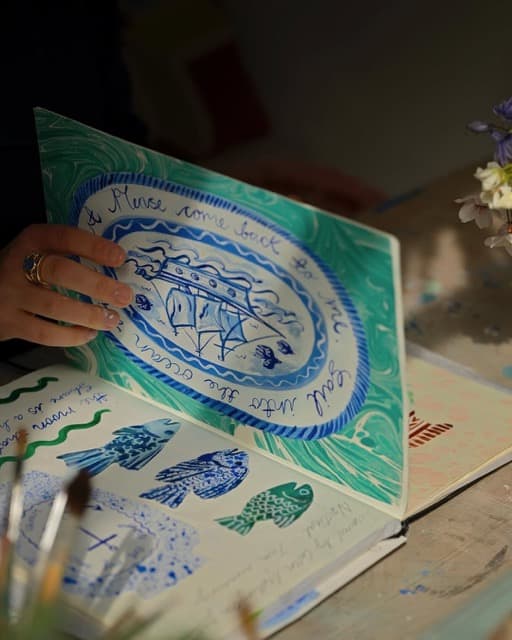
Meet the Maker: Sasha Compton, Painting a Life of Purpose
In this Q&A with Sasha Compton, we step into the vibrant world of a multidisciplinary artist whose hand-crafted works are rooted in sustainability, storytelling, and skill. Raised between North Yorkshire and the Isle of Mull, and now based in London, Sasha blends her background in illustration and graphic design with a passion for slow, thoughtful making.
Since launching her studio in 2020, she’s garnered international recognition and collaborated with leading brands, all while staying true to her belief in buying better and celebrating the beauty of handmade art.

1. Can you tell us a bit about yourself and your artistic journey?
I am a British Artist and Designer based in London. Known for my colourful freehand style in painting or ceramics, I aim to transport viewers into a timeless world of Art by creating modern reinterpretations of classical concepts.
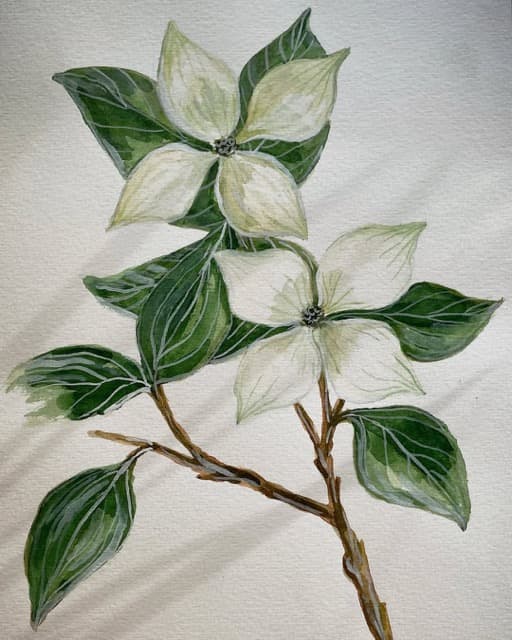
Using expressive and experimental techniques, I work with the colour theory to create decorative, whimsical and dreamlike artworks with the hope of bringing joy into people’s lives.
Inspired by nature, I grew up in a creative family, in North Yorkshire and the remote Isle of Mull, Scotland. I was awarded an art scholarship at the age of 14 years old and went on to study at Central St. Martins (2012, Illustration) and then at Chelsea College of Art (BA Graphic Design in 2015). I lived in Amsterdam for four years working as a Senior Graphic Designer, and moved back to London in 2022 where I now create in my colourful art studio in Lambeth.
2. What inspired you to pursue your craft? Was there a defining moment or influence that sparked your passion?
Ever since I was little, I knew my career would be creative. After university I explored a few areas in the creative industry but it wasn’t until 2020 that I felt a spark to pursue art as a full-time career.
I had been advised to go down the Graphic Design route at CSM as it guaranteed a secure income, but had always wanted to create physically. In 2020 I was working as a Graphic Designer and unfortunately witnessed a traumatic cycling accident in Amsterdam, I started focussing more on physical art (in particular ceramics) as a form of therapy, and soon realised that life was too short to not do something you love.
I suppose the accident put things into perspective for me. I made a business plan and started to take the next steps to becoming a full-time artist.
Your craft
3. How would you describe your work in three words?
Romantic, freehand, decorative.
4. What materials or techniques do you use, and why are they important to your process?
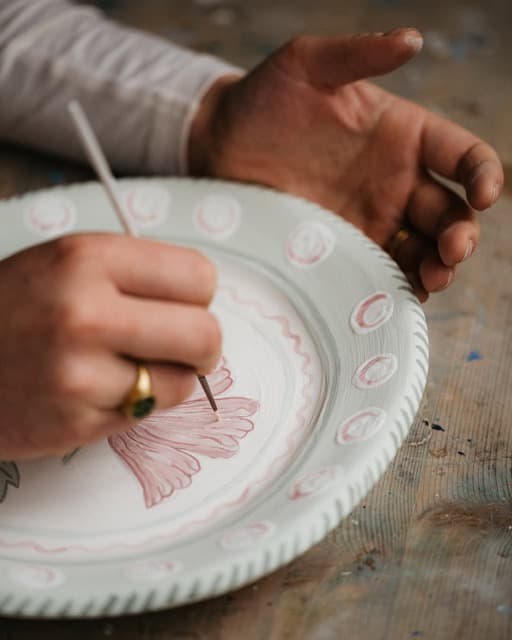
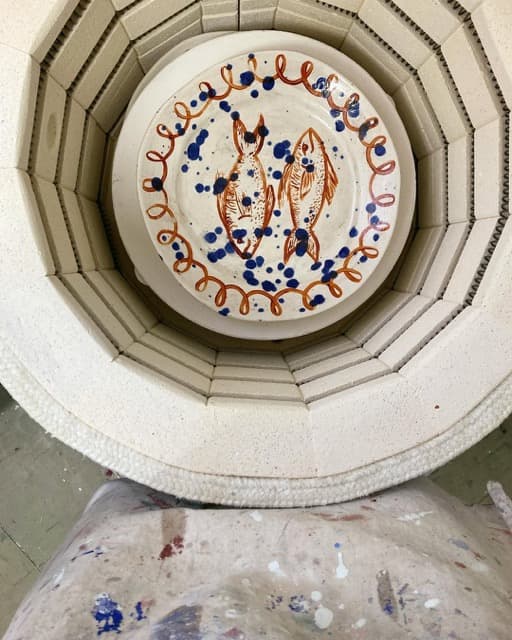
I like to use unpredictable materials like glazes, or watercolours. My work celebrates imperfections and character. Working with materials that feel like they have their own personality makes it an exciting process. I always think you can tell when an artist is enjoying making the artwork.
5. Can you tell us about a favourite piece you’ve created and the story behind it?
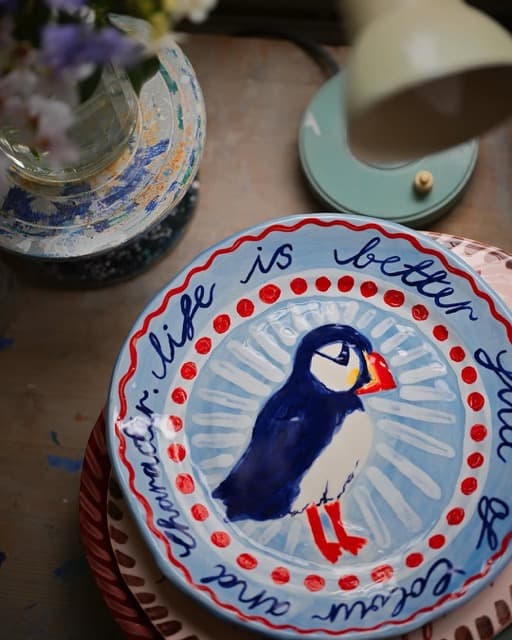
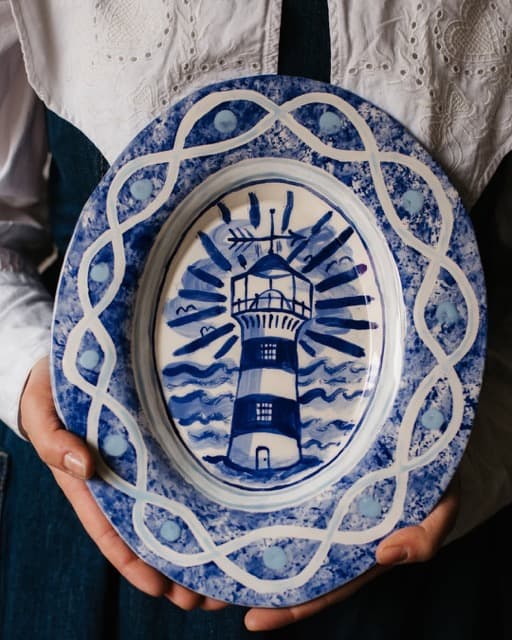
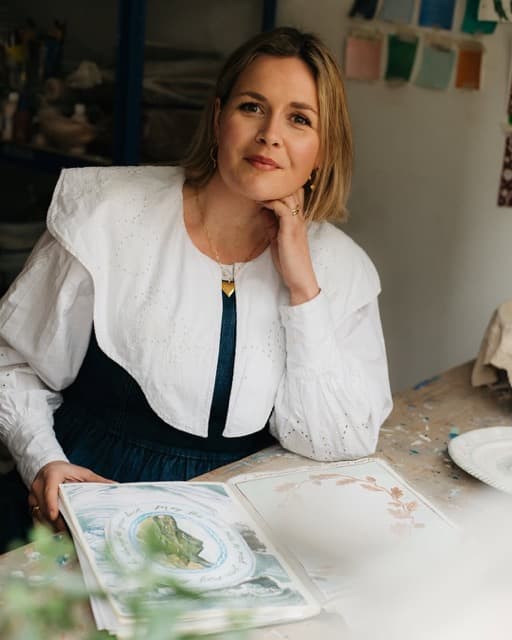
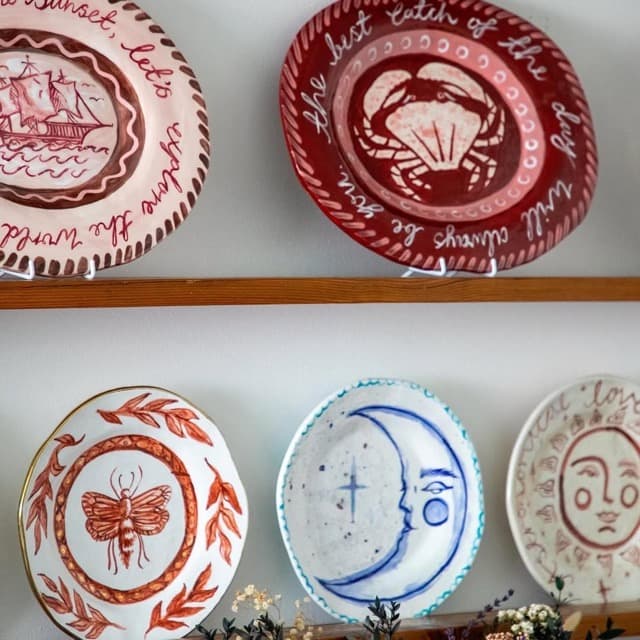
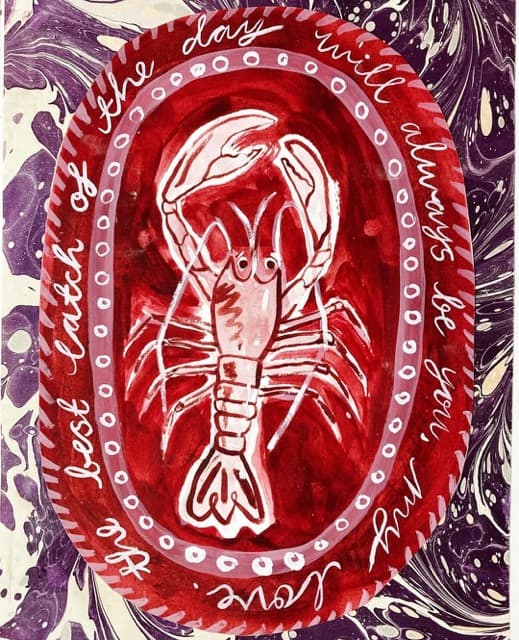
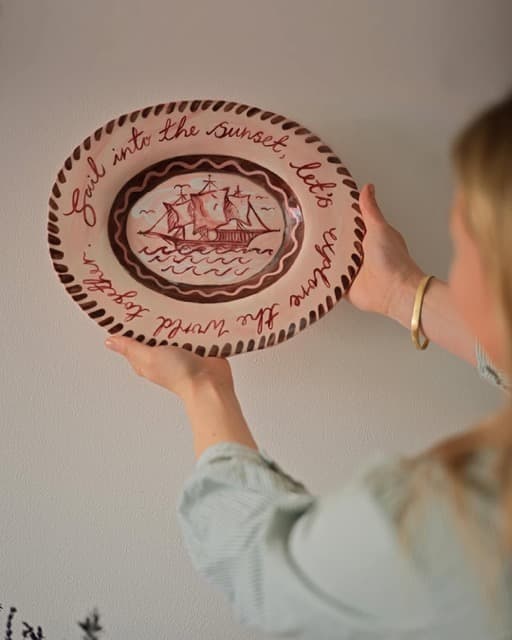
I’ve been focussed on developing my series of ‘Love Platters; a love letter to nature’. These are an ever-growing collection of ceramic platters which are handmade and glazed in my studio. Inspired by landscapes and happy memories in nature, the narrative for these works is an appreciate of nature. Each platter has romantic words written around the decorative border. The series questions ‘If you were to write a love letter to nature, what would you say?’ It feels very relevant for now.
Creative process
6. What does a typical day in your studio or workshop look like?
I tend to do my emails and admin at home with a coffee and then cycle to the studio. I collaborate a lot, often with Interior Designers or brands to create murals, lampshades and other decorative forms of art to their brief. So, I often have illustrations and samples to complete and meetings to attend. I always try to plan in an hour for sketching.
After lunch I focus on ceramics, working with clay or glazes and pack up for the day. No day is the same. Some days are dedicated to marketing plans, or accounts, or inspiration but those are less frequent.
7. Do you have any unique rituals or habits that help you stay creative?
No rituals as such, but I remind myself to ‘get fresh air, look up and stay curious.’
I think there are a lot of days where you don’t feel the ‘passion’, but as long as you are curious you will keep experimenting and playing which will lead to creativity.
8. How do you handle creative blocks? Do you have any strategies or tips for overcoming them?
I focus on something ‘easy’ that needs to be done and then the scary idea seems less scary. If it’s a prolonged block, I take a step back and seek inspiration in galleries, books or being out of my comfort zone. Running helps me a lot too.
Challenges and successes
9. What’s the biggest challenge you’ve faced as a maker, and how did you overcome it?
It is still one I struggle with but time-management and the lack of financial security. I write to do lists every day to keep me focussed and I try to make sure I always have a couple month’s rent saved up in case I have a slow month of sales.
I often pitch for work and get rejections which is always disheartening, but as each year goes on, I take the rejection less personally. The ups and downs are very normal in this industry. It’s the best feeling when you do get an exciting project!
10. What’s been your proudest moment or achievement so far?
I loved painting the window artwork for Martin Brudnizki’s shop And Objects in 2023.
I also adored painting a giant egg for The Queen’s Jubilee celebrations. The egg was exhibited on the streets of London with The Elephant Family (a charity endorsed by The King and Queen). My Fabergé inspired egg was selected by Fabergé to be exhibited for their coronation event in 2023.
11. What’s your favourite quote you’ve ever heard about your work? Who said it, or what was the name of the publication?
'Her focus is on crafting one of a kind pieces and limited runs, working against the mass production that's so rife in the homeware industry'
– HOUSE & GARDEN
Inspiration
12. Where do you draw inspiration from for your work? What sparks your imagination and creativity?
I am very inspired by architecture, patterns and nature, so a lot of my ideas come from just absorbing everyday life or thinking back to happy moments I can celebrate. I take a lot of photos for documentation and frequently update my mood board and sketchbook in my studio. I think collaboration is key to creative development too.
13. Do you have a favourite artist, maker, movement, or tradition that has influenced your craft?
I am influenced by various artists and movements and it’s always changing. Grayson Perry is probably my favourite artist. Perry was the UAL Chancellor in my time which I think played a huge part in his influence.
Illustration wise I admire Edward Bawden, and I find the woven 19th century nautical themed works by Colin Millington so charming. Decorative designs such as the patterns of Robert Adam often creep into my works.
Even though they were not early influencers on my practice, my work feels quite closely aligned to the Bloomsbury Group’s way of thinking too.
14. How does colour influence your practice; is it an important part of your process? Do you have a particular palette or favourites? Any go-to sources for colour inspiration?
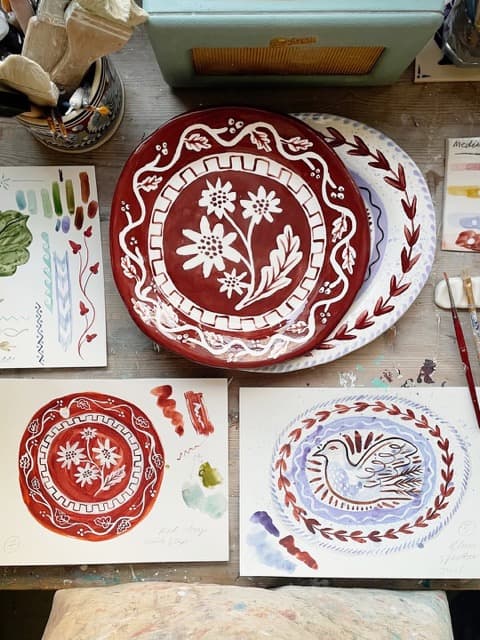
I often try new colours and end up being drawn to my favourite colours. I love the Georgian colour palette (dusty pinks, greens) and colours of nature (mossy tones, browns and blues). In general, I only use 2 or three colours in an artwork. This limited colour and use of the colour theory allows a stronger outcome for what I am trying to achieve.
Perspectives and goals
15. What role does your environment play in shaping your creativity?
I have to be in the right mindset, so making sure I don’t have lots of deadlines at once is important to my productivity. I also need to feel comfortable so I often listen to the radio or light a candle in my studio. I like the presence of plans and the sounds of the Waterloo trains that go by the studio.
16. What do you want people to feel when they experience your work?
I would like for people to feel a sense of play and an uplifting emotion. Ideally the artwork doesn’t just ‘go with the sofa’. It’s always lovely when someone really ‘gets’ your work and the craftmanship that’s gone into it.
17. What are you currently working on, and what excites you most about it?
I am currently working on an illustration project for a client which is very detailed and a great challenge. I am also working on some ceramics for a group show at The Watts Gallery called ‘Spirit of Charleston’ (Open Feb-April).
I am also working on some ceramic plates for Interior Designer Rosanna Bossom which is also exciting as I have no idea how they will look in situ. Straddling the role of artist and designer is my dream balance so I am grateful when there is a mix.
Advice and reflection
18. What advice would you give to someone starting out as a maker?
I’m not really one to give advice as everyone has their own beautiful journey.
If I had to advise – it would probably be to ‘always give it a go, and if you can – plan. Also turn up to events as you never know who you might meet that could be a new creative friend or collaborator.’
19. If you could go back to the start of your career, what advice would you give your younger self?
Try to care less what others think, listen to what you feel is right, and don’t overcomplicate things.
Closing thoughts
20. If you could collaborate with any artist, past or present, who would it be and why?
I would adore to collaborate with an artist / brand like Diptyque or Ffern as I find their focus on nature is aligned with my work. I would also love to do a fabric range if there are any fabric suppliers out there who’d like some illustrations? (I have a few ideas..)
21. Where can people find your work, and how can they support you?
You can find my work on my website: www.sashacompton.com and via my Instagram: @sashacompton_design.
I link which galleries are selling my work on my Instagram. I often take on collaborations and commissions, so please get in touch if you have something fun in mind.
From her vibrant London studio, Sasha Compton champions handmade, sustainable design through expressive artworks and one-of-a-kind creations. With each brushstroke and carefully crafted detail, she celebrates creativity, tradition, and the joy of slow, thoughtful making.
Explore Sasha’s latest collection and follow her creative journey:
Support Sasha Compton by following her creative journey on Instagram and exploring her full collection on her website.

Meet the Maker: Rosie Gore, Crafting Colour and Character in Clay
In this Q&A with London-based ceramicist and designer Rosie Gore, we explore her hand-built approach to creating thoughtful, one-of-a-kind stoneware.
With a background in interior styling and a love for slow, intentional design, Rosie Gore shapes each piece by hand, balancing earthy textures with bright, painterly glazes. Her work embraces the beauty of imperfection, bridging the gap between rustic and modern, and bringing warmth, colour, and individuality into everyday living spaces.

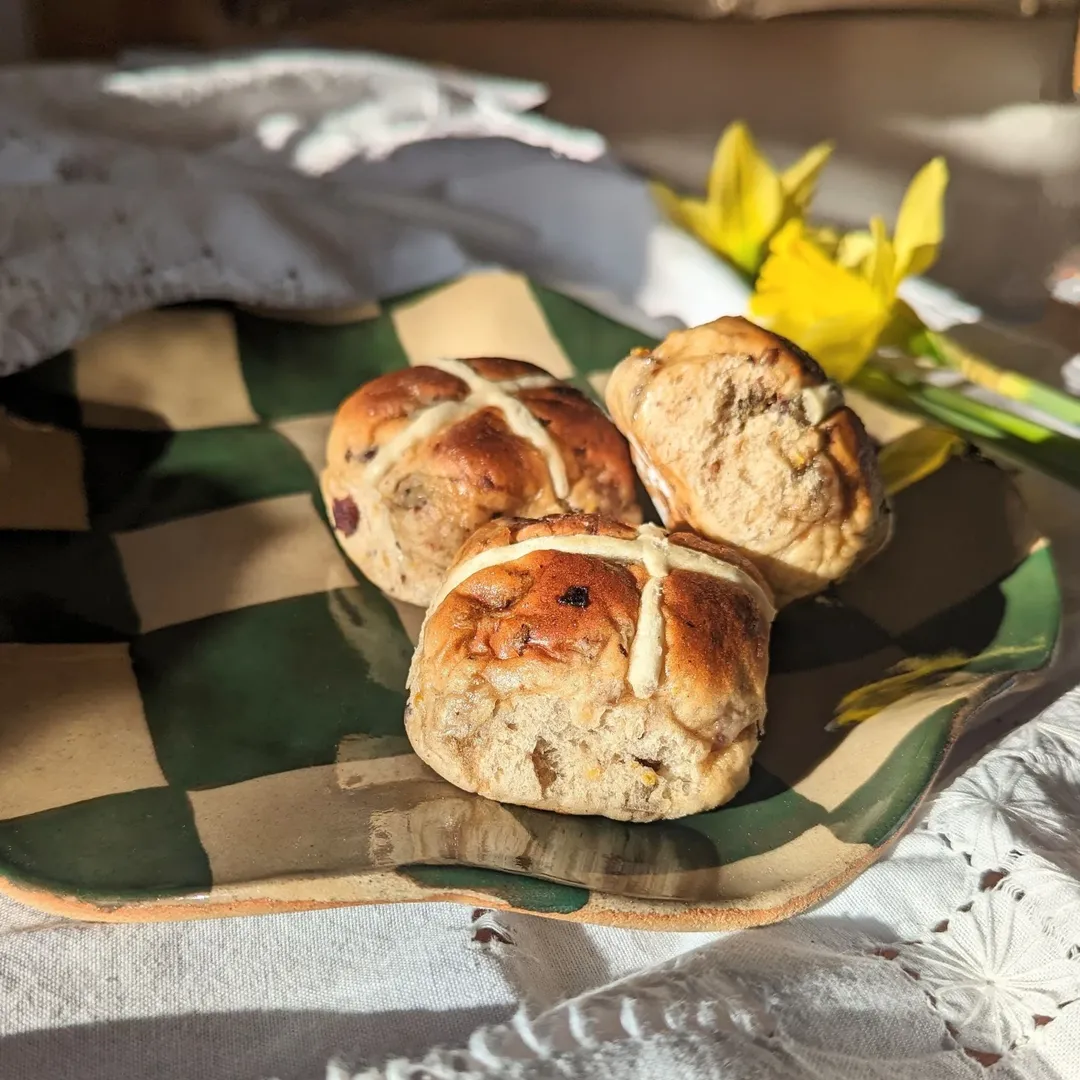
1. Can you tell us a bit about yourself and your artistic journey?
I’ve always loved designing and making things since I was a child and being very dyslexic I quickly realised that this was where my strengths lay and definitely where I feel most confident. I was always painting, sewing, and making things, but for some reason the idea of studying anything artistic at university seemed very scary and would never lead to a ‘proper’ job.
After five years of working as a primary school teacher, I handed in my notice to go travelling around Central America for a year, but then two weeks later COVID struck and we went into lockdown, needless to say we didn’t make it to Mexico that year and I had to reassess my career options!
But there was most definitely a plus side in this difficult time, as having stopped teaching It let me see that although I loved some parts of it, it had also made me incredibly stressed and anxious, so I decided to try doing what I loved full-time and focused on my creative side.
I’d always made ceramics as a side hobby but now I finally had the chance to really invest in what I most loved doing and try to make a career out of it. I tutored and freelanced as an assistant stylist on interior shoots to keep the lights whilst I developed my ceramics.
To my delight (and quite honestly amazement), for the last year and half I have been working full-time for myself and developing my practice with such an amazing community of followers. All self-taught and learning as I go, it’s been such a liberating process and I’m so grateful and thankful for where I am now.
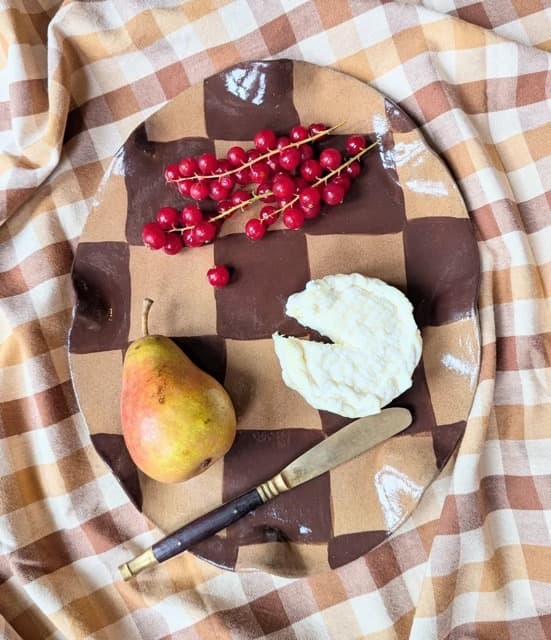
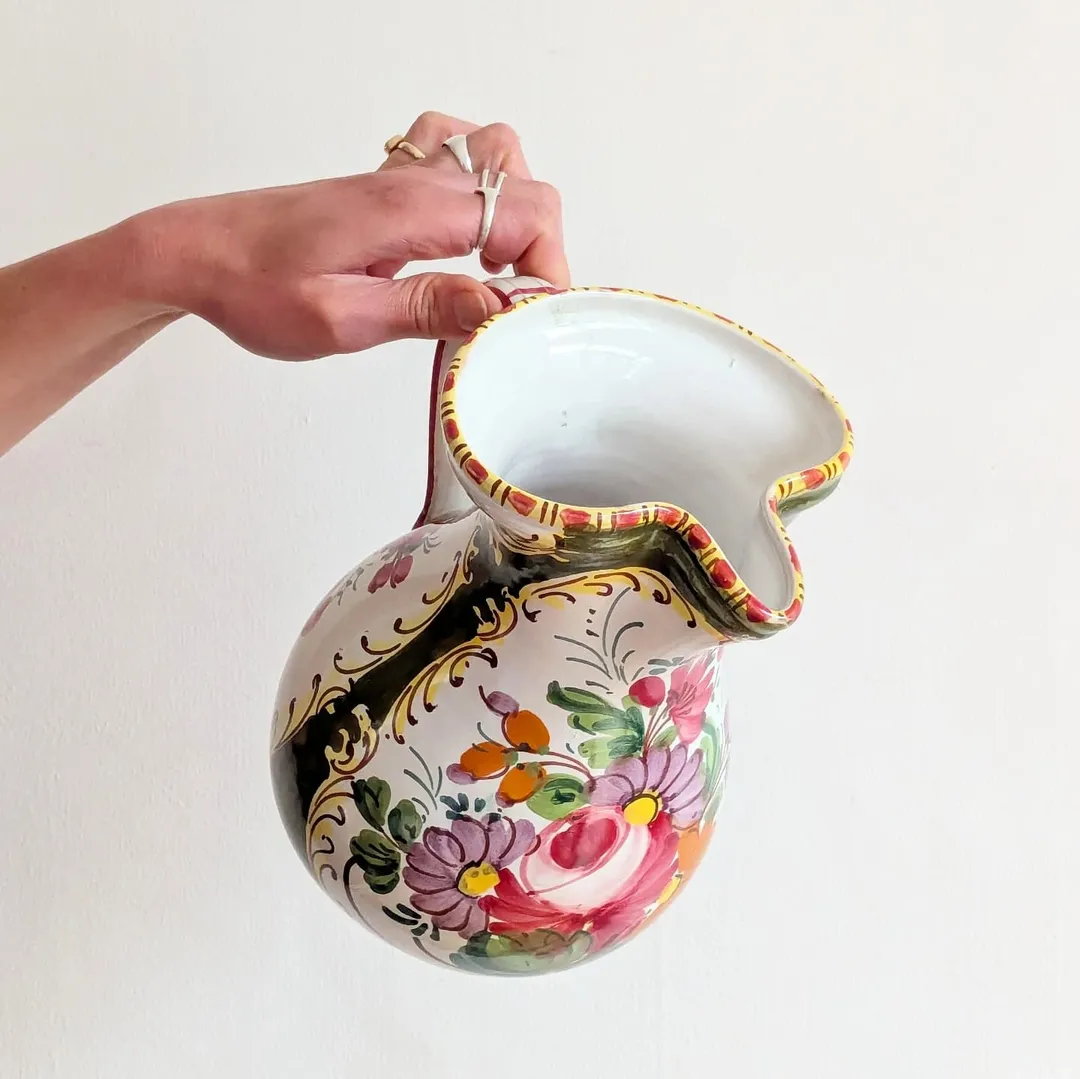
2. What inspired you to pursue your craft? Was there a defining moment or influence that sparked your passion?
A defining moment in my career was most definitely working as an assistant stylist on interior shoots, working alongside some incredibly talented interior stylists and creative directors, watching them curate the most incredible spaces filled with beautiful pieces which blurred the lines between pieces of art and functional items for the home.
There have been so many inspirations to my work over the past two years, but two which really stick out were firstly working with the most incredible pieces of artwork from MAH Gallery whilst assisting interior stylists; helping to curate living spaces full of texture, shape, colour and pattern. This cemented my belief in the beauty and importance of hand crafted pieces, which can be both a work of art and a usable item that brings joy to people.
The second, Charleston House. Home of artists Vanessa Bell and Duncan Grant, Charleston was where the 20th century’s most radical artists, writers and thinkers, the Bloomsbury group, met. The house itself is truly the most inspiring of places, covered with beautiful yet often whimsical, carefree hand painted patterns on mantel pieces, walls, doors, and ceilings, it reminds me of the importance of fun when making art, while also being such an important place historically for our culture.
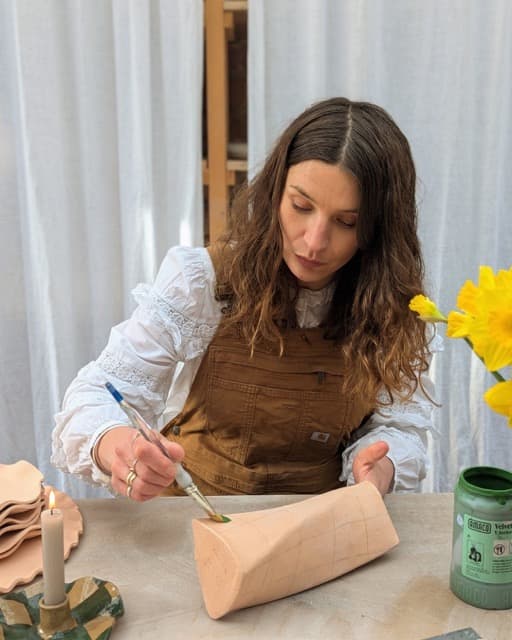
Your craft
3. How would you describe your work in three words?
Natural, expressive, personal
4. What materials or techniques do you use, and why are they important to your process?
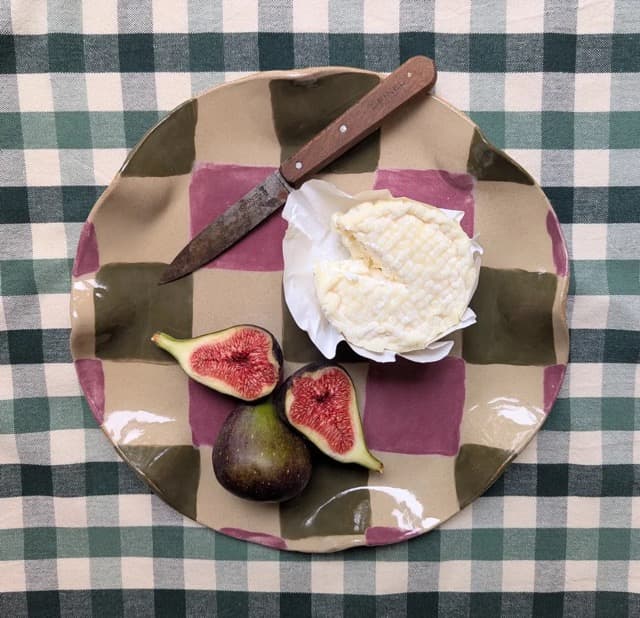
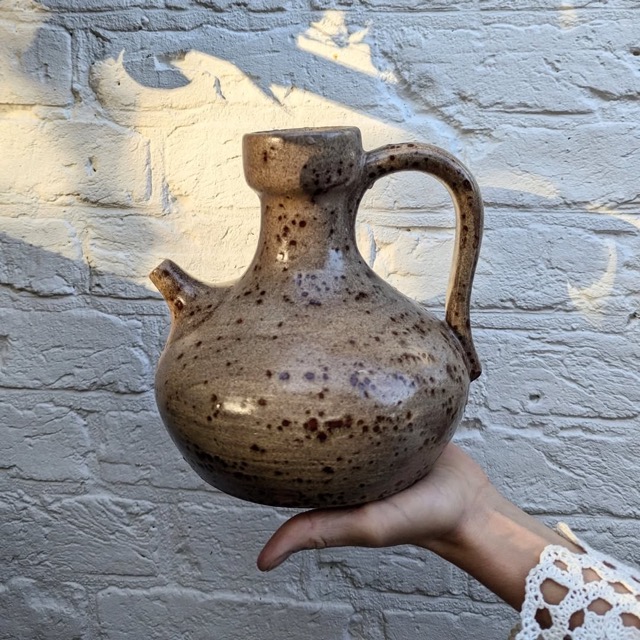
My ceramics are hand built in stoneware clay, from which I work to create organically shaped pieces which are then painted and glazed by hand. The speckled, organic, earthy tones of the stoneware are designed to balance the brightly coloured glazed patterns.
Shaping each piece by hand means they are all unique in their own way, and aims to emphasise my belief in creating unique, slow, sustainable pieces for the home.
5. Can you tell us about a favourite piece you’ve created and the story behind it?
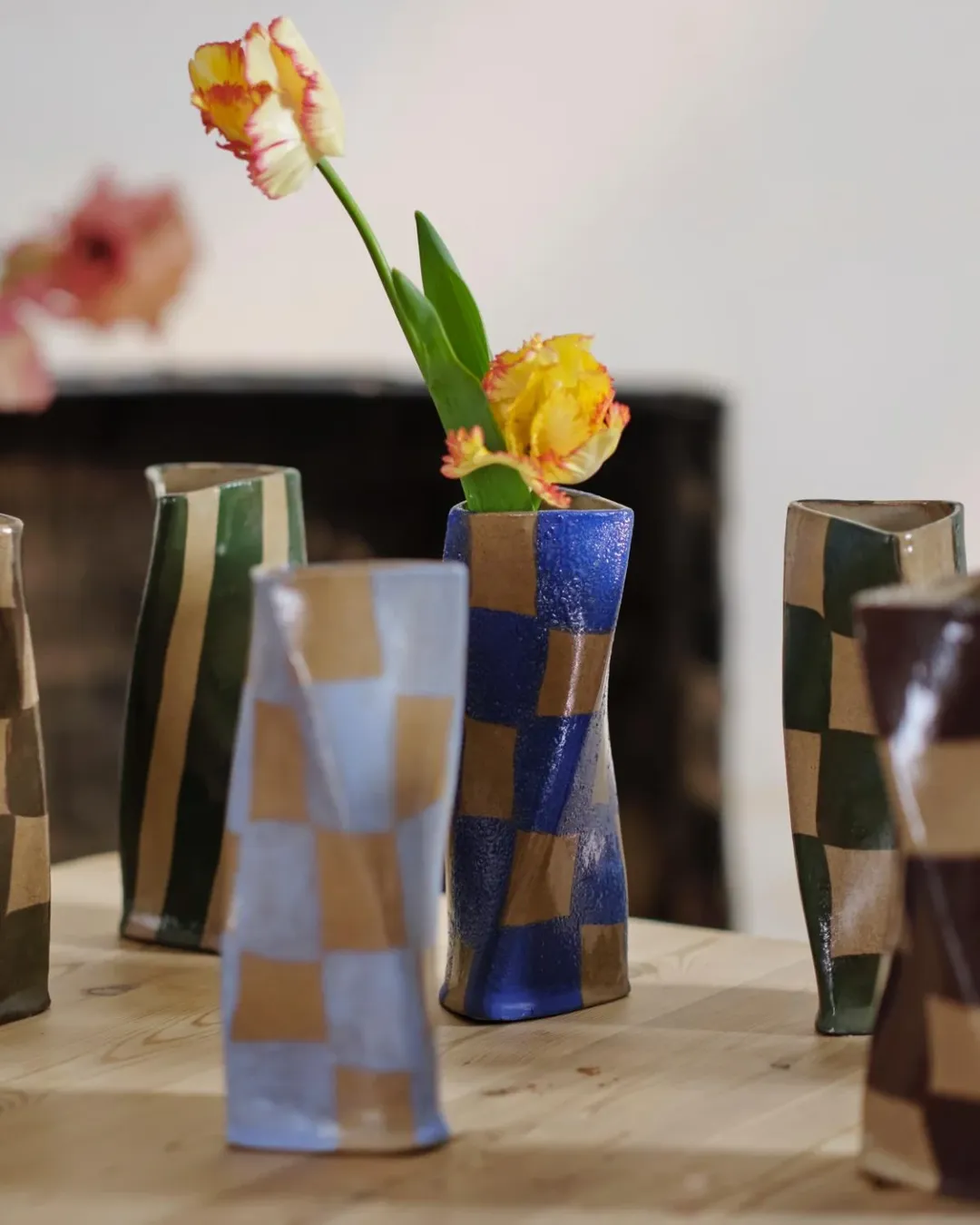
My Check Twist vases are probably my favourite piece so far and are probably the most iconic. I love check patterns but wanted to create a shaped vase where the pattern wasn’t just flat on it, but a shape that drew your attention as much as the pattern did. It took quite a lot of experimentation to come up with the final design, but I am so happy with how the final pieces look now.
Creative process
6. What does a typical day in your studio or workshop look like?
Having been a teacher where your days and even holidays are so regimented down to the minute, I now absolutely love that my time is my own. Depending on my schedule, sometimes I start work very early to start rolling out slabs upon slabs of clay, whereas other mornings I make myself a tea and sit in bed until 9am doing admin!
Depending on when I need to fire my pieces, my days are normally either a “making” day, or an order packing and admin day (although sometimes both!). Woman’s Hour is a daily must, along with many earl grey teas along the way.
7. Do you have any unique rituals or habits that help you stay creative?
To make sure I still always remain feeling energised and creative, whenever I’m making a batch to fire I always try to include a test for a new design idea.
This gives me so much excitement when the time comes to open the kiln!! For me this is really important, as sometimes finding the time to experiment and test ideas is really hard when you are really busy making orders.
8. How do you handle creative blocks? Do you have any strategies or tips for overcoming them?
For me I think taking a break is really important, I very rarely have new ideas come to me when I’m sitting down trying to think some up! They normally come when my mind is completely elsewhere and then I have to quickly jot it down or draw it. So my tip would be, go and do something else completely!
Challenges and successes
9. What’s the biggest challenge you’ve faced as a maker, and how did you overcome it?
It is quite a juggle! A great juggle, but there is lots and lots to learn on the go! Designing and making is only one part of it, so you have to be really organised and have quite a lot of initiative.
A challenge I have is planning for the year ahead, what I want to achieve and the industry deadlines for this, especially when there is so much work to do on a day-to-day basis too, so having a large yearly planner has really helped me keep on track with this.
10. What’s been your proudest moment or achievement so far?
Aside from the press coverage I’ve had without any PR agency, my proudest achievement has to be making a collection for Charleston House. Having my pieces there feels incredibly surreal!
11. What’s your favourite quote you’ve ever heard about your work? Who said it, or what was the name of the publication?
‘Your pieces are straight out of Charleston House!’
– A recent customer at a market exclaimed, which I was so delighted about!
Inspiration
12. Where do you draw inspiration from for your work? What sparks your imagination and creativity?
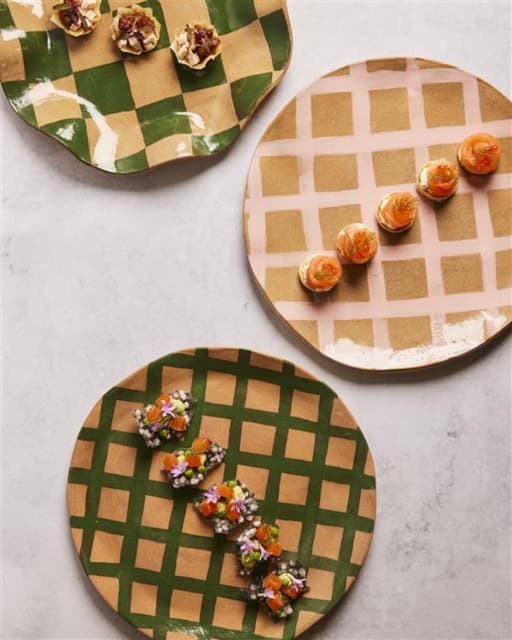
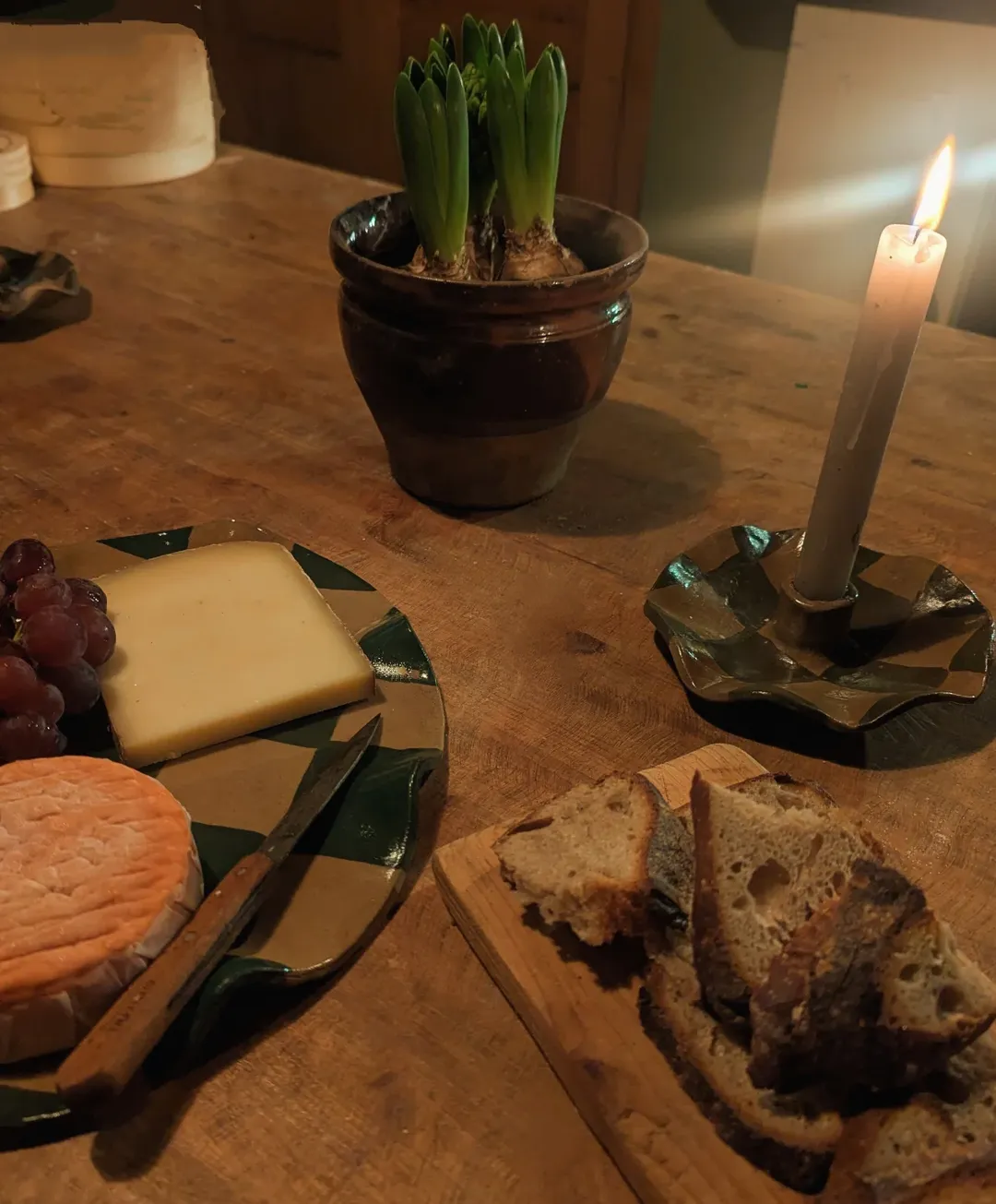
I draw inspiration from the living world around me, earthy colours inspired from nature which are complemented by traditional patterns such as check or gingham mixed with architectural shapes. The beauty in functional pieces really inspires me, pieces that are really beautiful and interesting but also can be used during a dinner party or displayed in a cabinet.
13. Do you have a favourite artist, maker, movement, or tradition that has influenced your craft?
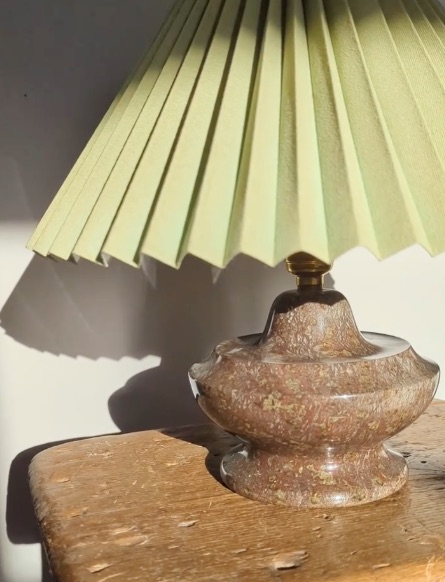
It has to be the work of Vanessa Bell and Duncan Grant. Charleston is a house full of hand painted mantels, walls and doorways each showing signs of the maker’s paint brush strokes, hand sewn lampshades with visible wobbly stitching and ceramic pendant lampshades with fingerprint idents of the makers, all completely unique, personal and freeflow. The freeness of their work within the house really inspires me. It’s fun and free from pretense.
Another is the arts and crafts movement, specifically Standen House. I’ve been visiting here for years and it is one of my favourite places for inspiration. A place which is timelessly stylish.
14. How does colour influence your practice; is it an important part of your process? Do you have a particular palette or favourites? Any go-to sources for colour inspiration?
Colour is a huge part of my practice, giving a pop to the earthy, speckled tones of the stoneware. Different seasons call for different colours, but different styles are also suited to certain colours.
I generally prefer a more earthy colour palette- greens, browns & burgundies in varying shades. However, I love experimenting with trending colour combinations and get inspiration from designers like Studio Ashby, Beata Heuman and Colours of Arley.
Perspectives and goals
15. What role does your environment play in shaping your creativity?
My environment plays a big part in helping my creativity and generally making me feel like I’m in a productive and creative mindset. I’m now in between London and St Leonards and am loving being by the sea. I definitely feel calmer and happier closer to nature.
16. What do you want people to feel when they experience your work?
Just enjoyment and to know that it’s uniquely theirs.
17. What are you currently working on, and what excites you most about it?
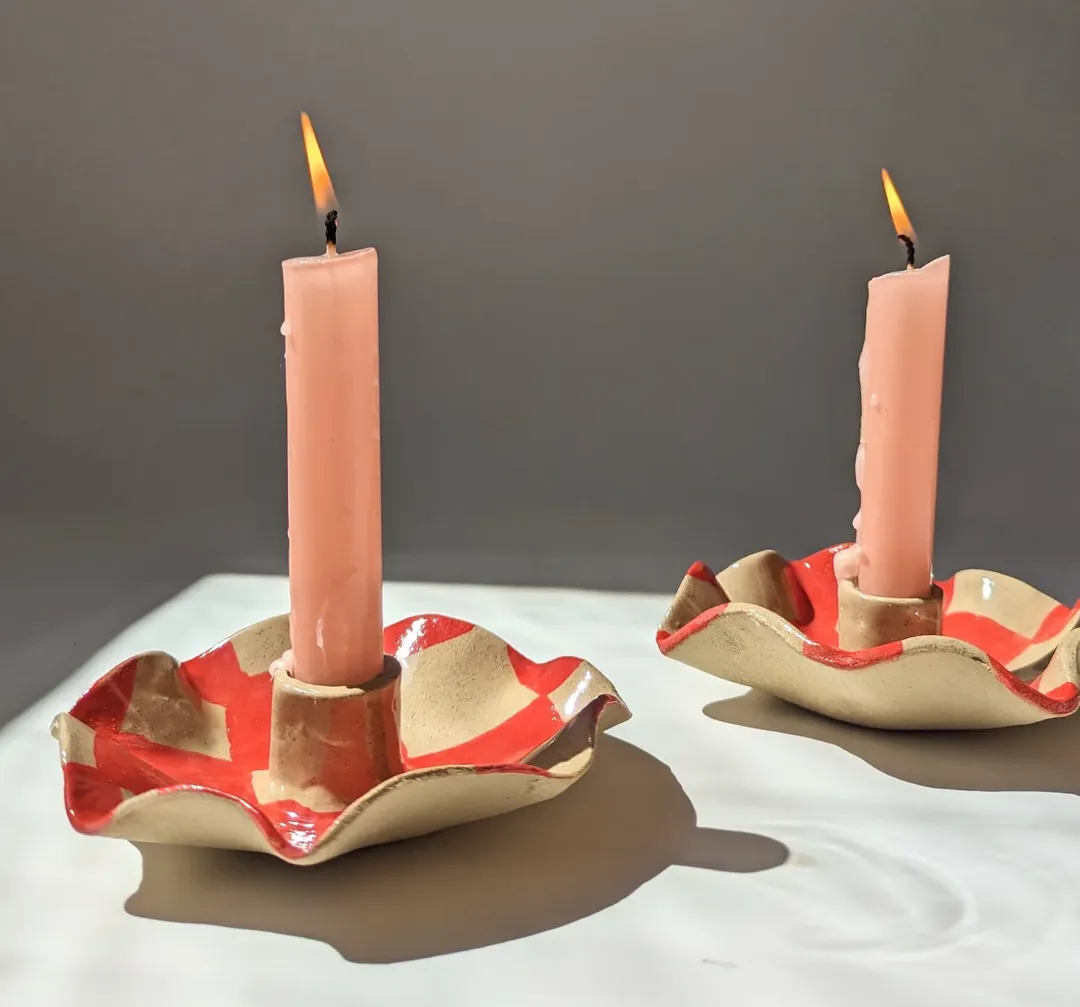
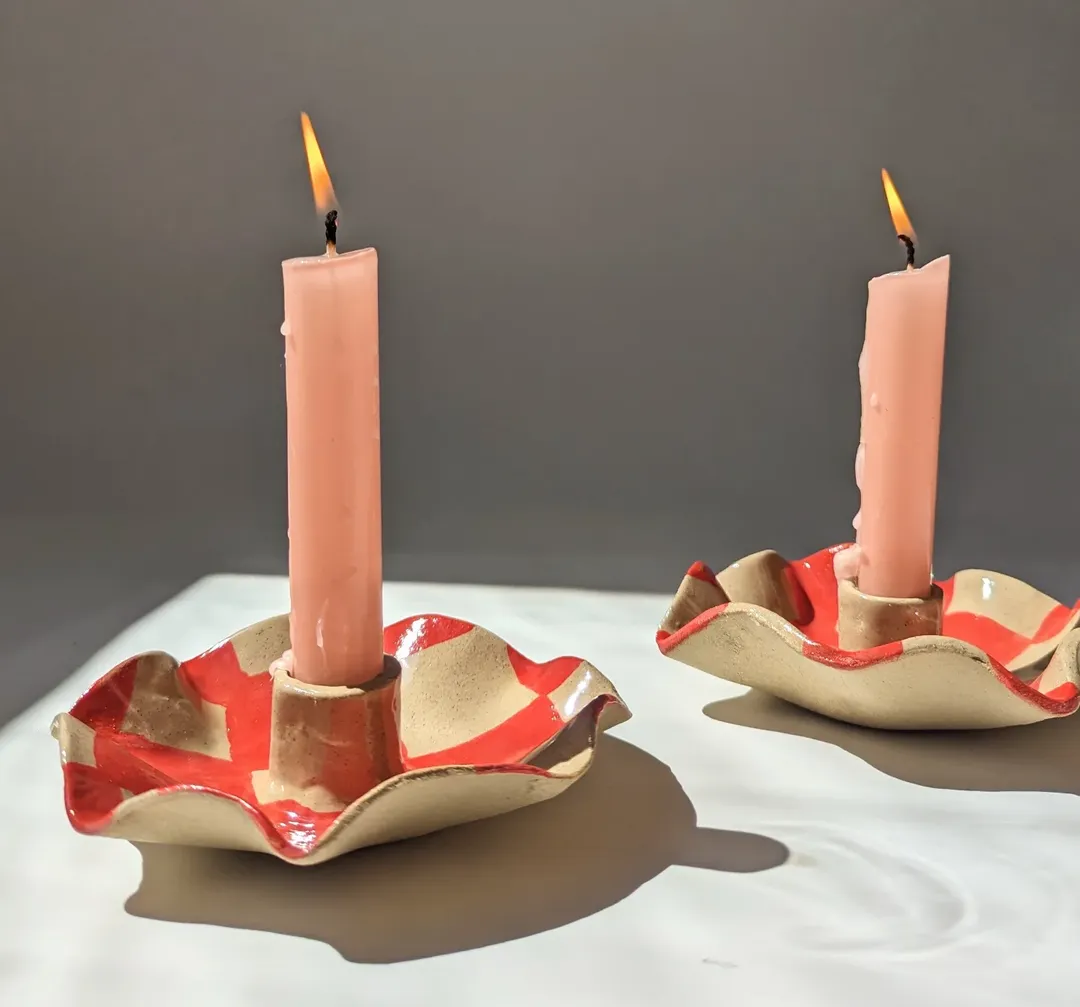
I’m currently working on a commission of some wavy candle sconces which I’m really excited about, can’t wait to experiment with which patterns look best for them.
Advice and reflection
18. What advice would you give to someone starting out as a maker?
To have confidence in your work but to also not be too precious about it. Not everything you design is going to be great and that’s OK. Trial and error is important, but I think as adults we are shaped into feeling like it’s a bad thing. Also some people will love something that you don’t like as much yourself!
19. If you could go back to the start of your career, what advice would you give your younger self?
To actually follow what you enjoy doing and what you feel most confident in. It’s really tricky as I think when you are young unless you have contacts within industries in subjects you are interested in, it all feels very daunting and you actually have no idea of the range of jobs there are out there. I’d tell myself to have a bit more confidence in myself.
Closing thoughts
20. If you could collaborate with any artist, past or present, who would it be and why?
Ivon Hitchens because I love his earthy colour palette and colour block patterns.
21. Where can people find your work, and how can they support you?
My website is the best place to find all of my work! Showing support on instagram is always a great help to spread the word!
From her London studio, Rosie Gore continues to champion handmade, sustainable design through her distinctive ceramic pieces. With every curve, brushstroke, and glaze, she offers a celebration of thoughtful craft, inviting us to find beauty in the details and joy in the handmade.
Explore Rosie’s latest collection and follow her creative journey:
Support Rosie Gore by following her creative journey on Instagram and exploring her full collection on her website.
Meet the Maker: Lizzie Scarlett Towndrow and the Charm of Handmade Keepsakes
Lizzie Scarlett Towndrow’s ceramics sit somewhere between functional homewares and curious keepsakes. Based in South London, Lizzie brings her background in illustration and textiles to every hand-built piece.
She draws on a long-standing fascination with ancient ruins and the stories they preserve, exploring the passing down of knowledge, the handmade processes, and how everyday objects can hold sentiment and memory. With a practice shaped by years of experimentation, from patchwork quilting to her MFA in Crafts, Lizzie continues to build a collection of tactile pieces that feel familiar yet deeply personal.

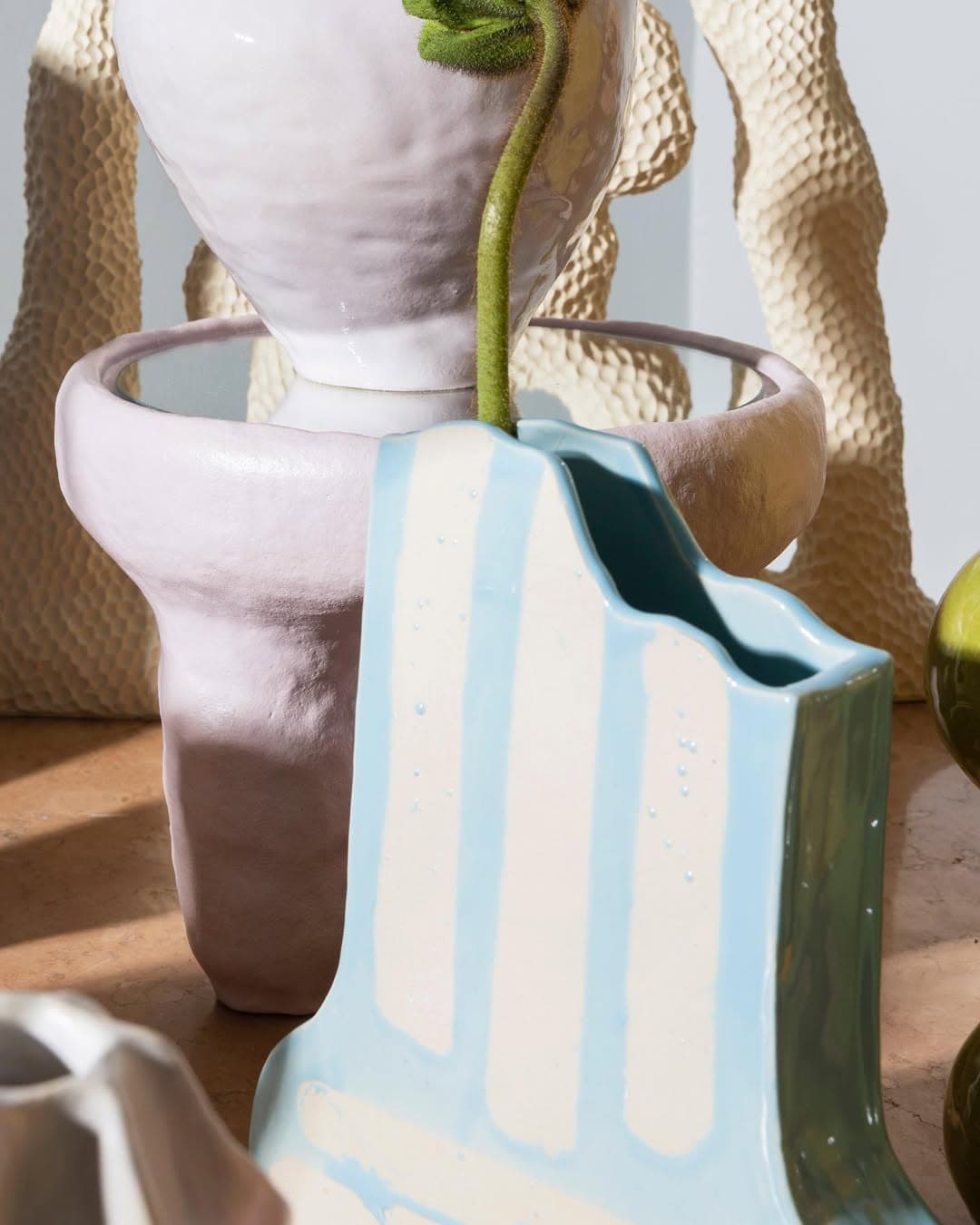
1. Can you tell us a bit about yourself and your artistic journey?
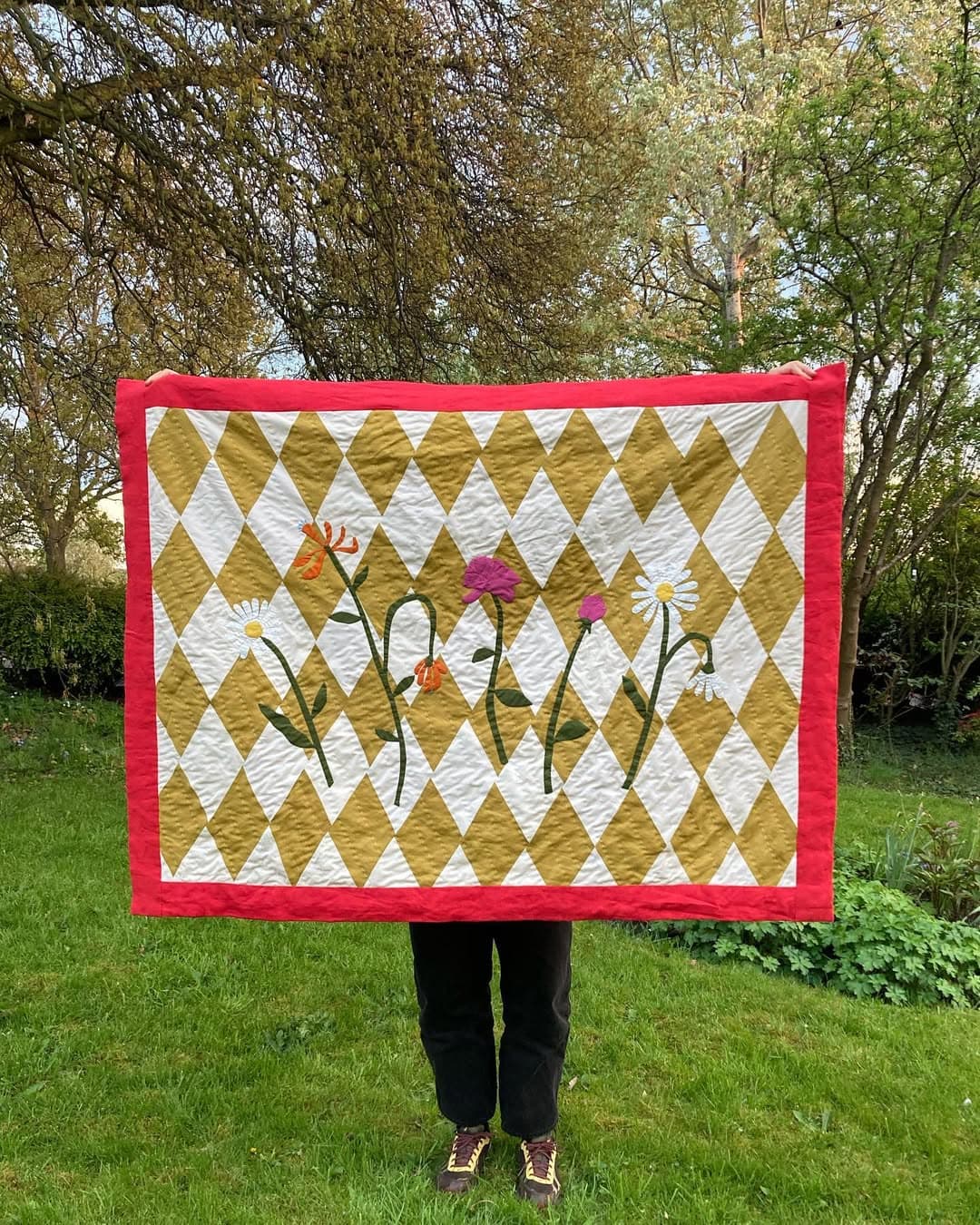
I started in illustration but soon found that a lot of the materials I was using to illustrate were textiles, which led to my Masters in textiles and crafts. I would say my primary practice is patchwork quilting, but for the last 15-plus years, I have also been playing with clay, making functional homeware, exploring the passing of knowledge, skills, and stories through making, interaction, and play, in my little South London studio.
2. What inspired you to pursue your craft? Was there a defining moment or influence that sparked your passion?
I learned lots of crafts from my Grandmother, embroidery, knitting, painting, baking, gardening, etc. I have always loved making with my hands, and through experimenting with ceramics during uni, I realised I could manipulate the clay in the same way as I would a textile pattern, making 2D into 3D.
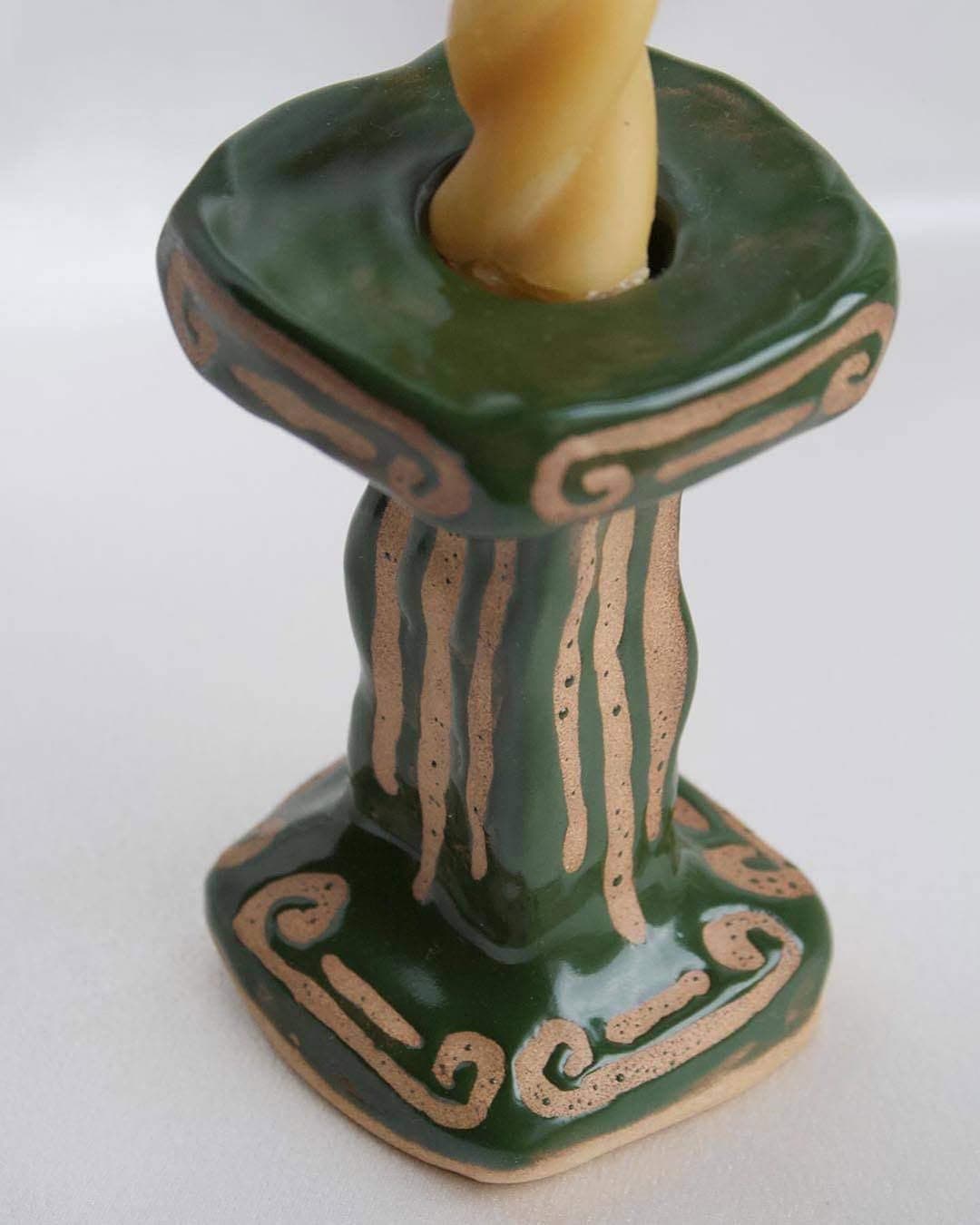
Your craft
3. What materials or techniques do you use, and why are they important to your process?
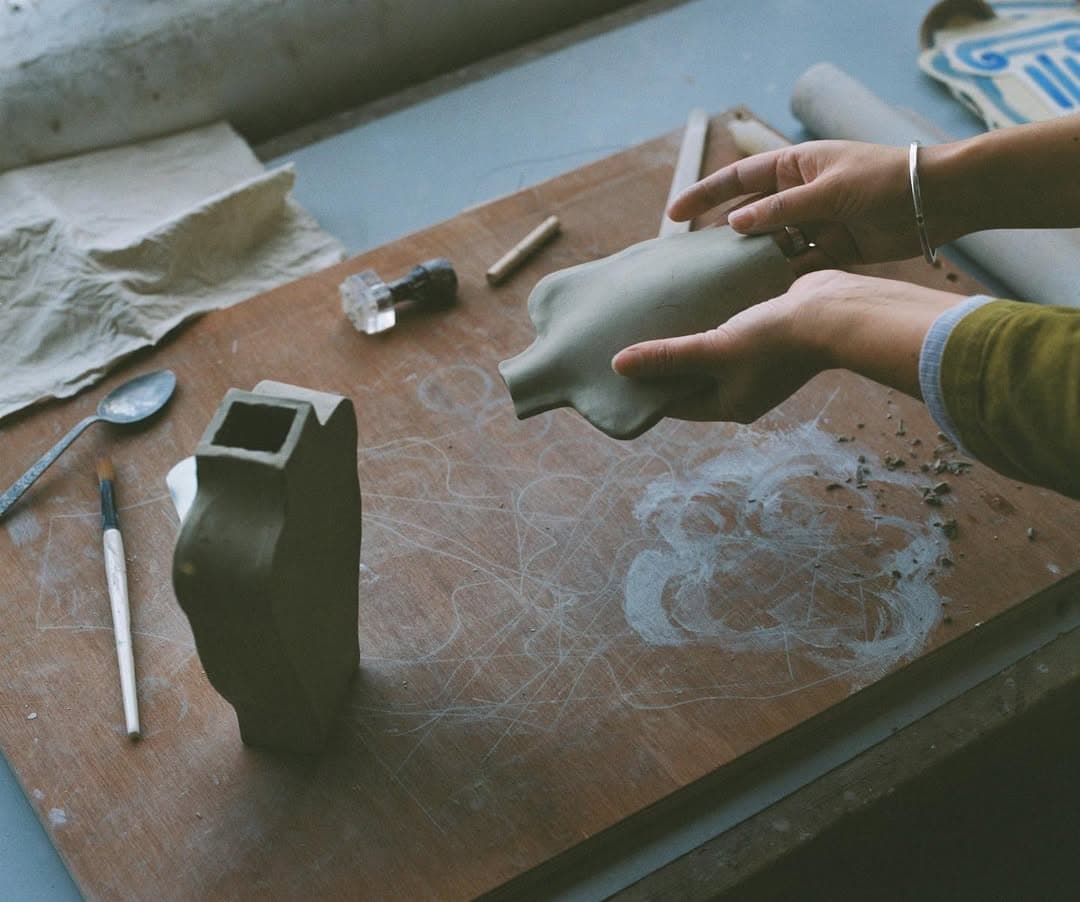
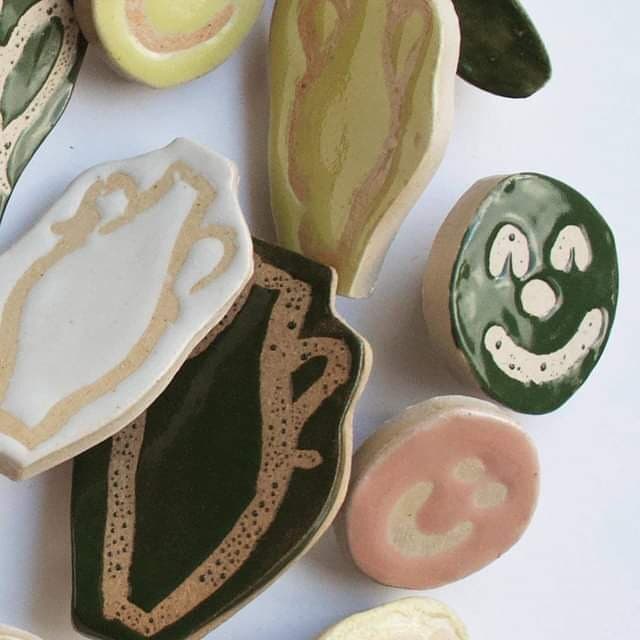
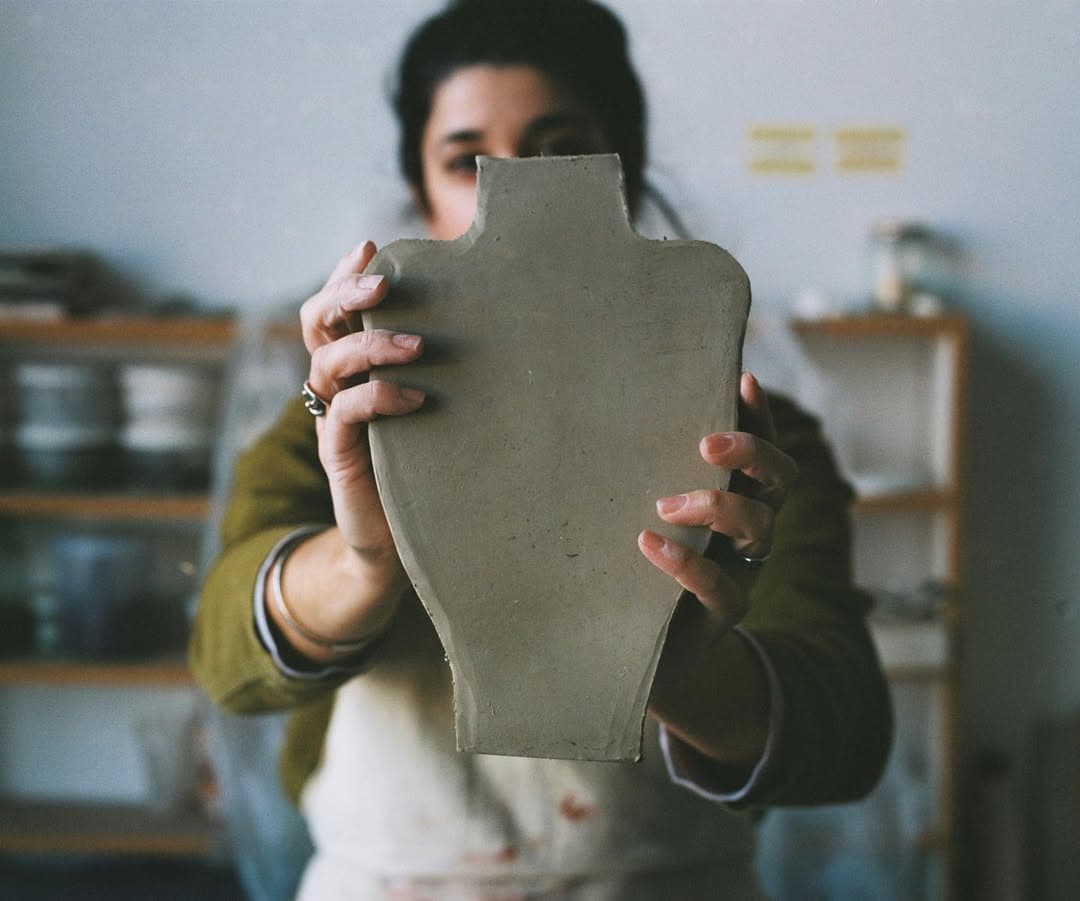
I mainly work with stoneware clay and hand-build each individual piece. Slab building allows each piece to be one of a kind, showing the marks I make with my fingers and hands.
4. Can you tell us about a favourite piece you’ve created and the story behind it?
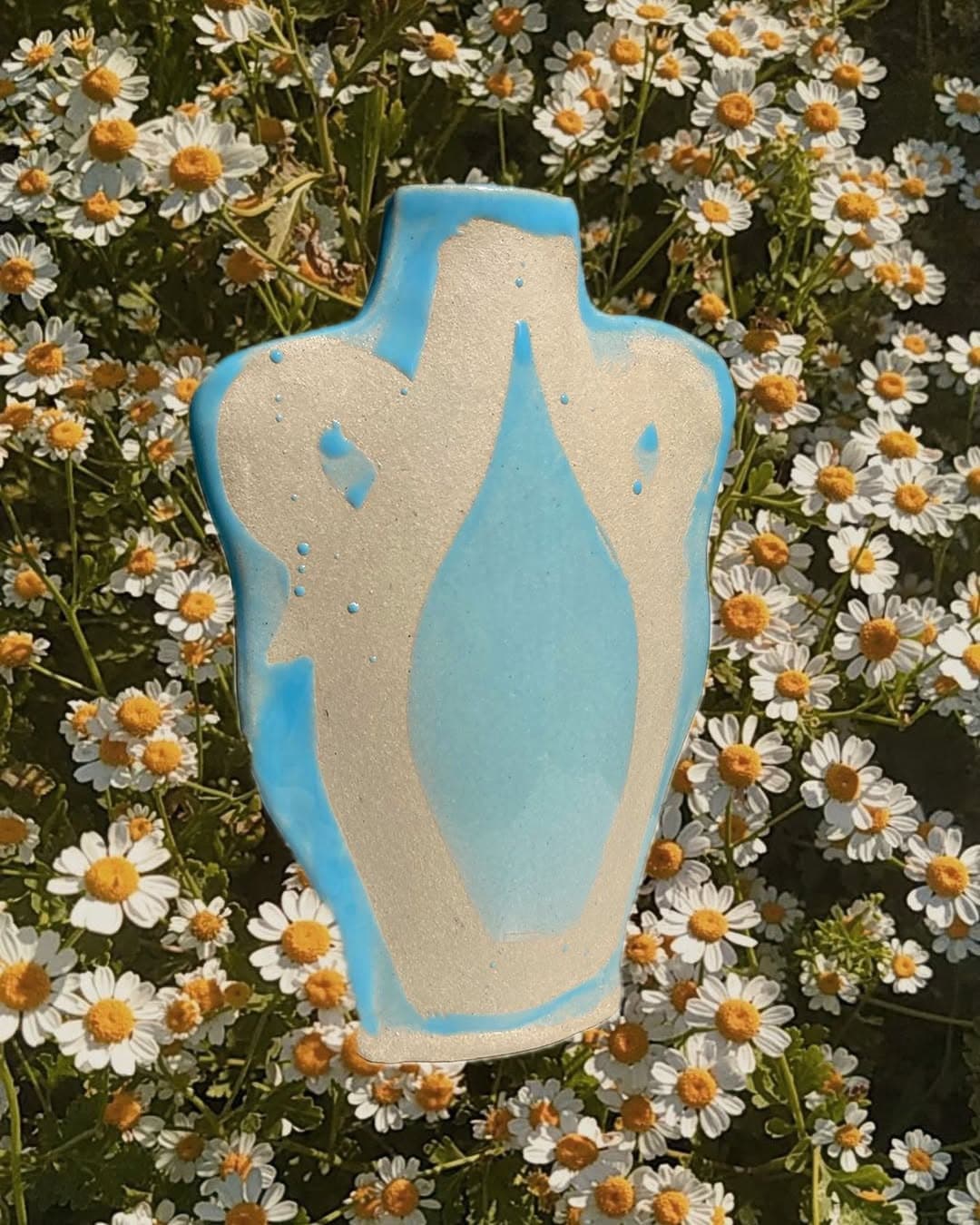
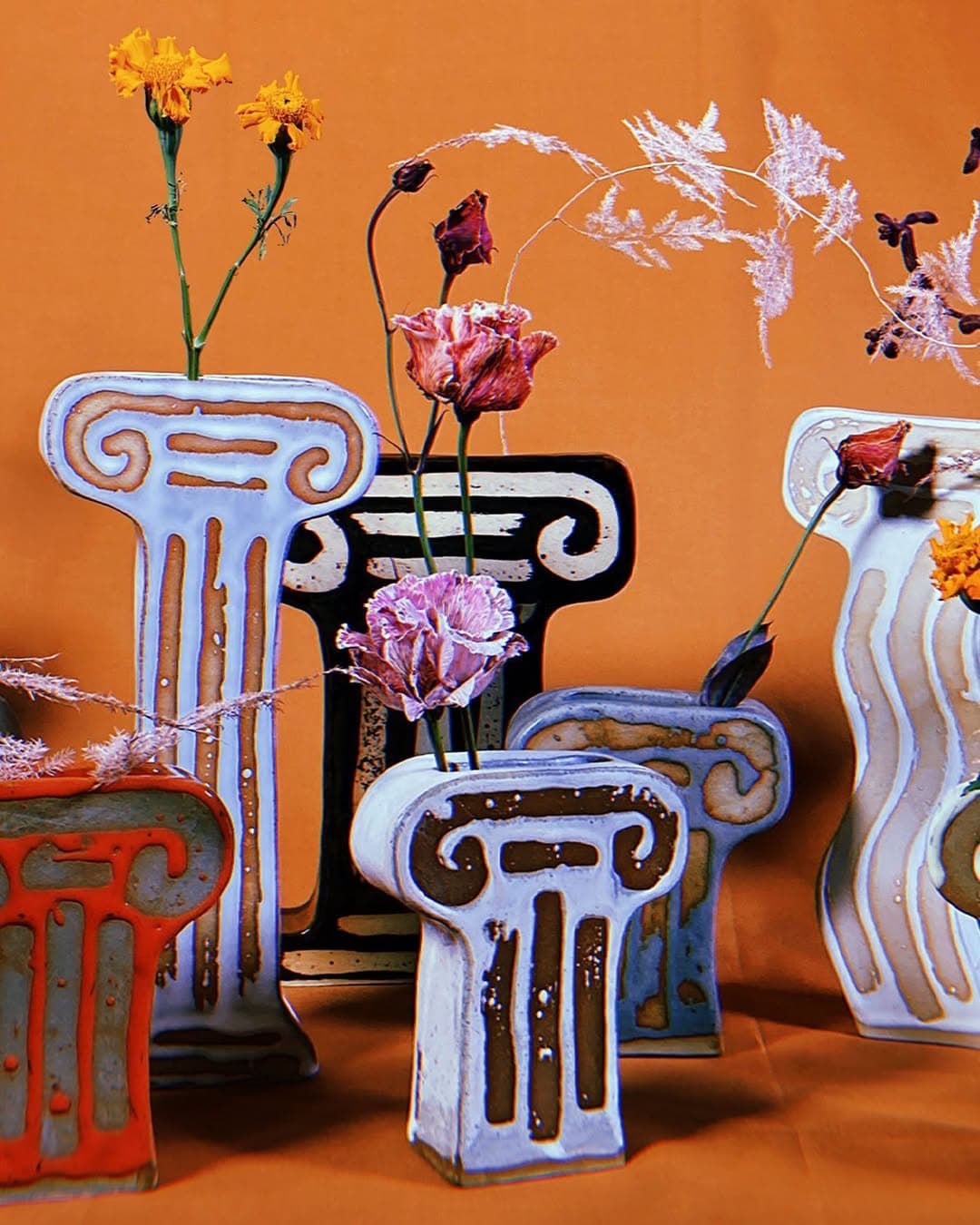
My classic vase, I call ‘Vase Vase’, as I draw the line of the vase shape onto the vase to bring out its silhouette. This is a shape I have been making for over 10 years and came from my interest in ancient Greek artifacts, the amphora vase.
Creative process
5. What does a typical day in your studio or workshop look like?
Like most crafts it’s a very slow process, I start by prepping the clay, rolling it out, and letting it stiffen up a little, then I will choose one of my template patterns to cut all the pieces out before constructing. I will have a few different designs on the go at the same time, all at different stages, so whilst one is drying, I can build another, or work on glazing. You can never have too many hands in a ceramic studio.
6. Do you have any unique rituals or habits that help you stay creative?
Not so unique but a good old fashioned sketchbook is always in my bag, I maybe do not sketch in them as much as I would like to, but full of notes and lists that consists of ideas, diagrams and to do’s.
7. How do you handle creative blocks? Do you have any strategies or tips for overcoming them?
When I’m coming up with new designs, I like to work in silence, sketching and making notes, I find with no distractions the hours pass by so quickly – plus snacks and coffee!
Also just playing, not having any idea what the outcome might be, but testing, practicing, seeing what works, and you never know what is going to come out of a ball of clay.
Challenges and successes
8. What’s the biggest challenge you’ve faced as a maker, and how did you overcome it?
Time – This is ongoing but i’m trying to manage it by giving myself deadlines and planning in my calendar day by day what I need to tick off.
Underselling your craft – Again this is something ongoing, trying to make sure I sell my work at its true value, taking into consideration all of the hours that has gone into making it and all materials and bills.
Cost of your craft – I think for most creatives its always challenging financially, being able to cover your cost of studio rent, materials, etc… This is something I think we always have to keep a close eye on, but its just about trying to keep ontop of it all and believing in myself.
9. What’s been your proudest moment or achievement so far?
It’s always special working on commissions or projects and seeing the final pieces in homes, stores, shoots and magazines, once everything has come together.
Inspiration
10. Where do you draw inspiration from for your work? What sparks your imagination and creativity?
I love traveling and visiting different museums and galleries, but mostly I love seeing people’s homes and work spaces, what they have, and how they use spaces and objects.
When I’m at home I look through lots of artist, interior, design and history books, then it is lots of doodling and notes. But i’m constantly looking for inspiration, theres nothing better than a wander and getting lost around London to spark ideas and my imagination.
11. Do you have a favourite artist, maker, movement, or tradition that has influenced your craft?
Theres a lot but theses are some of my favourites: Henri Rousseau’s paintings, Charles & Ray Eames home and designs, the community of Gees Bend and their quilts
12. How does colour influence your practice; is it an important part of your process? Do you have a particular palette or favourites? Any go-to sources for colour inspiration?
I do love a primary red, but then I tend to use more earthy tones such as the natural colour of the toasted sandy stonewear clay or deep earthy orangy red of terracotta clay.
This also depends on how the glazes I mix react, its always a guessing game and a surprise, and I find it hard to get the same glaze to look the same in each firing, but that is the fun of it and means no two pieces are the same.
As I mentioned above, I love the colours in Rousseau paintings, The Dream being my favourite.
Perspectives and goals
13. What role does your environment play in shaping your creativity?
Living in London everything is very fast-paced, I work for a textile designer in the day, then any evening or weekend I try to get into the studio. My studio is not only there to make my work, but there to make work and wind down, and switch off at the same time. I find working with clay very cathartic, the hours pass so quickly and I’m in my own little world.
14. What do you want people to feel when they experience your work?
I want them to smile and feel happy when looking at or handling work, and if it is something they own, to cherish and use forever and hopefully pass on
15. What are you currently working on, and what excites you most about it?
I would like to make more dinnerware, so currently making a set of plates for our home.
I am also excited to spend some time on developing my vases and working on new designs
Advice and reflection
16. What advice would you give to someone starting out as a maker?
Go for it, try and spend as much time as possible on your work so you feel really happy and confident with your outcome
17. If you could go back to the start of your career, what advice would you give your younger self?
Say yes to opportunities, don’t worry (about the money side), believe in yourself and go for it !
Closing thoughts
18. If you could collaborate with any artist, past or present, who would it be and why?
I think it would be really fun to collaborate on some kind of homeware with Ray Eames, I love her playful approach to design, colour, and materiality, especially her products aimed more so at children. Also just to have been able to hang out in their home and studio would have been a dream.
19. Where can people find your work, and how can they support you?
At the moment please message me through Instagram or email and I can send you my available stock list, but also if you are interested in orders and commissions, including my textile work
Lizzie Scarlett Towndrow’s ceramics are rich with quiet stories, playful yet poetic pieces that honour both the past and the present. Balancing function with feeling, her work celebrates the handmade as a form of preservation: of knowledge, of joy, and of small, everyday rituals. With each unique object, Lizzie invites us to see domestic spaces as places of memory, creativity and care.
Explore Lizzie’s latest collection and follow her creative journey:
Support Lizzie by exploring her playful, memory-infused ceramics, discovering hand-built pieces that blend function with storytelling, and following her creative journey as she reimagines everyday objects through humour, history, and heart.
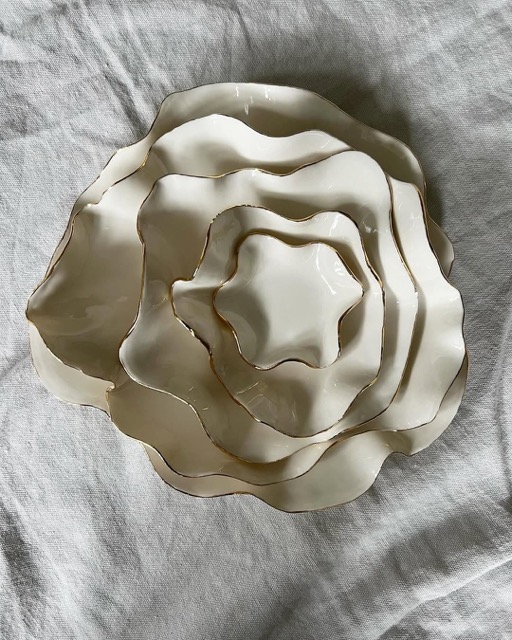
Meet the Maker: Joanna Ling and the Art of Considered Ceramics
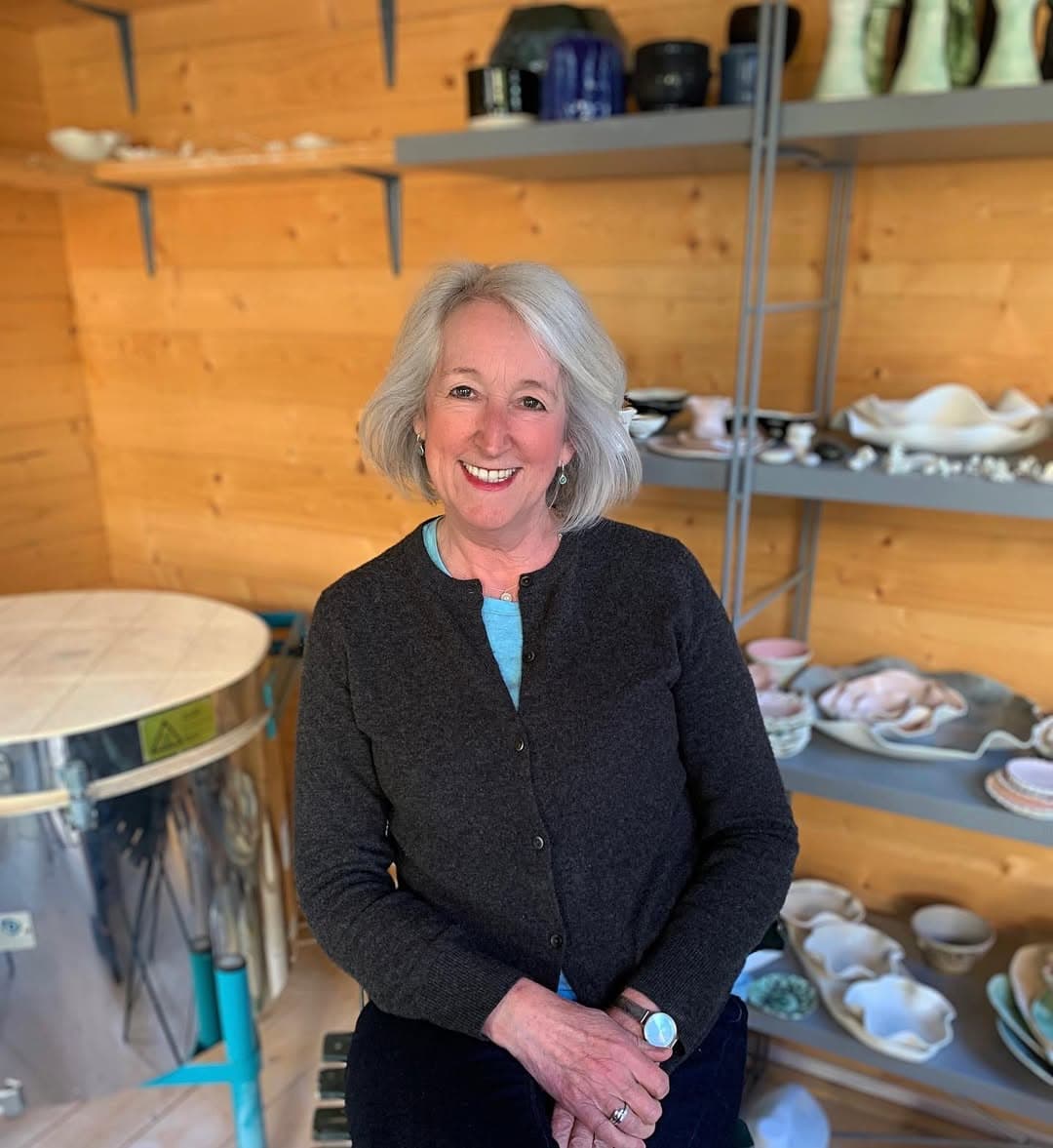
In this Q&A, we speak with Joanna Ling about the quiet elegance of her ceramic practice shaped by the English countryside and a considered approach to design. Joanna Ling explores how minimalism and meaning come together in each handmade piece, drawing on the gentle forms of fields, woods, and the spaces her work is destined for.
She shares her thoughts on the beauty of one-of-a-kind objects in a world of mass production, the satisfaction of working on bespoke commissions, and the role sustainability plays in her process, from brush-on glazes to careful material reuse.
With a client list that includes Matches Fashion, the National Portrait Gallery, and The Newt in Somerset, Joanna Ling’s ceramics resonate with those who appreciate thoughtful craft and timeless design.

1. Can you tell us a bit about yourself and your artistic journey?
I design and make – mainly porcelain – ceramics from my garden studio. I worked at Sotheby’s for over 30 years and while I was there I did a ceramics evening class. I was immediately smitten and when I left Sotheby’s in 2018 I set up my ceramics business. It has been an incredibly rewarding journey since then!
2. What inspired you to pursue your craft? Was there a defining moment or influence that sparked your passion?
I have always been fascinated by ceramics. Soon after I started my ceramics evening class, I entered a porcelain bowl in the Sotheby’s annual staff exhibition which was, to my great surprise, bought by the chairman and other pieces were commissioned by a high level Sotheby’s client. This gave me the boost to start making ceramics commercially.
Your craft
3. How would you describe your work in three words?
Contemporary, unique, functional
4. What materials or techniques do you use, and why are they important to your process?
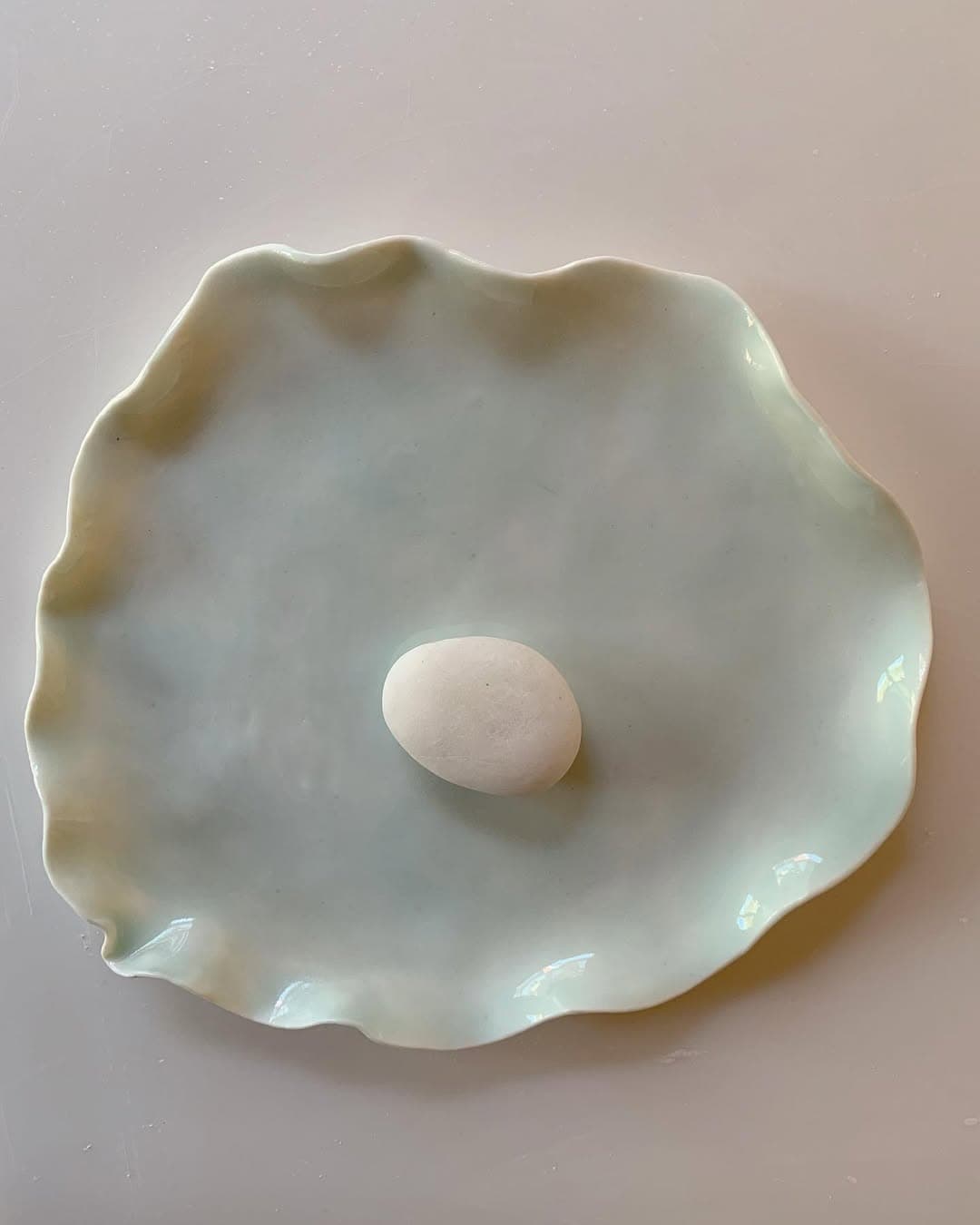
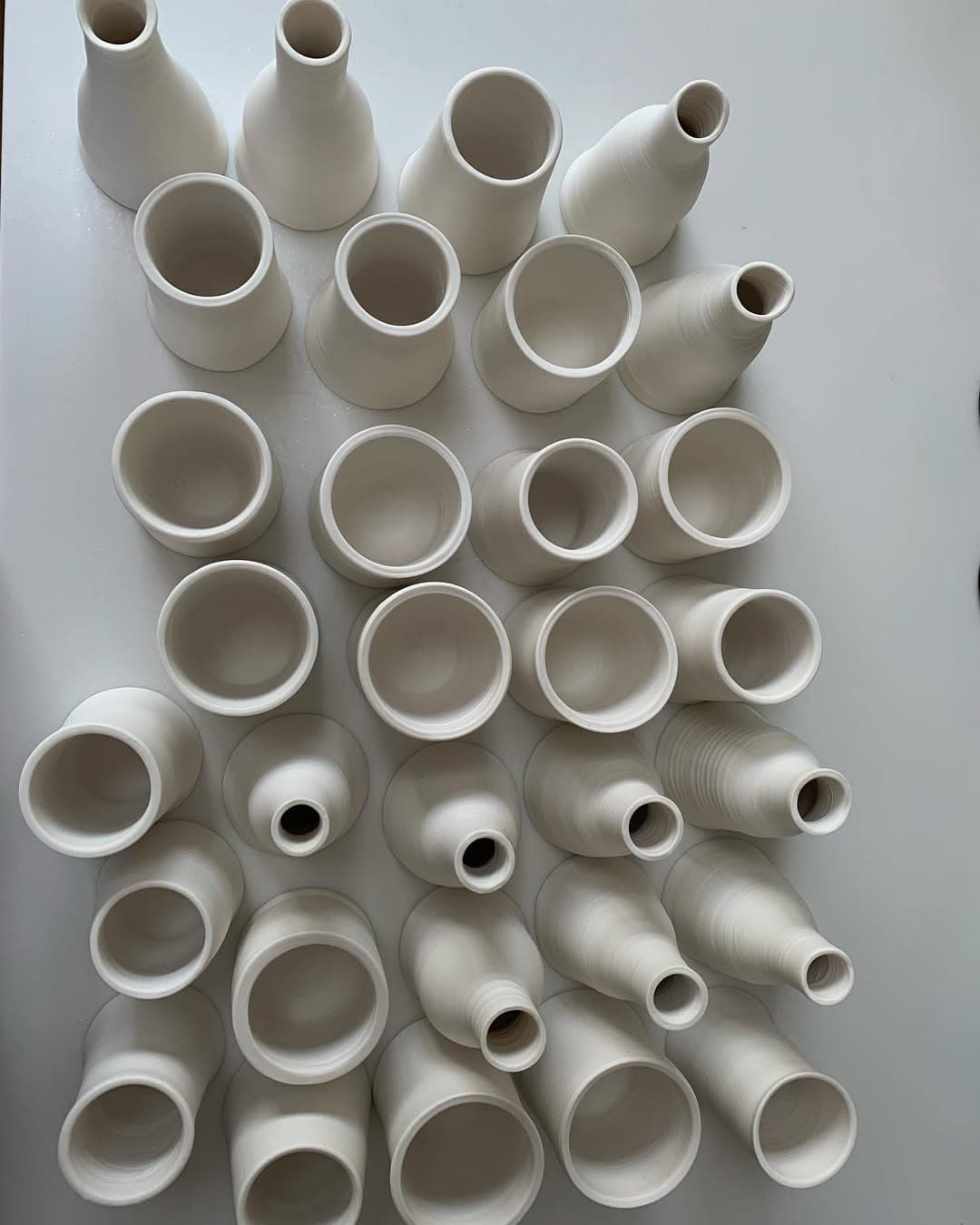
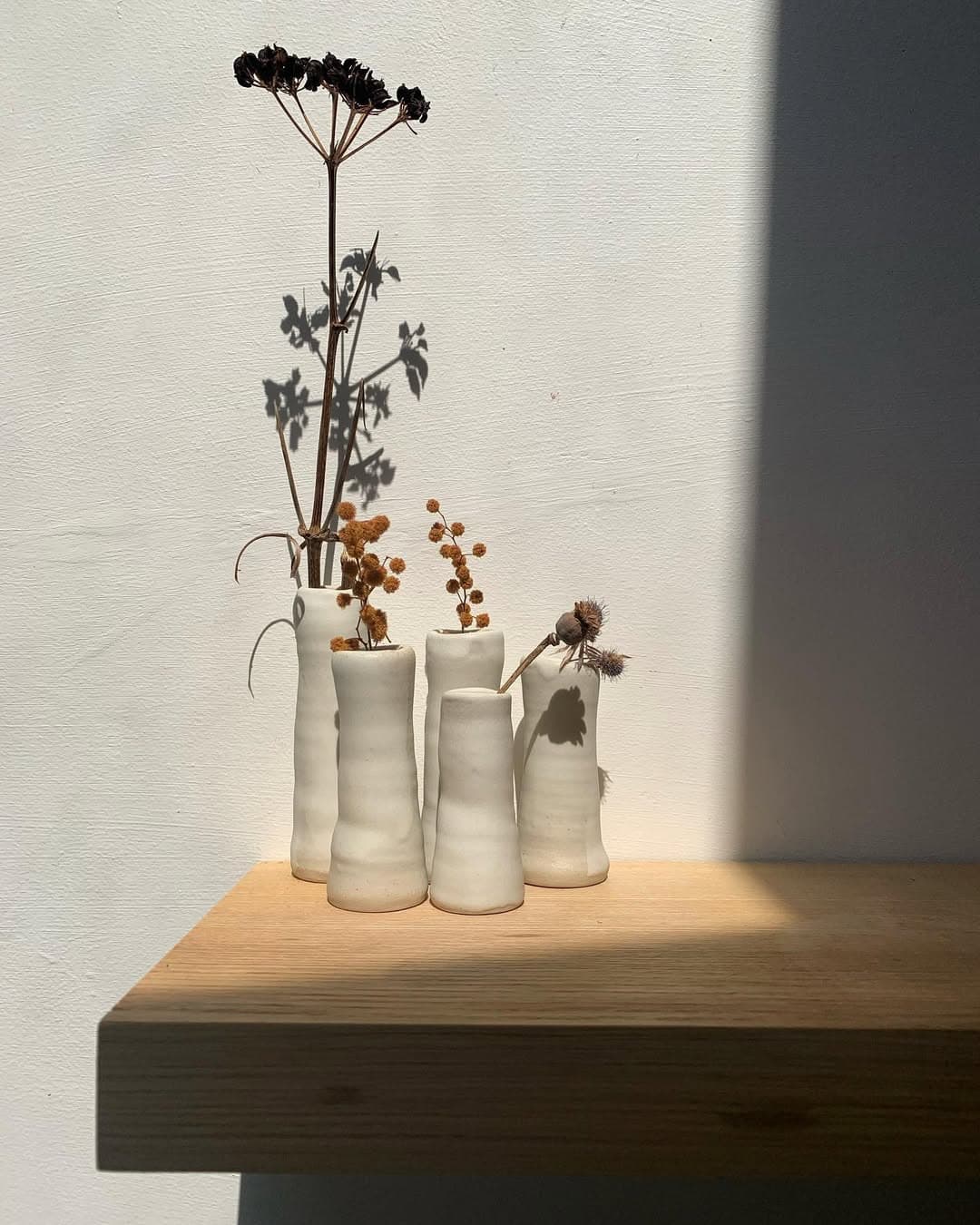
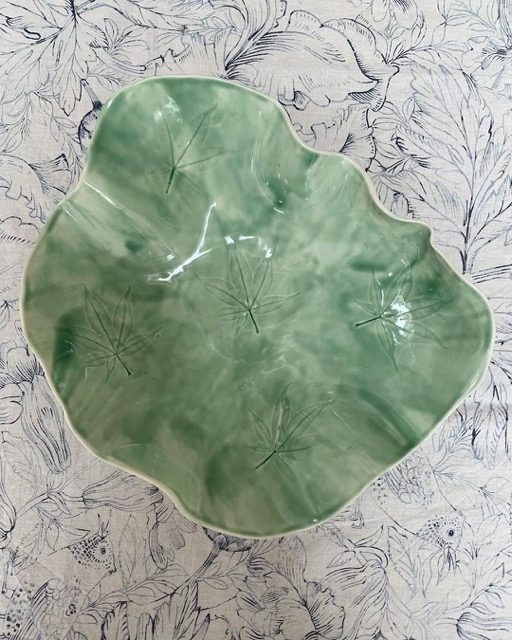
I work almost exclusively with porcelain because although it is a difficult clay to work with I love its delicacy and translucency once it has been fired. I normally use a transparent glaze to accentuate these qualities.
I either hand build or throw on the wheel or a combination of the two. As I make everything individually, no two pieces are the same, so when you buy from me you know that you have a unique work. In a bid for sustainability, I raw glaze my work with brush-on glazes and recycle wherever possible.
5. Can you tell us about a favourite piece you’ve created and the story behind it?
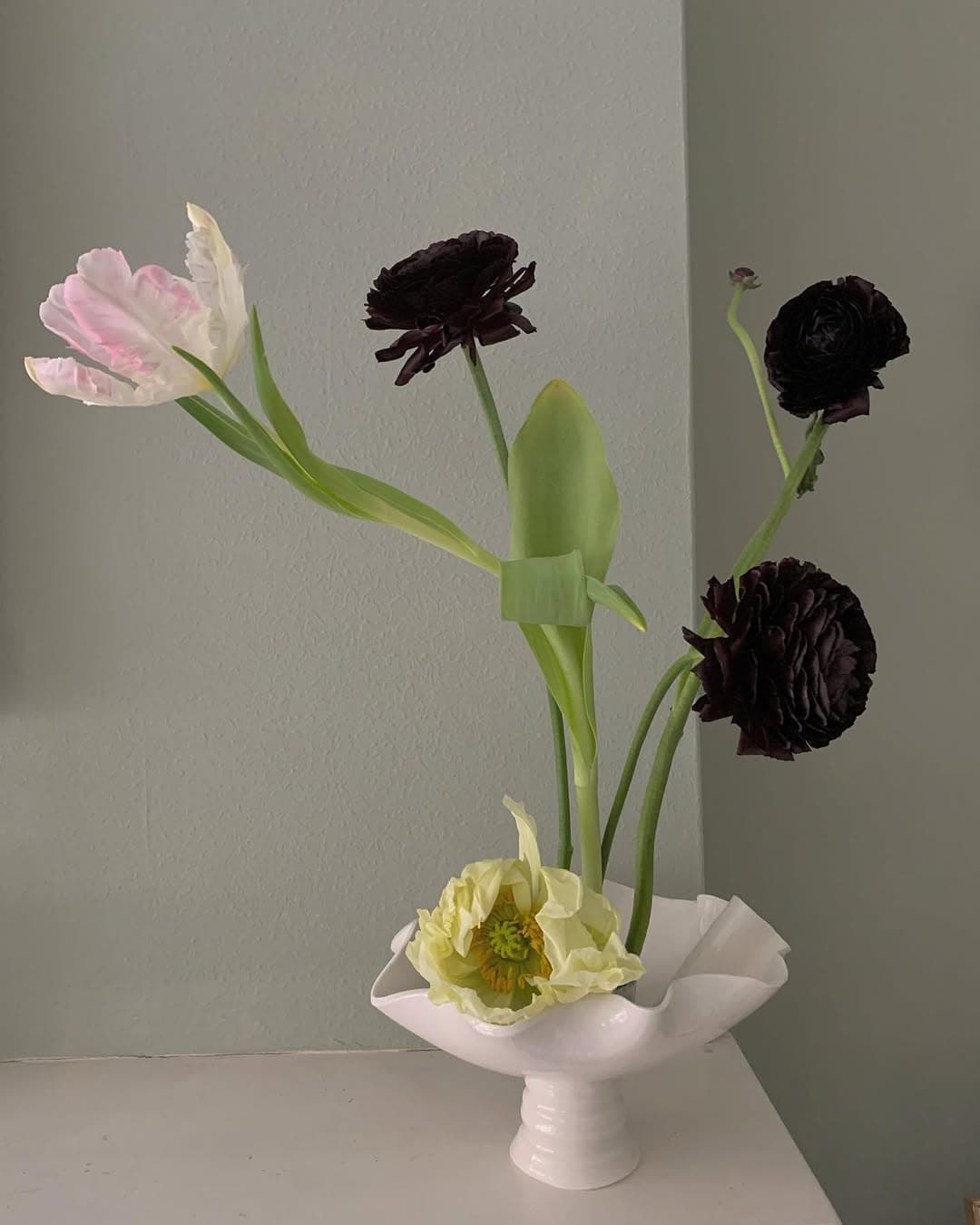
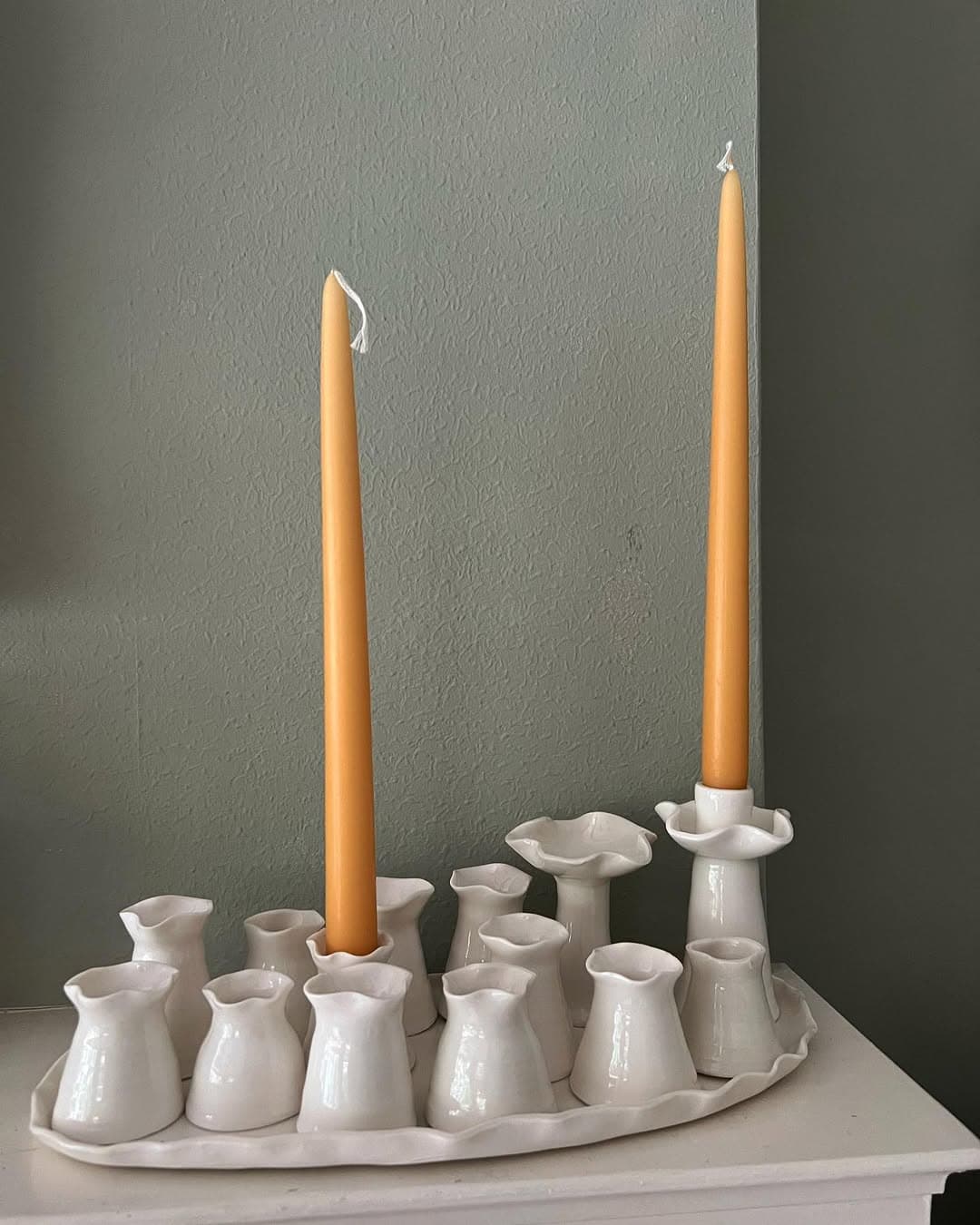
I have been making wave top pedestal bowls for many years and they are one of my most popular designs. I suddenly had an idea to make a vase version of it which I did last year and I love it because it works well with all my other designs but serves a different function, can be styled in so many ways and makes a great table centrepiece. I have now experimented with different sizes and heights so that they can be used for a single stem or an extravagant arrangement.
Creative process
6. What does a typical day in your studio or workshop look like?
All my days are different. Most of the time I am working on orders which means throwing on the wheel in my studio or hand building, often in my kitchen. Other days are glazing days and as with any business a lot of time is spent on admin.
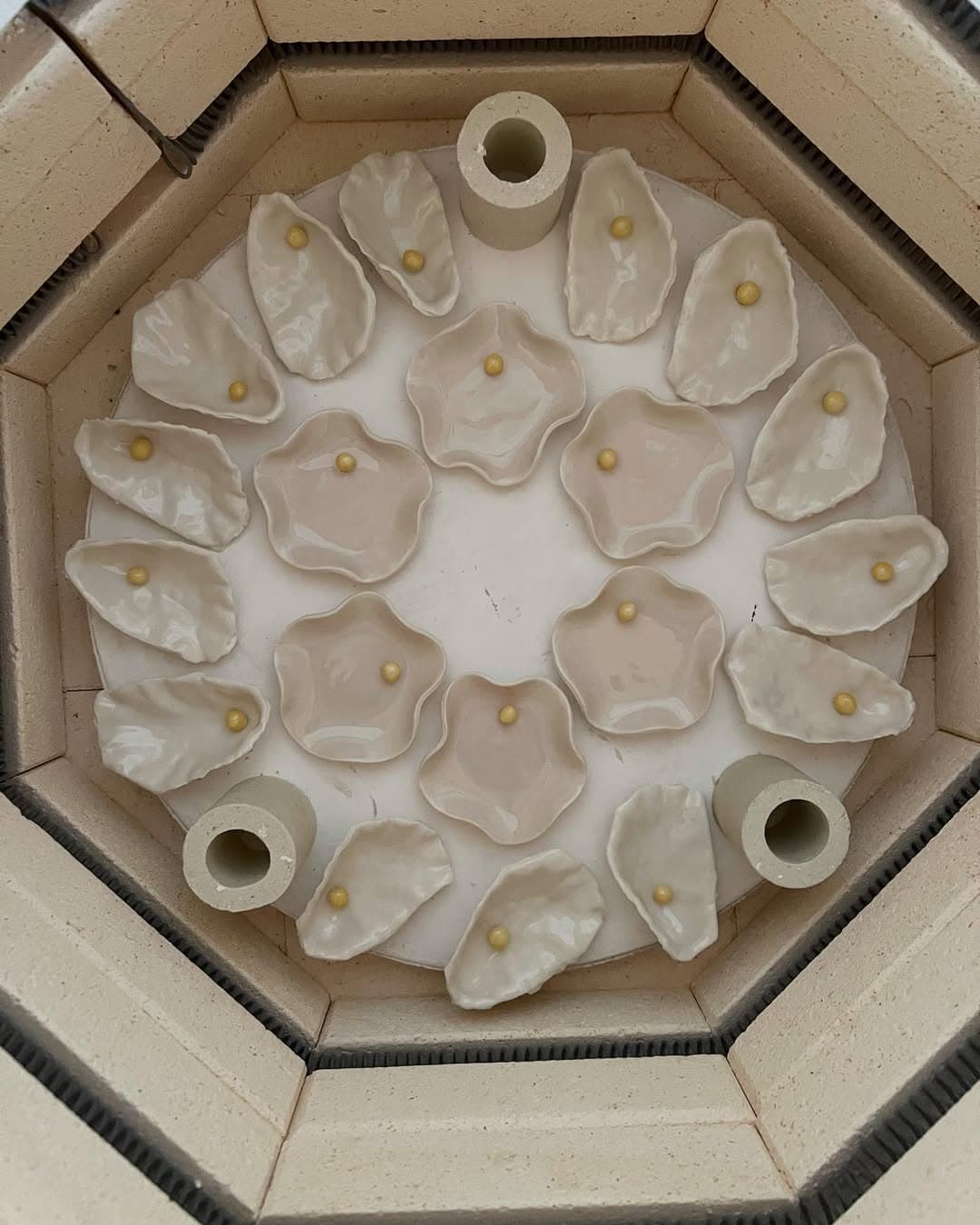
Days when I open my kiln to discover how everything has come out are always exciting. If I have set off a lustre firing it is usually a joy to open to see the gold or silver highlighting the porcelain.
7. Do you have any unique rituals or habits that help you stay creative?
I always have my notebook with me should inspiration strike. My work is very much influenced by nature and I walk in Richmond Park most days and often come up with new ideas whilst there. I am an art historian by training and one of my great pleasures is visiting exhibitions and often I will see something, be it a colour, a design on a frame or ceramic piece in a painting that can lead to thoughts for new designs.
8. How do you handle creative blocks? Do you have any strategies or tips for overcoming them?
I am usually busy working on commissions which doesn’t leave me much time to work on new designs but I find when I have a quieter patch that is when I have time to think and plan and get motivated about new work. I have accepted, after several years of running a business, that work and creativity ebbs and flows and that is ok.
Challenges and successes
9. What’s the biggest challenge you’ve faced as a maker, and how did you overcome it?
The solitary nature of being a maker. Being part of Makers Made is a brilliant antidote to that. It’s great to be part of a supportive network and to be able to run ideas and problems past people who are in the same situation. I have also recently joined a couple of local artists groups which are similarly rewarding.
10. What’s been your proudest moment or achievement so far?
It’s always a thrill to be commissioned by a well known brand or establishment but I think my proudest moment was having my work stocked in the shop at The National Portrait Gallery to accompany a major Cecil Beaton show there. I ran the Beaton Archive at Sotheby’s for over 20 years and had a curatorial role in the show so to be involved with both my old and new career hats on was an amazing experience.
11. What’s your favourite quote you’ve ever heard about your work? Who said it, or what was the name of the publication?
“I instantly loved your work when I first saw it - the delicacy, subtle tones, glazes and quirky shapes.”
- Birdie Fortescue
Inspiration
12. Where do you draw inspiration from for your work? What sparks your imagination and creativity?
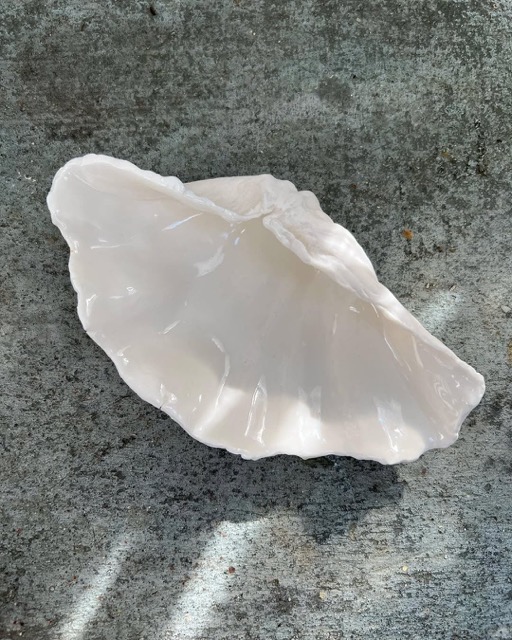
The natural world – especially flowers and shells – and working on the Cecil Beaton archive has definitely had an influence on my work. He had such an amazing eye for design.
13. Do you have a favourite artist, maker, movement, or tradition that has influenced your craft?
The ceramics of Lucie Rie, paintings by Giorgio Morandi and the pared back aesthetics of Japan.
14. How does colour influence your practice; is it an important part of your process? Do you have a particular palette or favourites? Any go-to sources for colour inspiration?
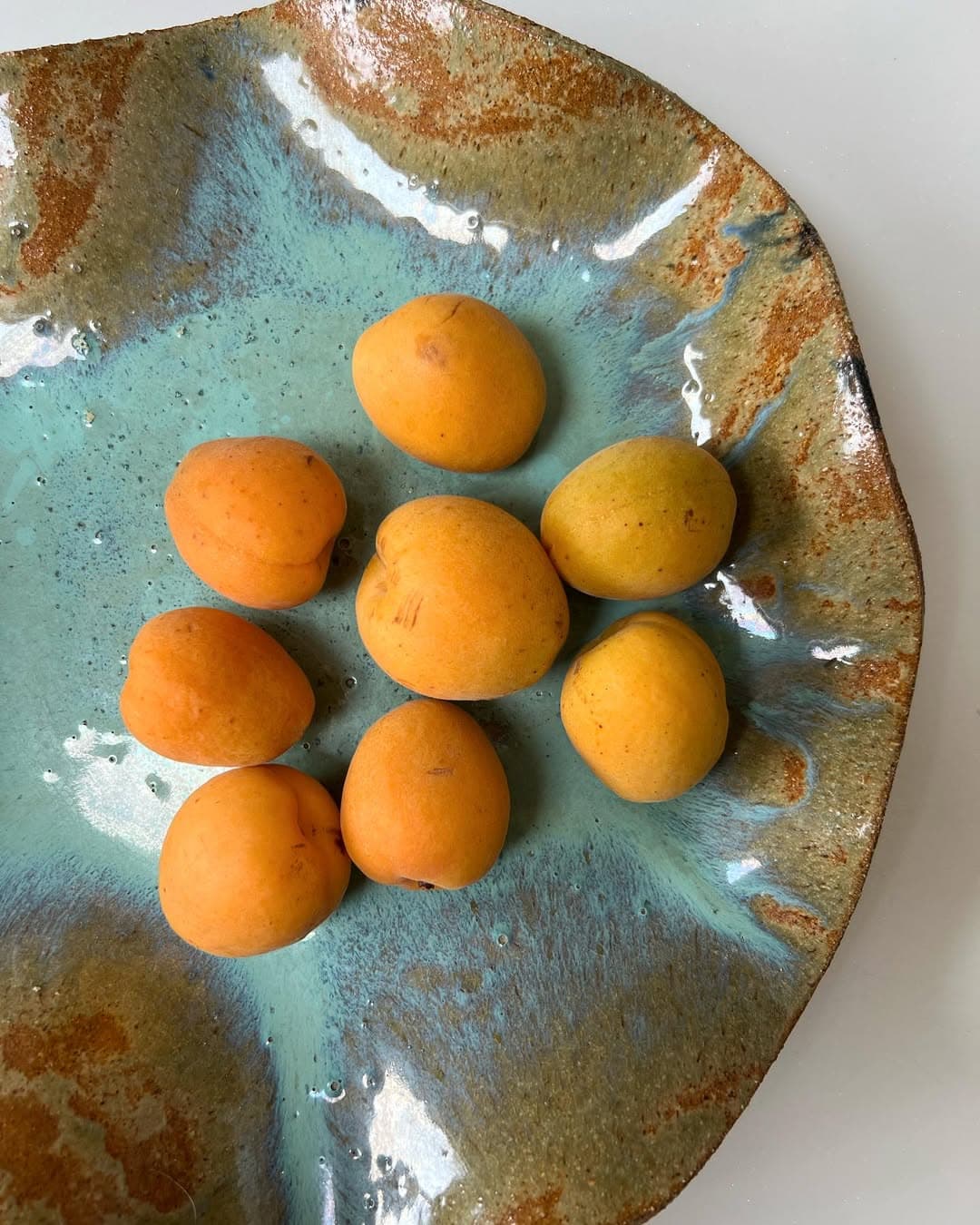
Decoration is usually in the form of my ceramics and leaving them unglazed or with a transparent glaze brings out the inherent qualities in the porcelain clay. I sometimes use green, blue and pink glazes and love a bit of gold lustre to add a highlight to a piece.
Perspectives and goals
15. What role does your environment play in shaping your creativity?
A huge role. I am lucky enough to have my own studio in my garden. It is simple and functional but surrounded by greenery. It is a peaceful and soothing creative space.
16. What do you want people to feel when they experience your work?
That they are seeing something that is aesthetically pleasing but also functional and that they will enjoy it for a long time.
17. What are you currently working on, and what excites you most about it?
I was recently commissioned to make vases to go on each table in The Glade Bar at Sketch in London. I love making bespoke pieces for a particular place so this was perfect, particularly as it is such an amazing place!
Advice and reflection
18. What advice would you give to someone starting out as a maker?
Just go for it! If it is the right thing for you it will work and give you great pleasure and satisfaction. Don’t be afraid to approach stockists or galleries you would like to work with.
19. If you could go back to the start of your career, what advice would you give your younger self?
That things work out as they should. Don’t feel you have to stay in a job if you want to start your own business. My second and fulfilling career came about after leaving a company I had worked for for over 30 years. It was scary but so worth it. Be brave.
Closing thoughts
20. If you could collaborate with any artist, past or present, who would it be and why?
Lucie Rie. I would have loved to work with her in her small studio in Albion Mews and learn how she produced such beautiful work. She was so ahead of her time and her work still looks so contemporary.
21. Where can people find your work, and how can they support you?
I have various UK stockists including The Muse at Estelle Manor, The Newt in Somerset, Thyme England and Glassette amongst others. You can also buy direct from me by contacting me through my website or through my Instagram account. I have an Open Studio in May and November each year where new work, seconds and samples are for sale.
Visitors are also welcome to my studio at other times, by appointment. It’s always lovely when people see where the work is made and can find one-off pieces that aren’t usually available.
Joanna Ling’s ceramics blend restraint, story, and intention, each piece echoing both the English countryside and the person or space it’s made for. In a fast-paced world, her practice offers a slower, more meaningful way of making, where uniqueness is celebrated and connection is at the heart of every commission.
Explore Joanna’s collections and find out more about her studio practice:
Support Joanna by visiting her website, exploring her delightful creations, and connecting with her vibrant community on Instagram.
Meet the Maker: Hodge Pots Approach to Conscious Clay
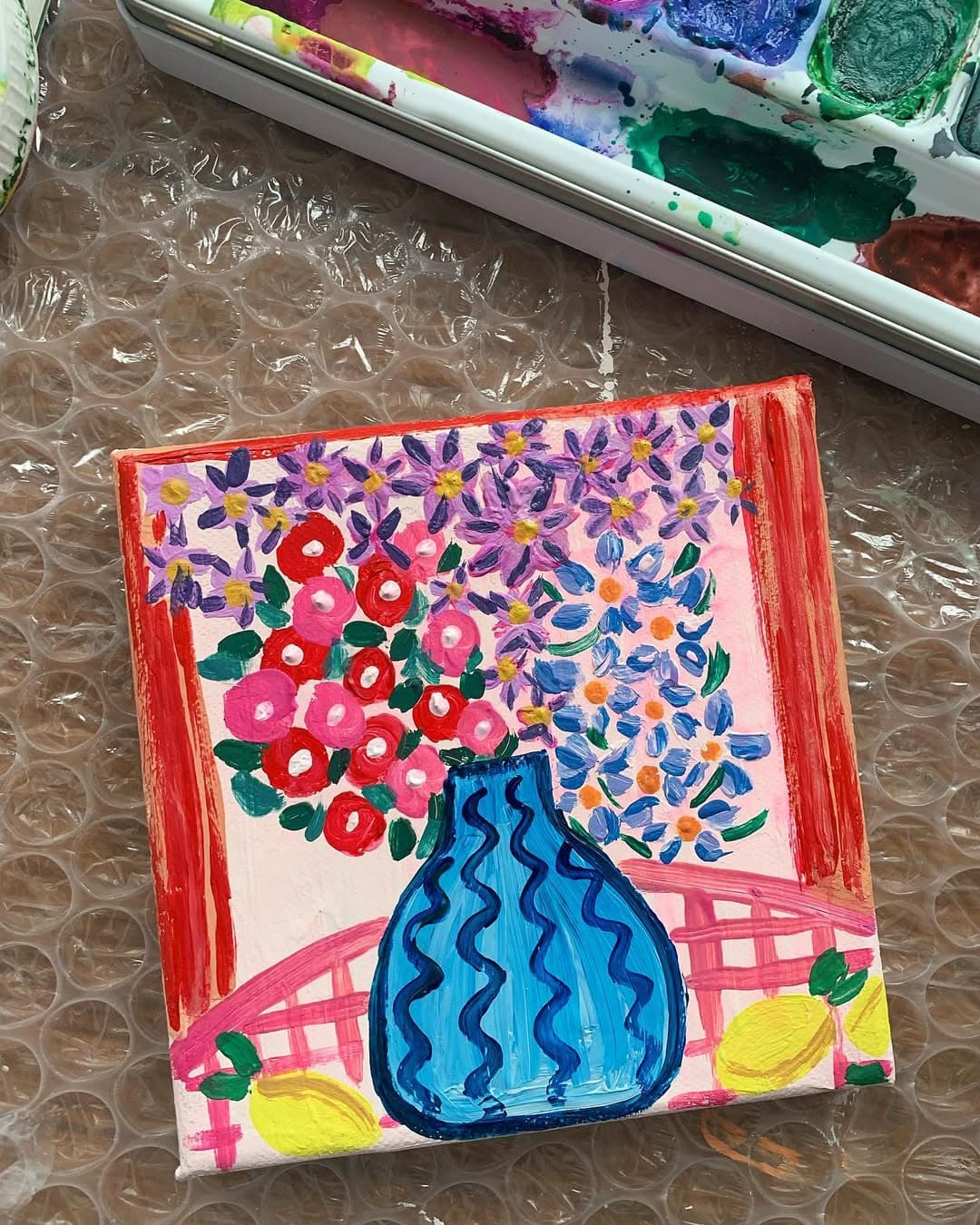
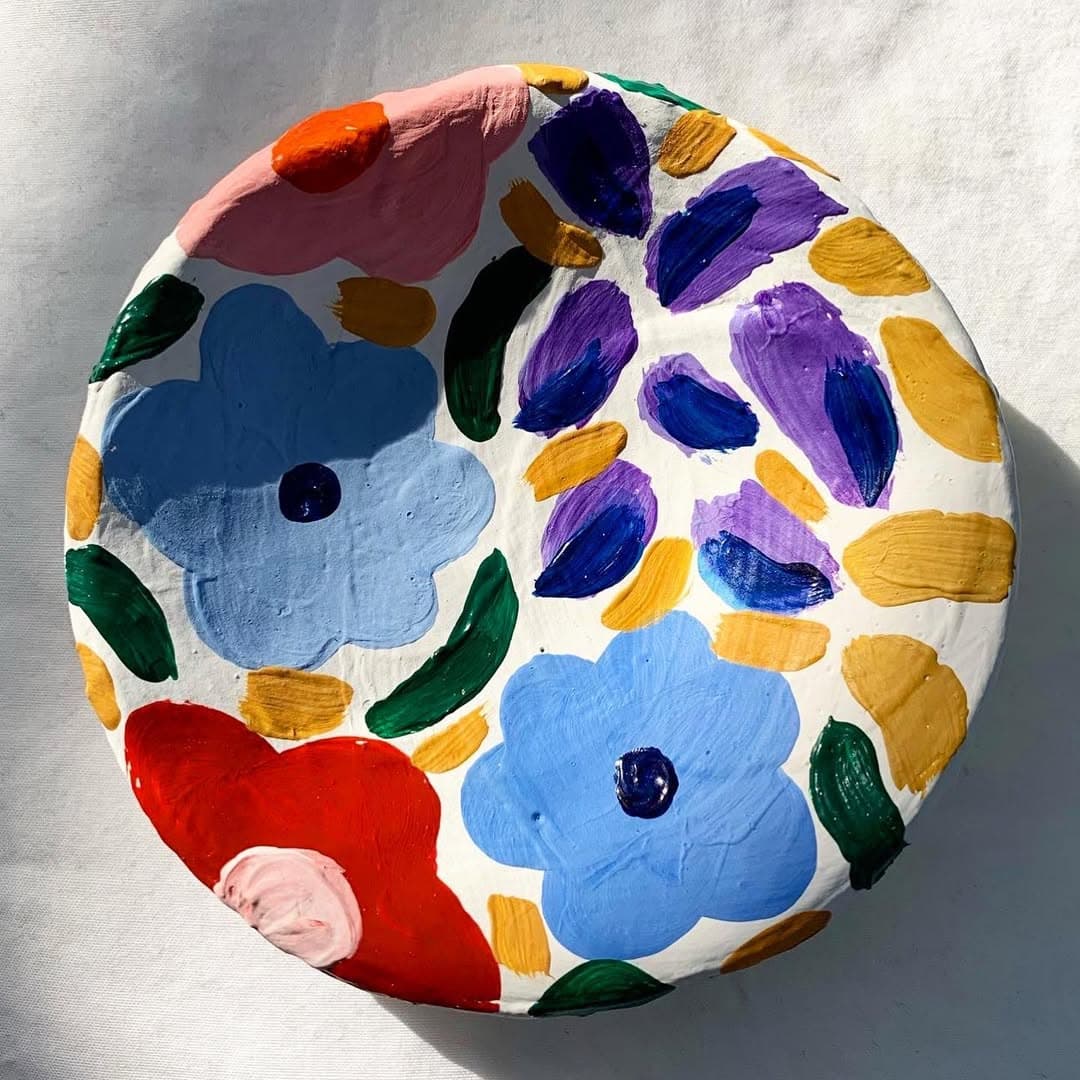
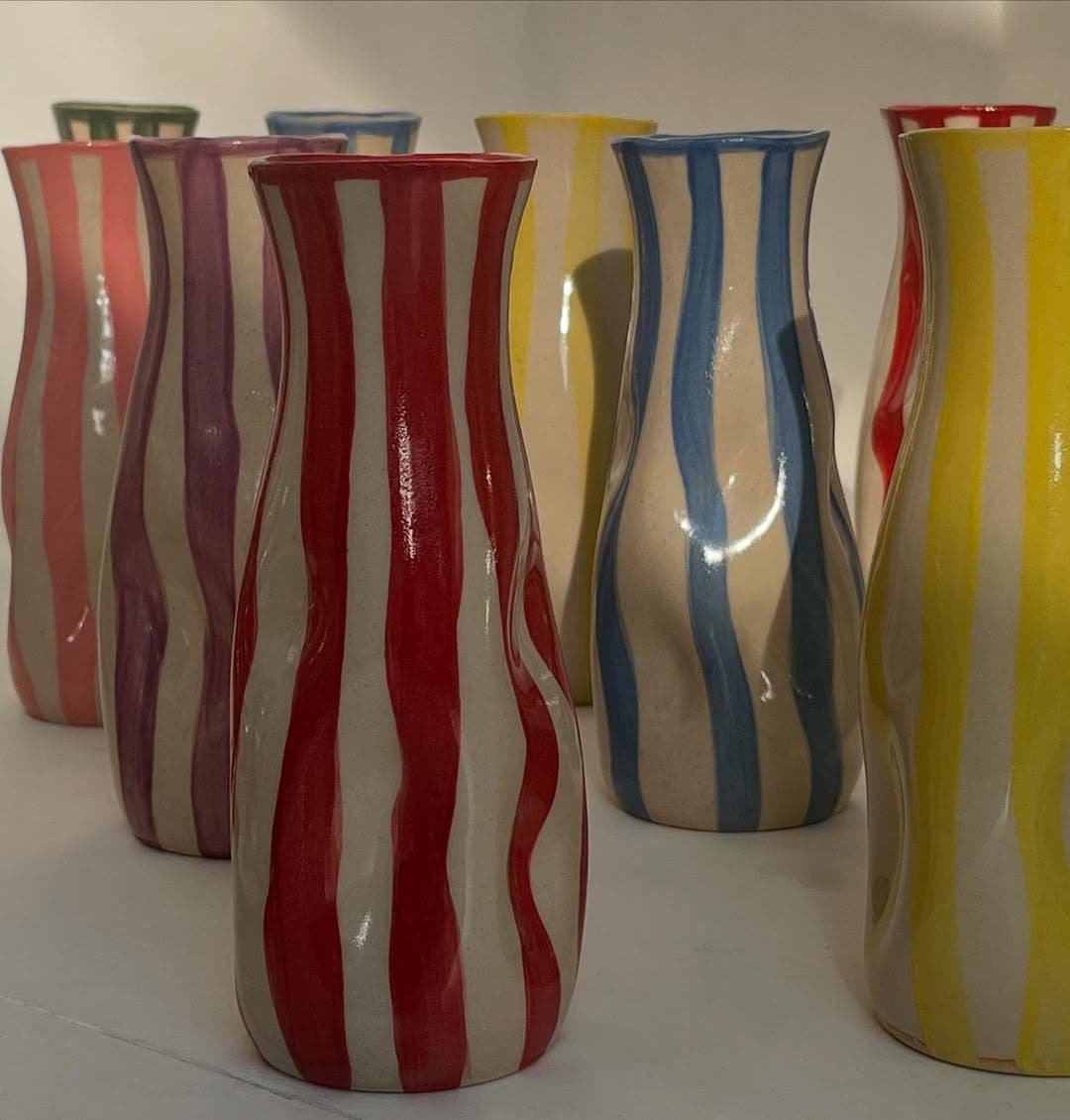
In this Q&A, we chat with Nikki Seymour, founder of Hodge Pots, about her journey into ceramics and the stories behind her joyful, hand-painted pieces. Nikki shares how travel, nature, and the buzz of North London inspire her designs, and opens up about the sustainable ethos at the heart of her practice. We delve into the rituals of her creative process, the challenges of building a small business rooted in craft, and the proud moments that keep her going, from studio milestones to seeing her pieces find homes near and far.
1. Can you tell us a bit about yourself and your artistic journey?
I’m Nikki, a North London-based artist with a background in fashion styling. For two decades, I worked with brands and luxury department stores like Selfridges and Harvey Nichols, styling shoots and curating window displays.
My journey with ceramics started unexpectedly during the pandemic. While on furlough, I needed a creative outlet and bought some clay, initially making pieces as gifts for friends and family. What started as a personal project quickly became something bigger—I fell in love with the process, and before I knew it, people were asking to buy my work. That’s when I realised I’d found something really special.
2. What inspired you to pursue your craft?
It all began with sharing my ceramics on Instagram—just as a way to document the process. But as more people started reaching out, asking if they could buy my pieces, I realised I had something worth pursuing.
Beyond that, working with clay is pure joy. It’s meditative, grounding, and offers a kind of creative freedom I hadn’t felt in years. Coming from the fashion world, where creativity is often shaped by external demands, ceramics gave me full control. There’s something really special about bringing an idea to life with your own hands, without anyone else’s say.
Your craft
3. How would you describe your work in three words?
Joyful, tactile, timeless.
4. What materials or techniques do you use, and why are they important to your process?
I hand-build all my pieces using stoneware clay. Sustainability matters to me, so I work with recycled clay that’s carefully processed by our studio technicians, ensuring nothing goes to waste.
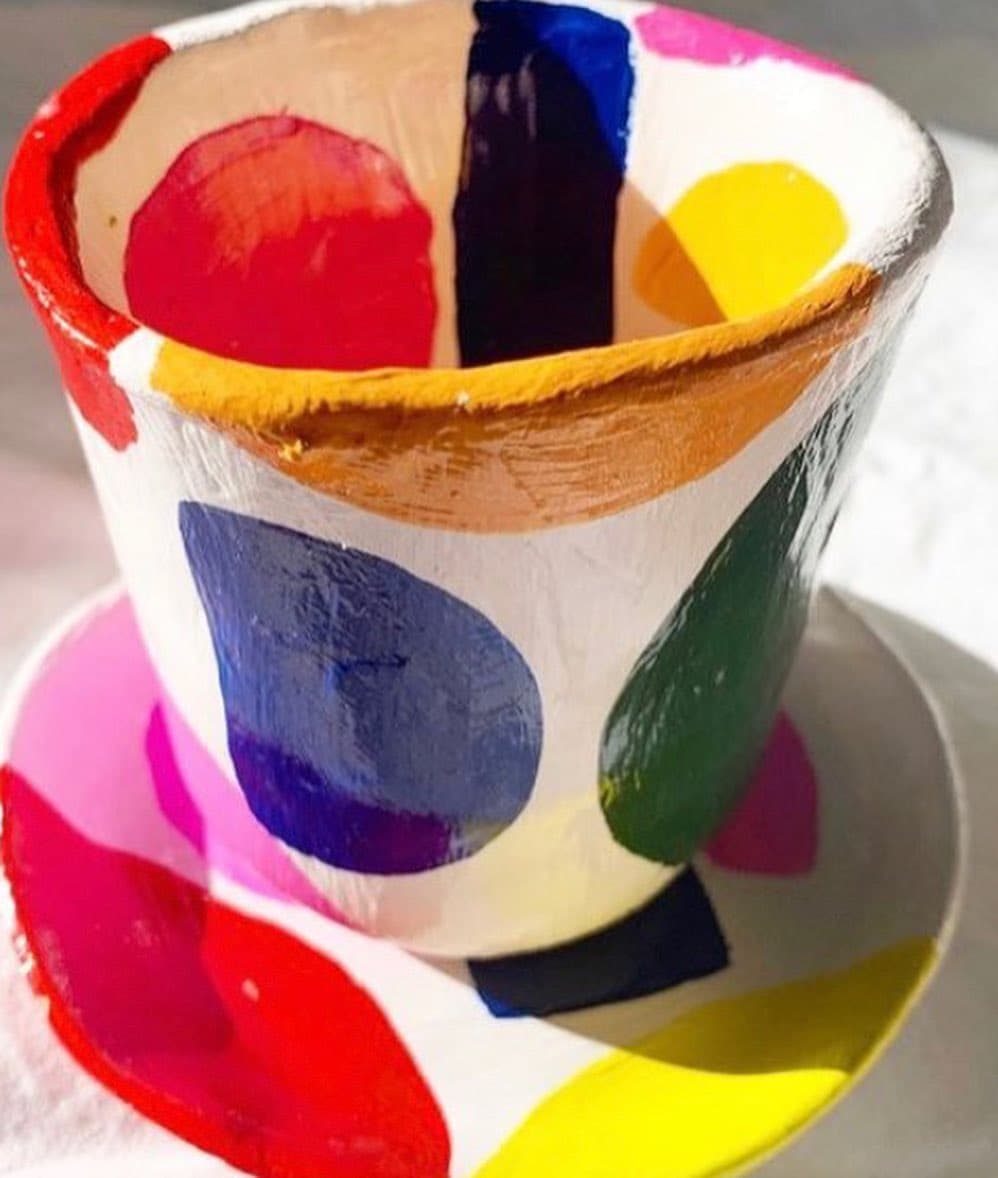
I primarily use coiling and slab-building techniques, which allow me to create organic, sculptural shapes. And then, of course, there’s the colour—bold, bright glazes are a signature of my work. I love the way they transform a piece, bringing warmth, energy, and personality to each one.
5. Can you tell us about a favourite piece you’ve created and the story behind it?
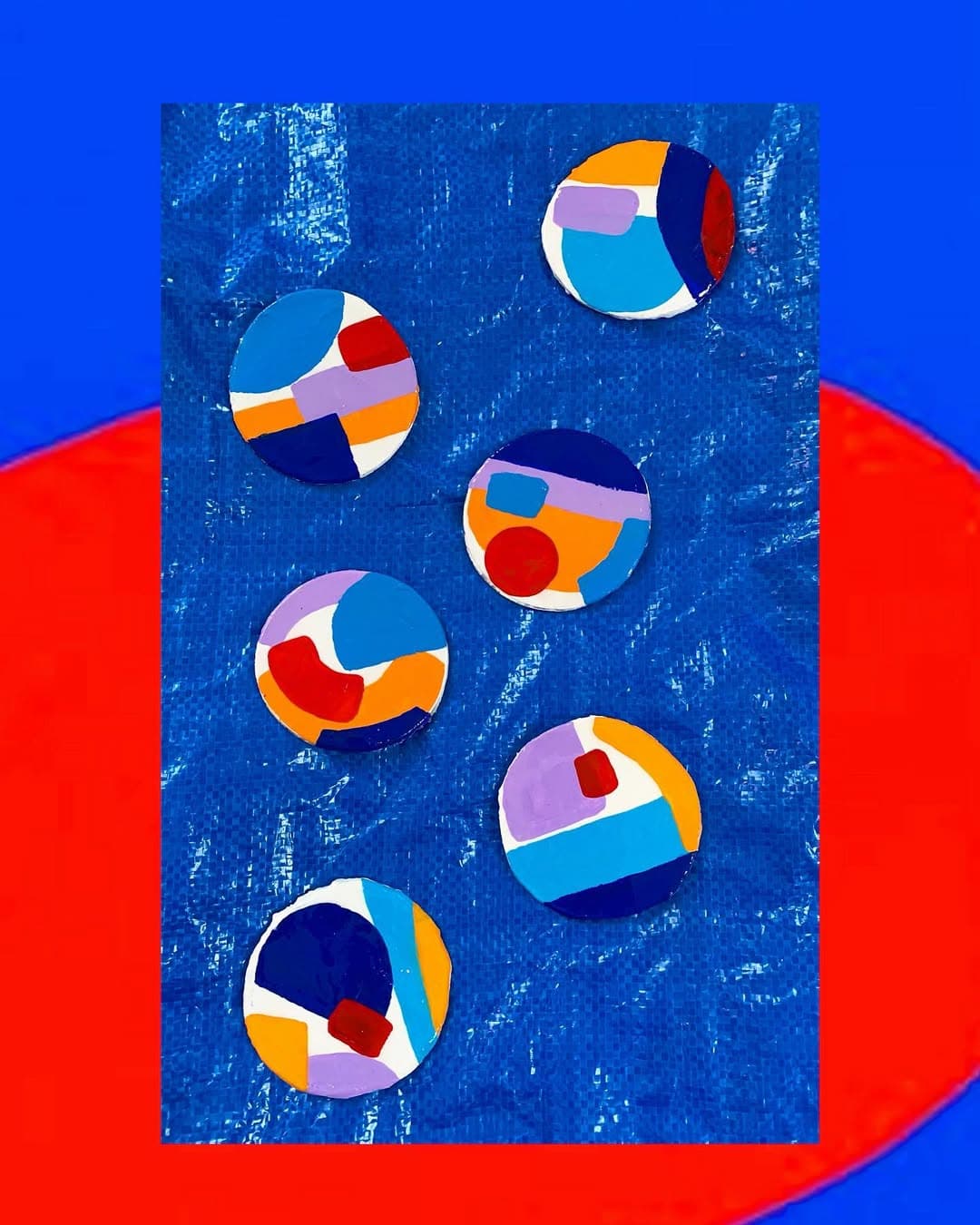
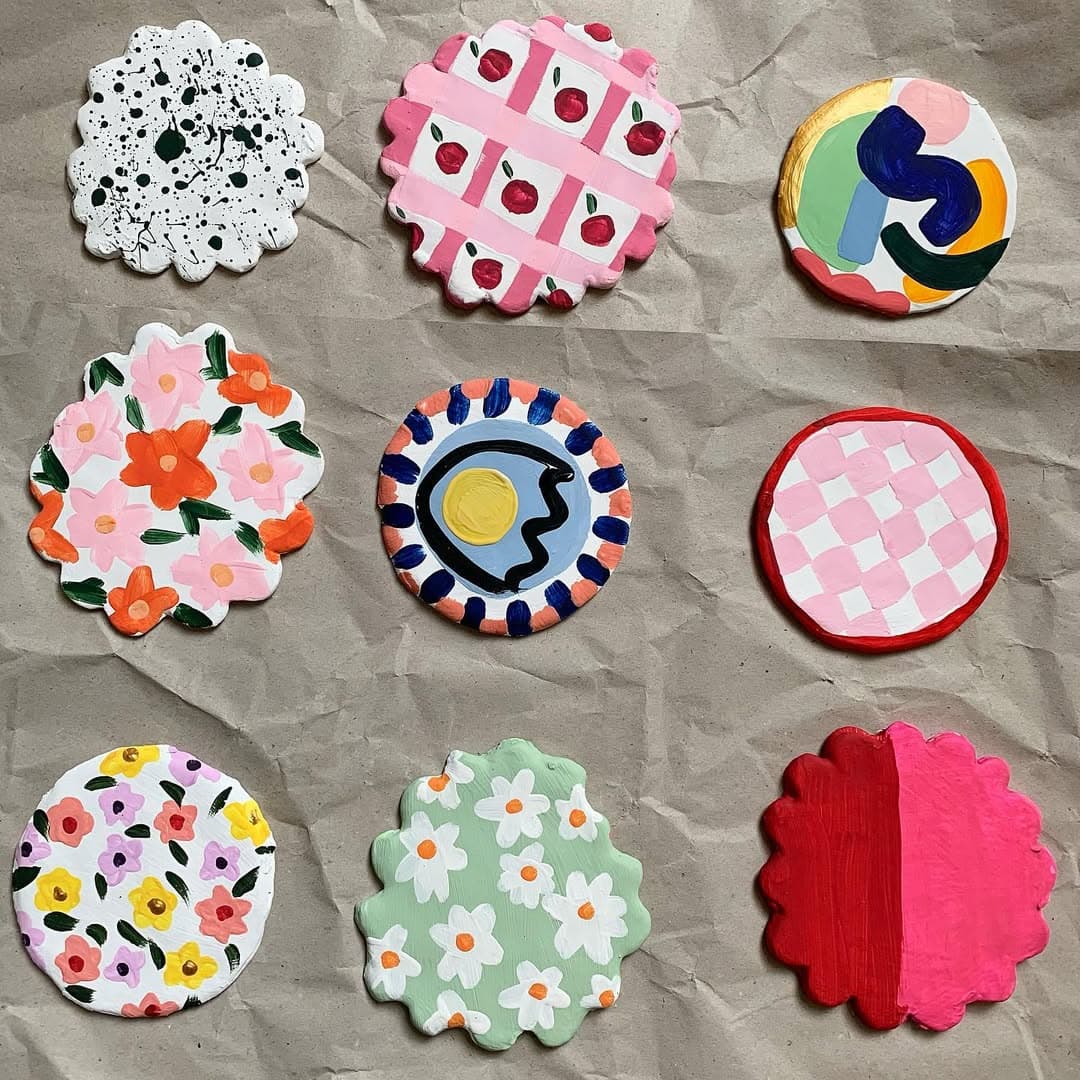
One of my favourites has to be the 200 ceramic coasters I made for my sister’s wedding. Each one was bespoke, stamped with the date on the back, and crafted with so much love. It was such a meaningful project—knowing that something I created would be part of such a special day made every moment in the studio feel even more rewarding.
Creative process
6. What does a typical day in your studio look like?
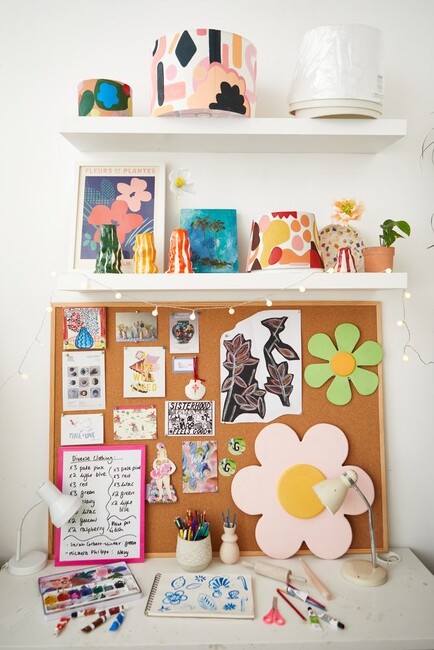
My day starts with Yorkshire tea and settling into my favourite spot at the studio—it’s my little ritual. Then, depending on what’s on my to-do list, I might spend the morning hand-building new pieces, painting pots, or glazing. There’s something really satisfying about seeing a piece come to life, layer by layer. The process is both calming and energising, and I’m at my happiest when I’m fully immersed in it.
7. Do you have any unique rituals or habits that help you stay creative?
I always start my studio days with a mug of Yorkshire tea and a bit of quiet time, just to settle in. But beyond that, nature is a big source of inspiration for me—whether it’s a walk in the woods, time by the sea, or just paying attention to textures and colours around me. And when I feel creatively stuck, I step away. A change of scenery—whether that’s a walk, an exhibition, or just a break—almost always sparks something new.
8. How do you handle creative blocks?
I’ve learned to trust the process. If I feel blocked, I don’t try to force it—I step away, do something different, and let my brain reset. Sometimes, revisiting old sketches or experimenting with a new technique helps. And if all else fails, I remind myself that creativity isn’t linear—some of my best ideas have come when I least expected them.
Challenges and successes
9. What’s the biggest challenge you’ve faced as a maker, and how did you overcome it?
Balancing creativity with the business side of things. As my work grew, I found myself juggling orders, logistics, and marketing—all things that can take you away from the creative process. I’ve had to learn to set boundaries, manage my time better, and accept that I can’t do everything at once. Having a strong support system—friends, fellow makers, and the amazing technicians at my studio—has helped me stay focused on what I love most: making.
10. What’s been your proudest moment or achievement so far?
Being asked to be a founding member of Makers Made was a big moment. The sense of community, especially among women makers, has been incredible. Seeing my work evolve over the years, gaining recognition, and being featured in the press—each milestone reminds me of how far I’ve come. It’s humbling, exciting, and always pushes me forward.
11. What’s your favourite quote about your work?
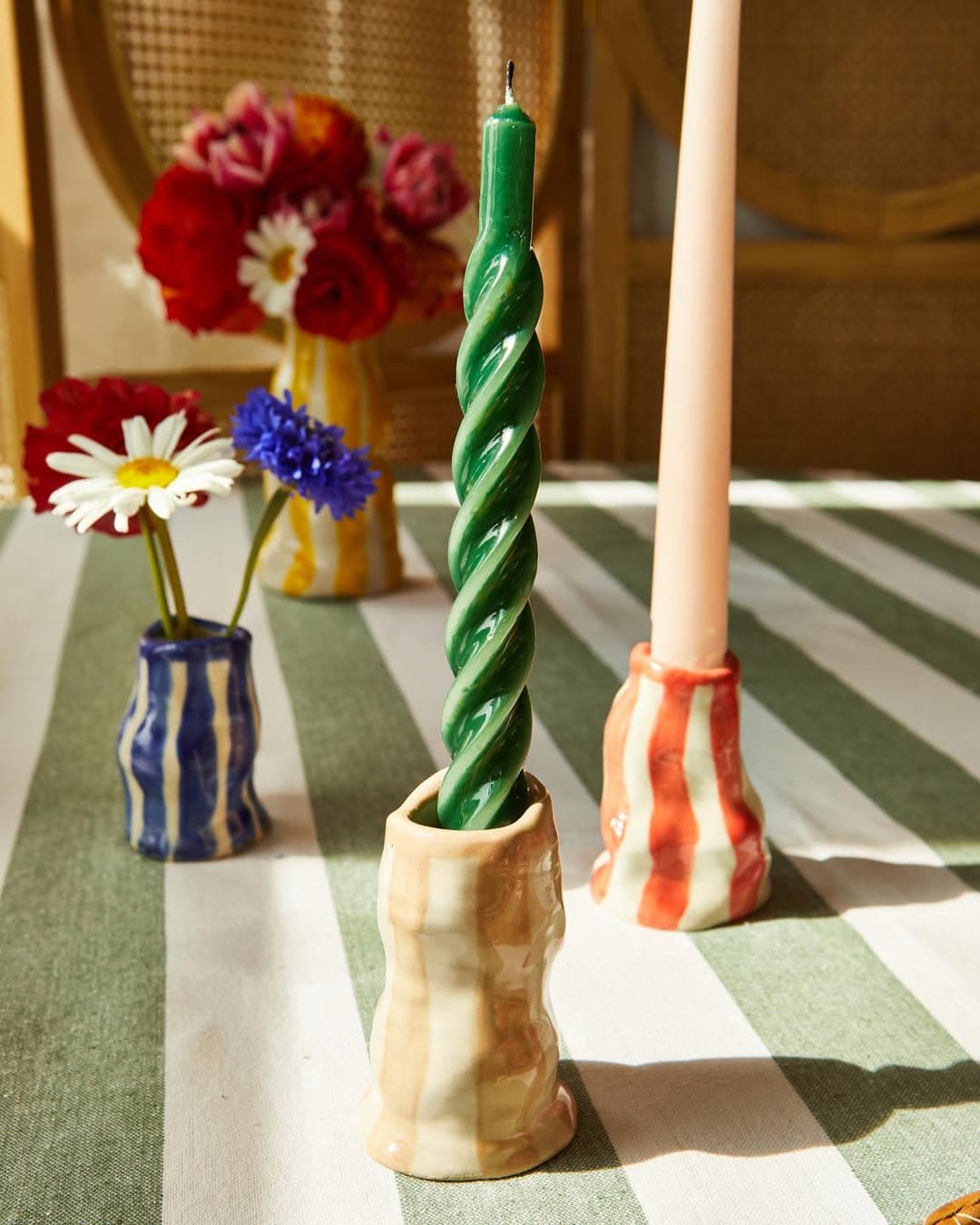
“Pairing smooth sculptural vases with higgledy-piggledy pots is a playful reminder to celebrate imperfection.”
- Homes writer Mandy Ando for Country Living UK

Inspiration
12. Where do you draw inspiration from for your work? What sparks your imagination and creativity?
Travel plays a huge role in sparking my creativity. A recent trip to Porto, with its stunning ceramics and tiled buildings, really set my imagination alight. Nature is another big influence—whether it’s the colours, textures, or shapes I find at the beach, in the woods, or wandering through the British countryside. Living in London also keeps me inspired, with its vibrant multicultural energy and all the exhibitions, festivals, and art happening around me.
13. Do you have a favourite artist, maker, movement, or tradition that has influenced your craft?
On a personal note, my grandad was a pottery and art teacher, so I grew up surrounded by his creations, which definitely shaped my appreciation for ceramics. My parents have a beautiful collection from artists like Springfield Pottery, Clive Bowen, and Sandy Brown. Last summer, I was fortunate enough to visit the studios of some of these incredible potters in Devon, and I even had the chance to try throwing with Philip and Franny Leach. The ceramic culture in that region left a lasting impression on me. I also draw a lot of inspiration from the Bloomsbury Group, particularly the Charleston Trust and Lee Miller’s house nearby. Those spaces are a real well of inspiration.
14. How does colour influence your practice; is it an important part of your process? Do you have a particular palette or favourites? Any go-to sources for colour inspiration?
Colour is a huge part of my practice—always has been. When I started creating Hodge Pots, the world felt a little gloomy, so I wanted to make a joyful, vibrant collection filled with bold colours and playful designs. Colour inspiration comes from absolutely everywhere: fashion shows, nature, magazines, even architecture and packaging! I’m especially drawn to different shades of green, along with blues and pinks—honestly, all of it speaks to me.
Perspectives and goals
15. What role does your environment play in shaping your creativity?
My environment has a huge impact on my creativity. Living in North London, I’m constantly surrounded by energy, diversity, and art. It pushes me to think in new ways, explore different influences, and incorporate elements of the city’s eclectic spirit into my work. Whether it’s the buzz of the streets or the peaceful moments in nature, everything around me feeds into my creative process.
16. What do you want people to feel when they experience your work?
I want people to feel joy, fun, and warmth when they experience my work. I aim to create pieces that invite a sense of playfulness and make people smile. There’s a real warmth of spirit in what I make, and I hope it brings a little brightness into people’s lives.
17. What are you currently working on, and what excites you most about it?
Right now, I’m working on some exciting collaborations and workshops that will lead to an adventurous summer. It’s all a bit hush-hush for now, but I’m really looking forward to seeing where these projects take me and the new creative connections they’ll bring.
Advice and reflection
18. What advice would you give to someone starting out as a maker?
My advice would be to stay authentic to yourself—make for yourself first and foremost. If you’re true to your own vision, everything else will follow. Don’t get caught up in what others expect of you.
19. If you could go back to the start of your career, what advice would you give your younger self?
Honestly, I wouldn’t change a thing. Even the mistakes have been part of my journey and helped refine my craft and my direction. Every experience—good or bad—shapes the path you’re meant to follow.
Closing thoughts
20. If you could collaborate with any artist, past or present, who would it be and why?
Without a doubt, I would collaborate with my grandad. He was such a huge influence on me, and it would be incredible to bring our creative worlds together.
21. Where can people find your work, and how can they support you?
You can find my work on Wonderful Makers Made, Maison Flaneur, and Dominca Marland. Of course, you can also visit my website, www.hodgepots.com, to see more of what I’m creating and how you can support my work.
Nikki Seymour’s hand-painted ceramics celebrate colour, sustainability, and a deep connection to place. Through Hodge Pots, she brings together playful design, conscious making, and a love for everyday beauty, crafting pieces that are as thoughtful as they are joyful.
Explore Nikki’s latest collections and follow her creative journey:
Support Nikki by visiting her website, exploring her characterful ceramic pieces, and following along with the joyful rhythm of her studio life on Instagram.
Meet the Maker: Daisy Tortuga Autobiographical Artworks
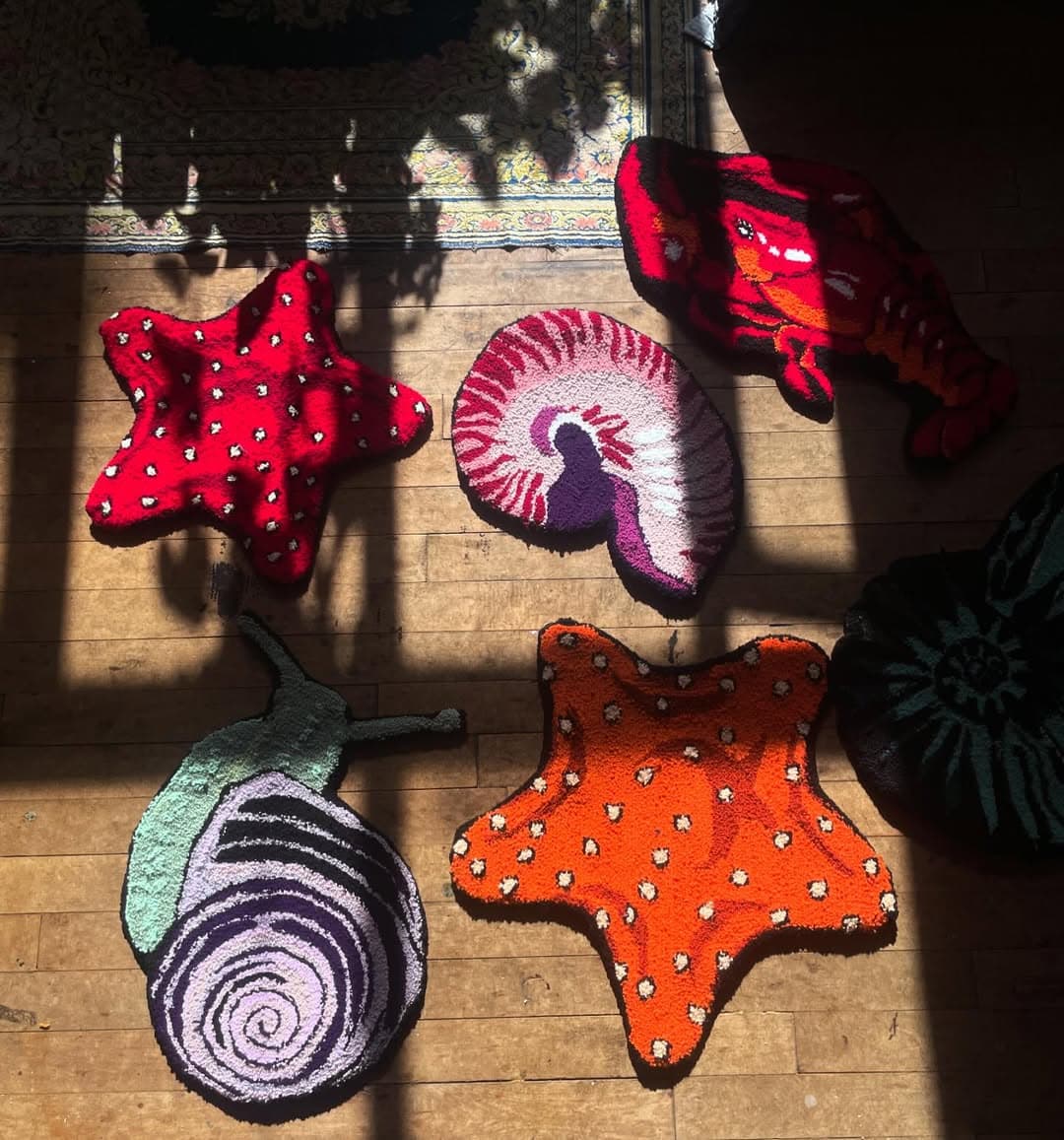
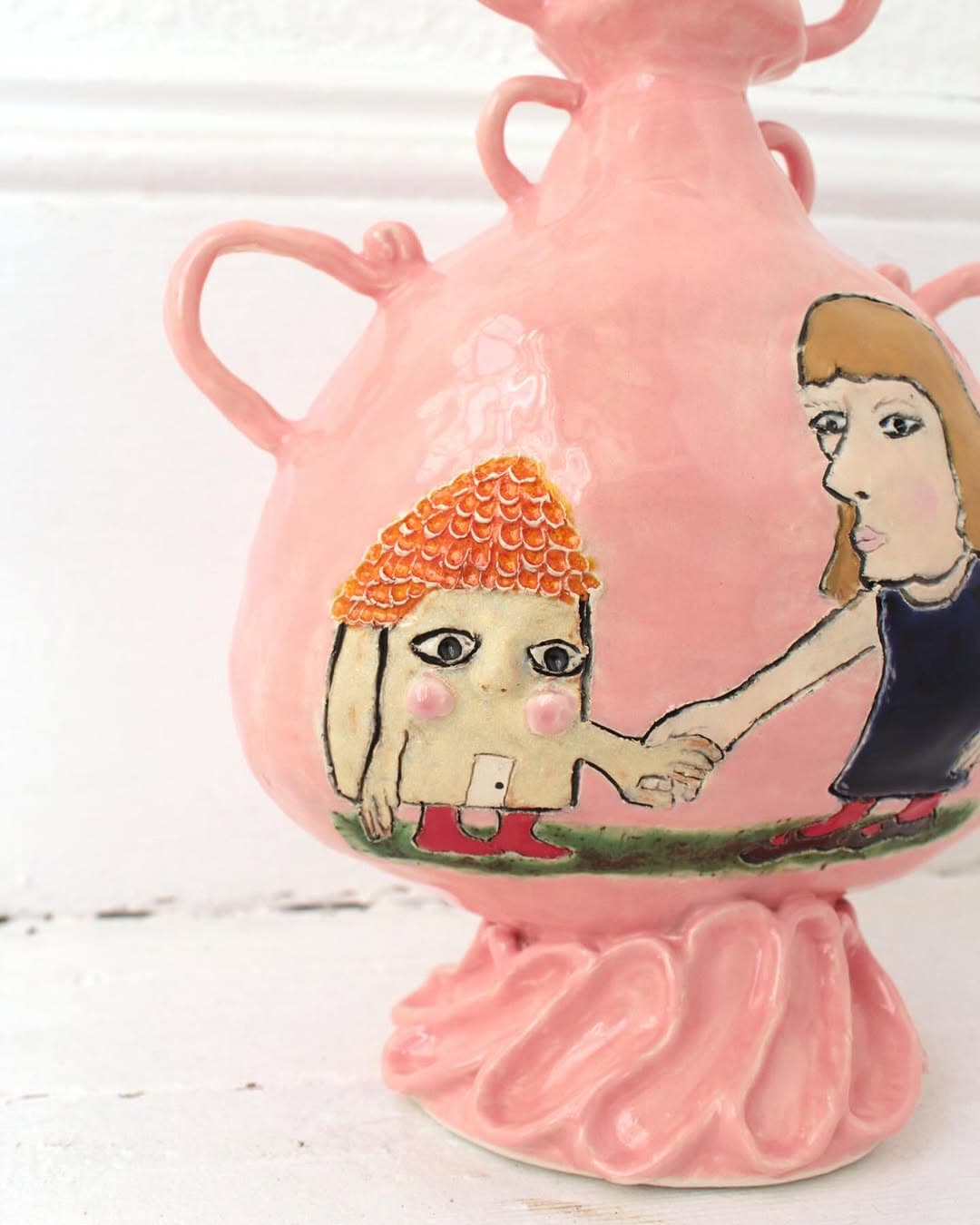
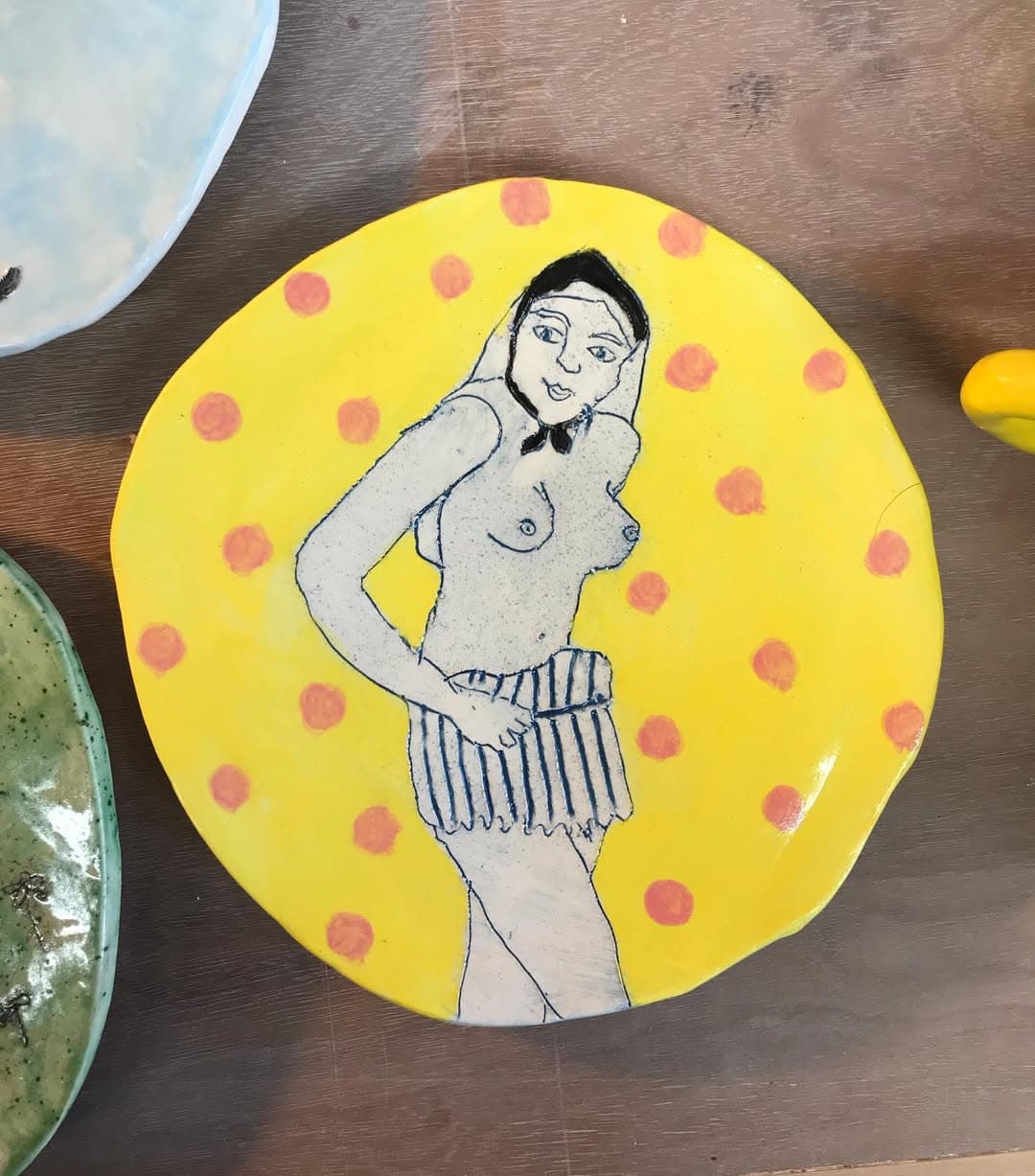
We recently caught up with Daisy Tortuga, an artist whose practice spans craft-based mediums, exploring the playful and autobiographical through textiles, ceramics, and music. Daisy shares stories from her creative journey, from crafting waistcoats for her childhood cat to finding catharsis in tufted rugs. We delve into how limitations fuel her creativity, her love for outsider and folk art, and the balance between experimentation and practicality. Daisy offers thoughtful insights on finding joy and authenticity in making art and embracing one’s unique path.
1. Can you tell us a bit about yourself and your artistic journey?
I have always enjoyed making things, it’s the only thing I have ever felt good at. I would describe myself as an artist that enjoys working in craft based mediums. I’ve never liked painting or drawing particularly, I think with craft mediums there is always a limitation with the material which makes me more excited than the endless possibility of paint colours for example. I like to use tangible materials like fabric, wool and clay; using their limitations to tell stories.
2. What inspired you to pursue your craft? Was there a defining moment or influence that sparked your passion?
My earliest memory of craft was making clothes for my cat Apricot when I was 5 or 6. I wasn’t able to sew yet but I stapled the seams together and made him a collection of waistcoats. My practice isn’t miles away from this now, not that I make clothing for animals but my work is very much led by what I feel like making at that time. My work has a connection of shared visual language but crosses many materials and forms.
Your craft
3. How would you describe your work in three words?
playful, autobiographical, tactile
4. What materials or techniques do you use, and why are they important to your process?
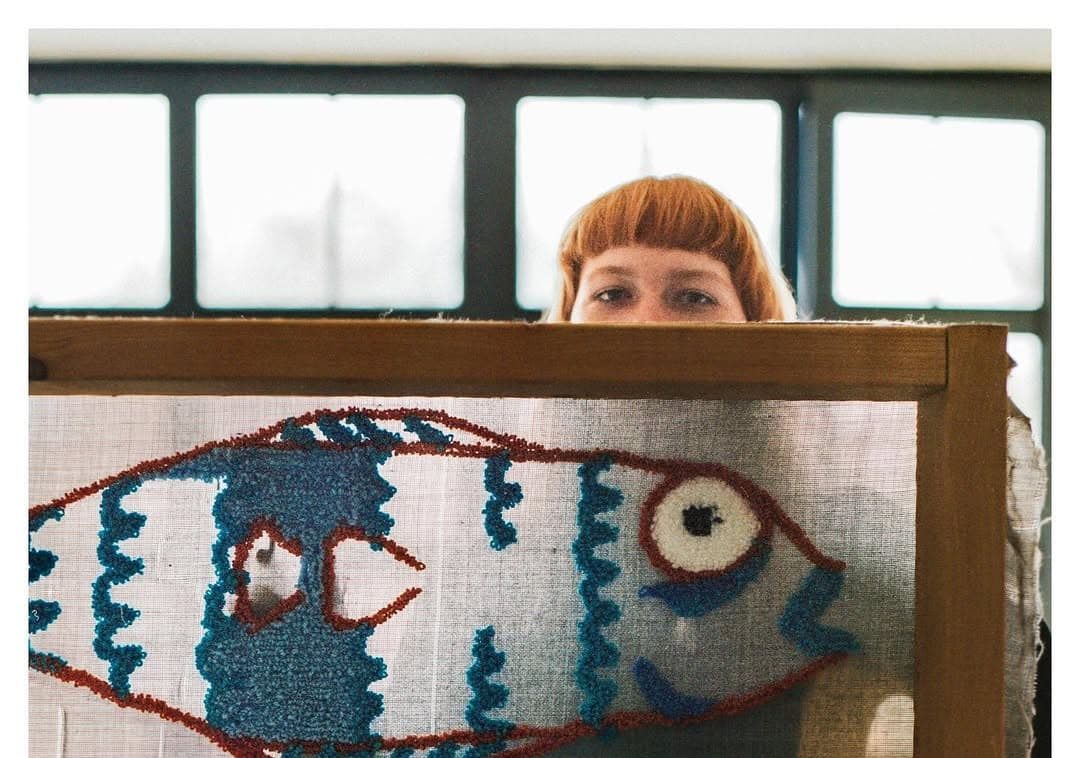
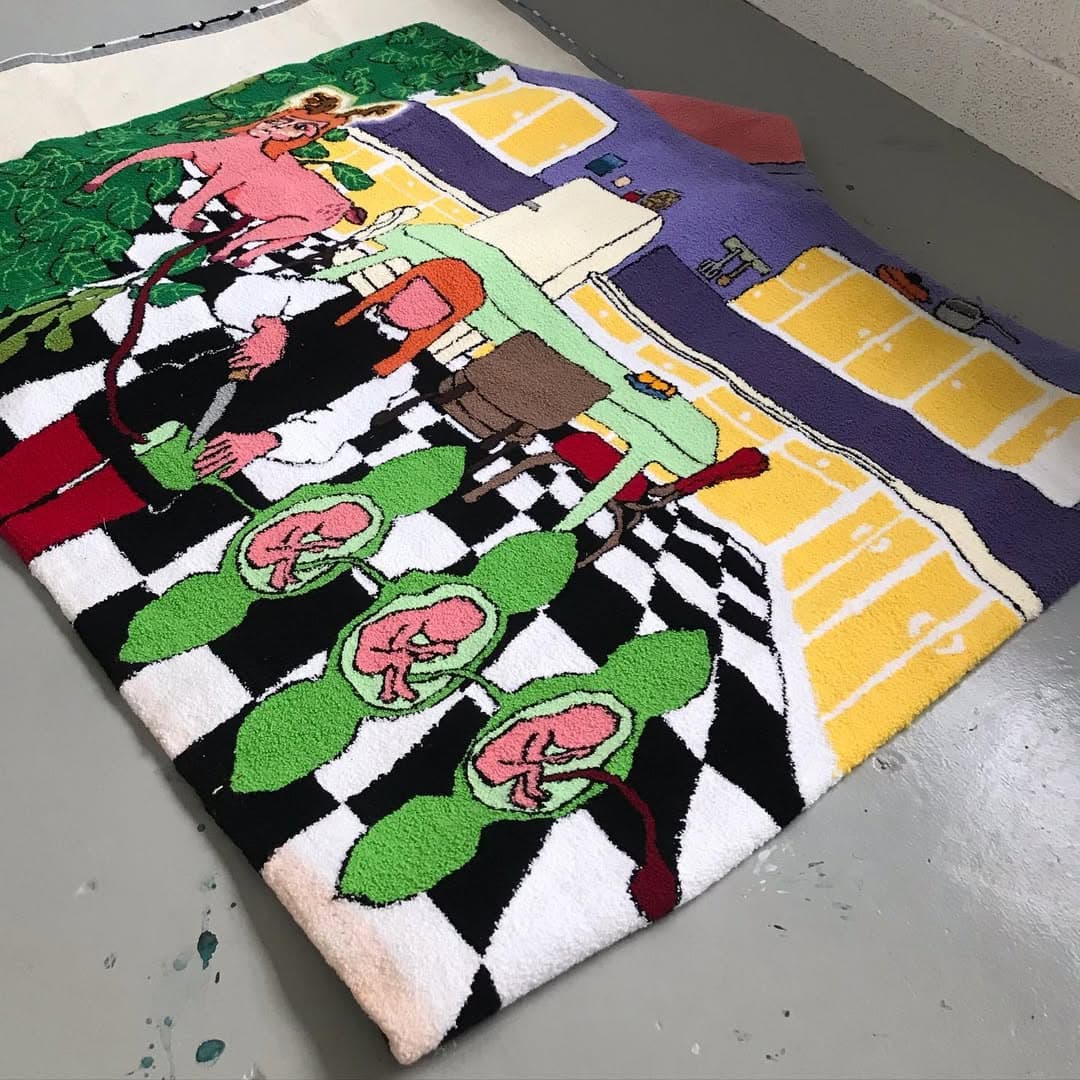
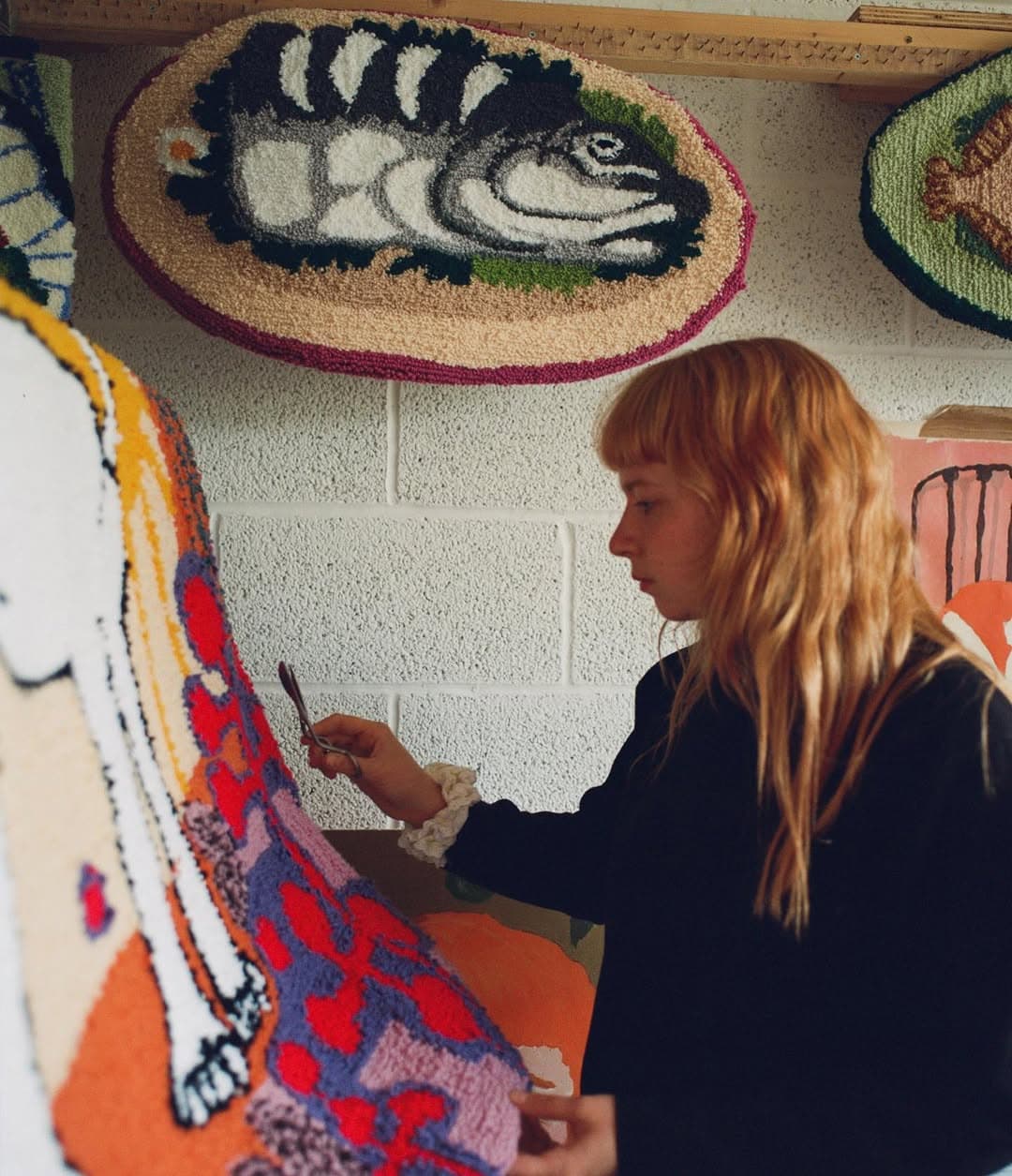
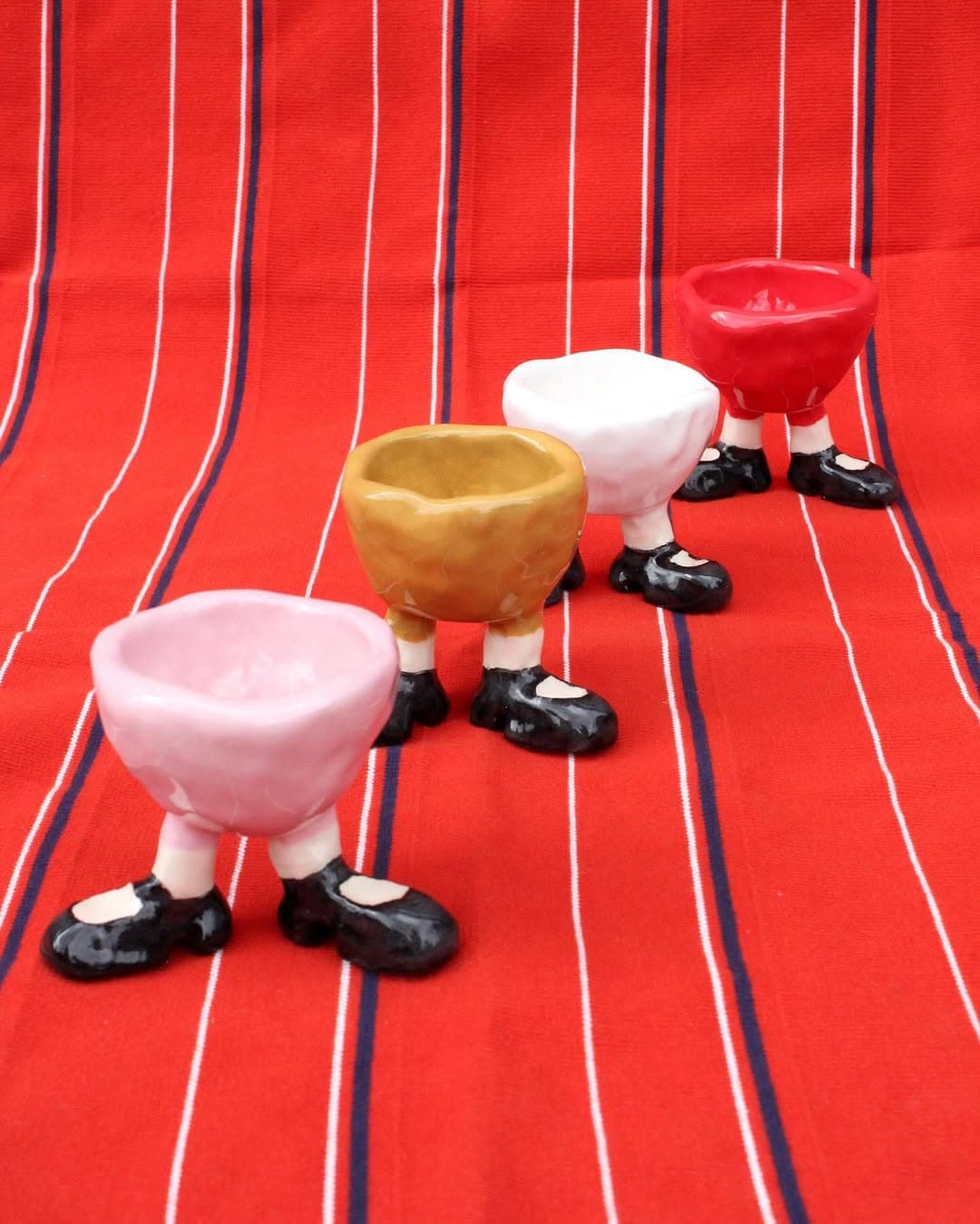
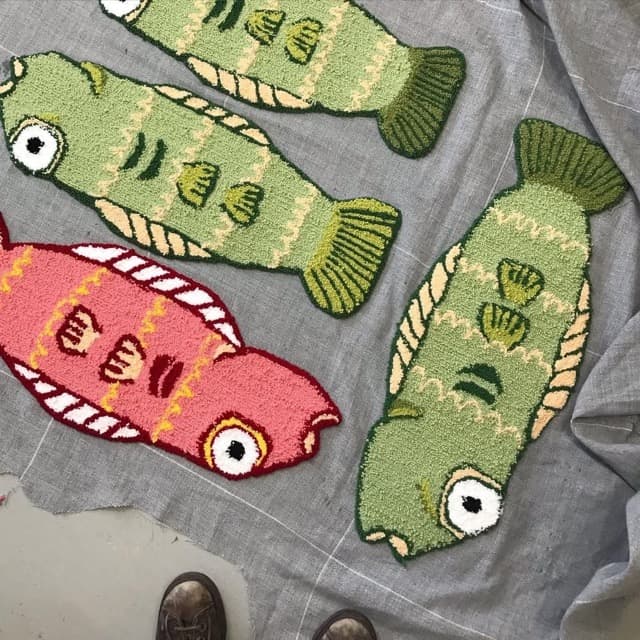
I work mainly in tufted rug using wool, knitting using a domestic knitting machine and in clay. These materials are important to me because they allow me to make illustrations but through more tactile materials than just paper and pen. As previously mentioned, the materials all have limitations, for example when making a rug my frame can only make a certain size, the yarn colours are already dyed and so deciding what to do within these limitations is what I work within. Also using traditionally female techniques is something I feel connected to and continuing this tradition is something I’m interested in. I am also a songwriter and musician, for me my music lives in the same world I have created visually.
5. Can you tell us about a favourite piece you’ve created and the story behind it?
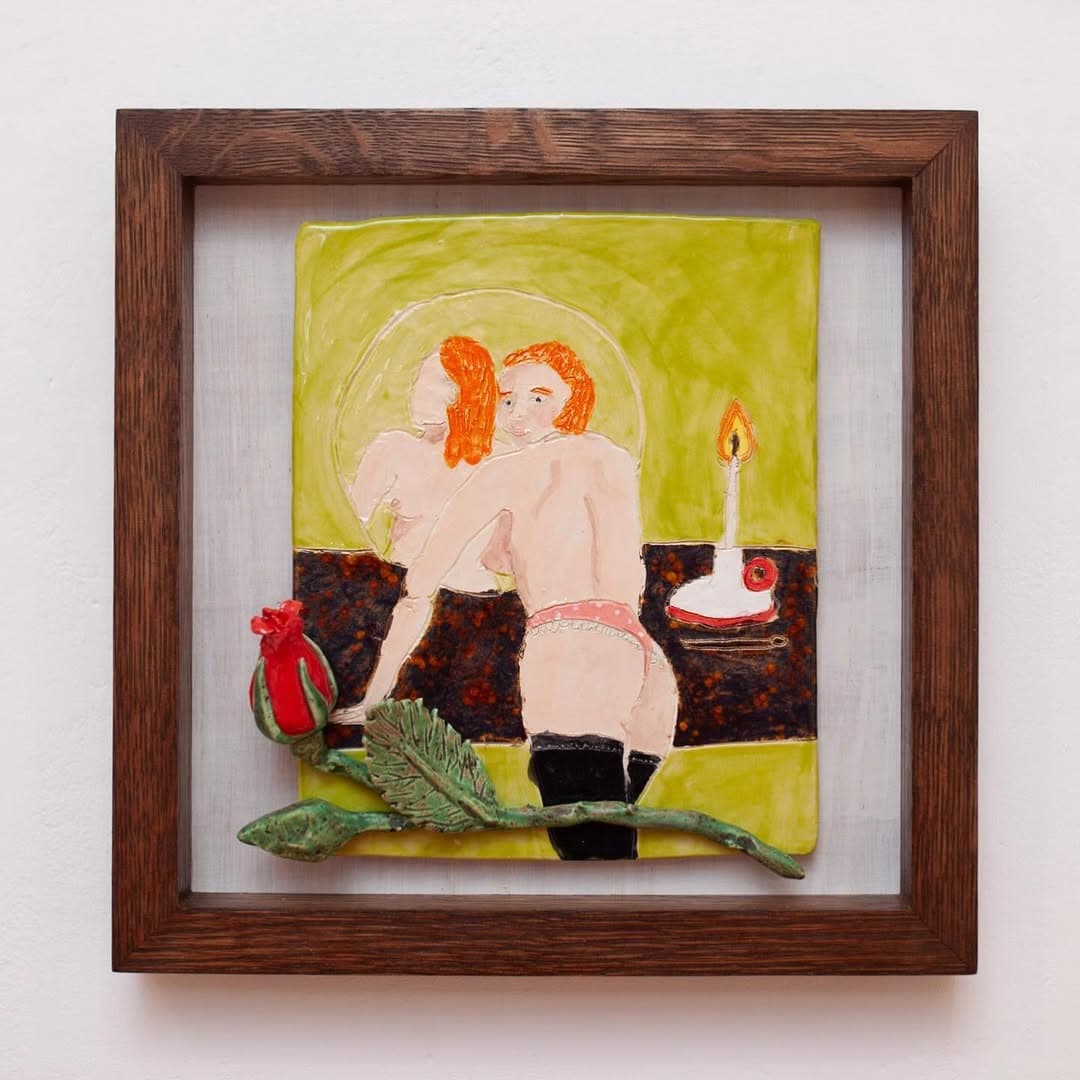
My favourite collection of work I have made was an exhibition I did called ‘New Rug, New Me’ in 2021 at The Truman Brewery in Shoreditch. I had a period of time constantly making rugs with autobiographical stories throughout and the work was made compulsively and in complete flow. I was extremely unhappy at the time and found catharsis in the body of work.
Creative process
6. What does a typical day in your studio or workshop look like?
I get to my studio around 10 am. I’m quite absorbed in my work when I’m working and don’t tend to procrastinate. I take cigarette breaks, make to-do lists, listen to podcasts and occasionally watch crap TV. I leave the studio at around 6 pm
7. Do you have any unique rituals or habits that help you stay creative?
Cigarettes
8. How do you handle creative blocks? Do you have any strategies or tips for overcoming them?
I find not working for a while the best thing for a block. Not being allowed to make work can make you miss it.
Challenges and successes
9. What’s the biggest challenge you’ve faced as a maker, and how did you overcome it?
Needing to make money at the same time as trying to experiment and take risks within my practice – still working on this
10. What’s been your proudest moment or achievement so far?
Finding my work in a charity shop
11. What’s your favourite quote you’ve ever heard about your work? Who said it, or what was the name of the publication?
‘Bitterly vindictive yet ultimately charming’
- Hard of Hearing Magazine about my bands EP
Inspiration
12. Where do you draw inspiration from for your work? What sparks your imagination and creativity?
I’m interested in outsider art/folk art. I think work made intuitively and without the intention of an audience is most interesting. I find myself inspired by literature, music and domestic spaces.
13. Do you have a favourite artist, maker, movement, or tradition that has influenced your craft?
I think craft work by women is an area of interest for me. Victorian needle point, handicrafts etc. This work was never considered art and I believe this is where the most pure, inventive creation can come. When there is no great intention of audience.
14. How does colour influence your practice; is it an important part of your process? Do you have a particular palette or favourites? Any go-to sources for colour inspiration?
My work definitely has a lot of colour, i’m not sure about a particular palette, I just add colours quite freely and don’t think about them too much.
Perspectives and goals
15. What role does your environment play in shaping your creativity?
I like to be alone when i’m working. I also like to wear headphones and be completely absorbed in what i’m doing, not distracted by phone messages etc. My studio also needs to be a place I feel safe and is decorated to my liking.
16. What do you want people to feel when they experience your work?
I’d like people to feel a sense of connection to something they might have experienced, like a story or character that resonates with them. Or simpler than that just an object that brings them joy.
17. What are you currently working on, and what excites you most about it?
I’m going to work on some more self portraits this year, I hope to make some vases a bit more similar to my textile work. I also want to make a collection of jumpers.
Advice and reflection
18. What advice would you give to someone starting out as a maker?
Do your own thing. Try not to follow trends
19. If you could go back to the start of your career, what advice would you give your younger self?
If I could tell myself at 16 that I could be a professional artist I would have been very pleased. I didn’t know I would be able to be a full time artist, I had never met anyone who had a creative job. I think its good to remember there are so many jobs involved in the creative world and you can always find your niche.
Closing thoughts
20. If you could collaborate with any artist, past or present, who would it be and why?
Black Sabbath
21. Where can people find your work, and how can they support you?
They can support me on my website daisytortuga.com or over on Instagram.
Daisy Tortuga’s vibrant, tactile artworks blend storytelling, playful exploration, and heartfelt connection, creating pieces that resonate deeply with everyday experiences. Her multidisciplinary approach crosses boundaries, offering joyful and introspective pieces that invite personal connection and warmth.
Explore Daisy’s latest collections and follow her creative journey:
Support Daisy by visiting her website, following her on Instagram, and staying tuned for her exciting new projects.
Meet the Maker: Aeyglom's Colourful Craftsmanship
In this Q&A, we chat with Aey of Aeyglom, exploring her artistic journey from childhood in Chiang Mai, Thailand, to establishing her ceramics studio in the UK. Aey shares the personal significance behind her brand name, her love for porcelain’s challenging beauty, and her vibrant approach to creating colourful ceramic pieces. She also discusses the delicate balance between creativity and business, drawing inspiration from global architecture, and her excitement for upcoming projects like expanding into lighting.
1. Can you tell us a bit about yourself and your artistic journey?
The brand name – aeyglom – is a combination of my Thai nickname Aey and the word Glom, meaning circle – the shape and form often reflected in my work. Having spent my childhood in Chiang Mai, Thailand, I moved to the UK as a teenager and graduated with a BA in three-dimensional design, specialising in ceramics before starting my own small ceramics studio.
2. What inspired you to pursue your craft? Was there a defining moment or influence that sparked your passion?
Design and homeware have always been a real passion, my love of food, design and ceramics featuring regularly throughout my career.
Your craft
3. How would you describe your work in three words?
Creative, Precise, Colourful
4. What materials or techniques do you use, and why are they important to your process?
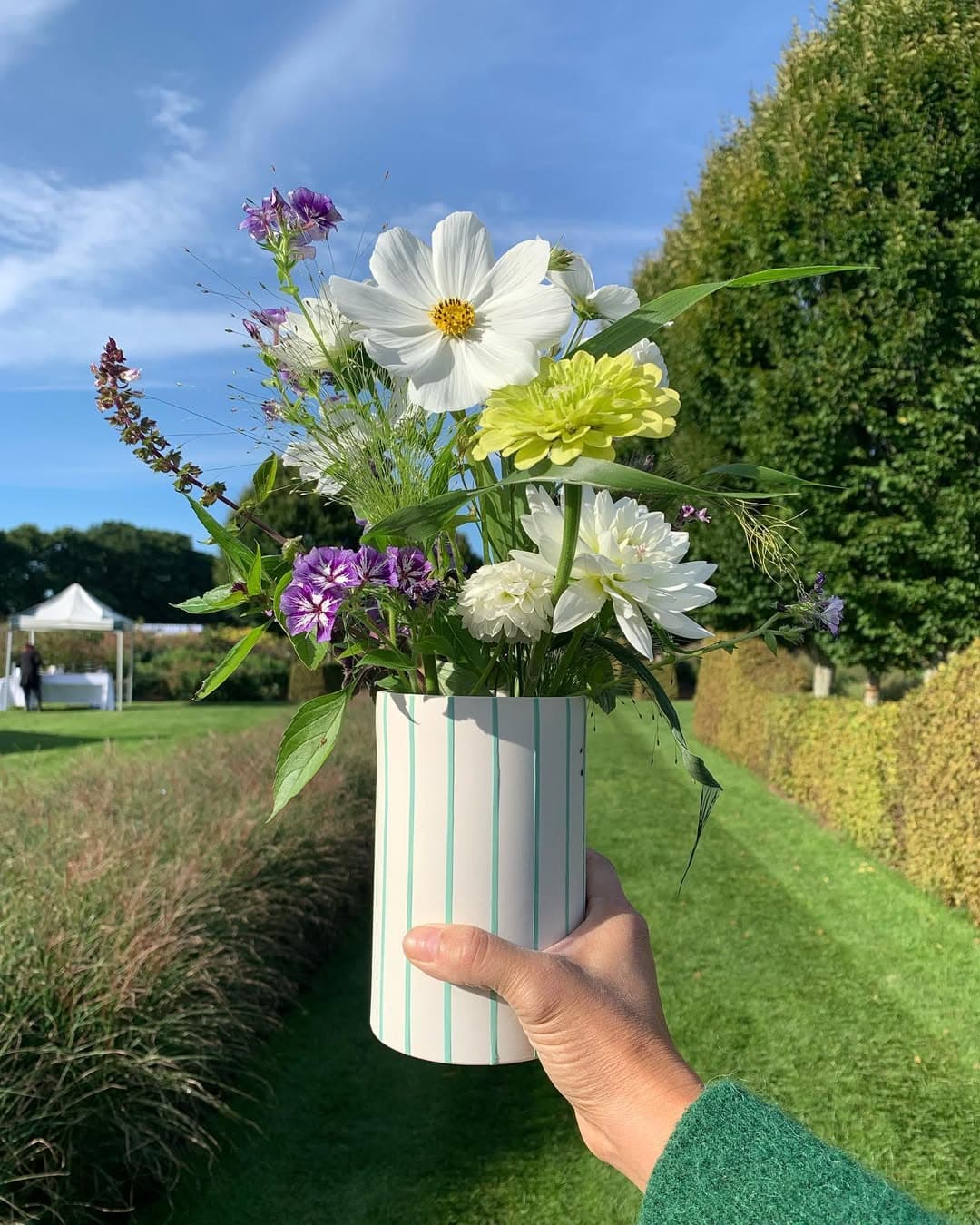
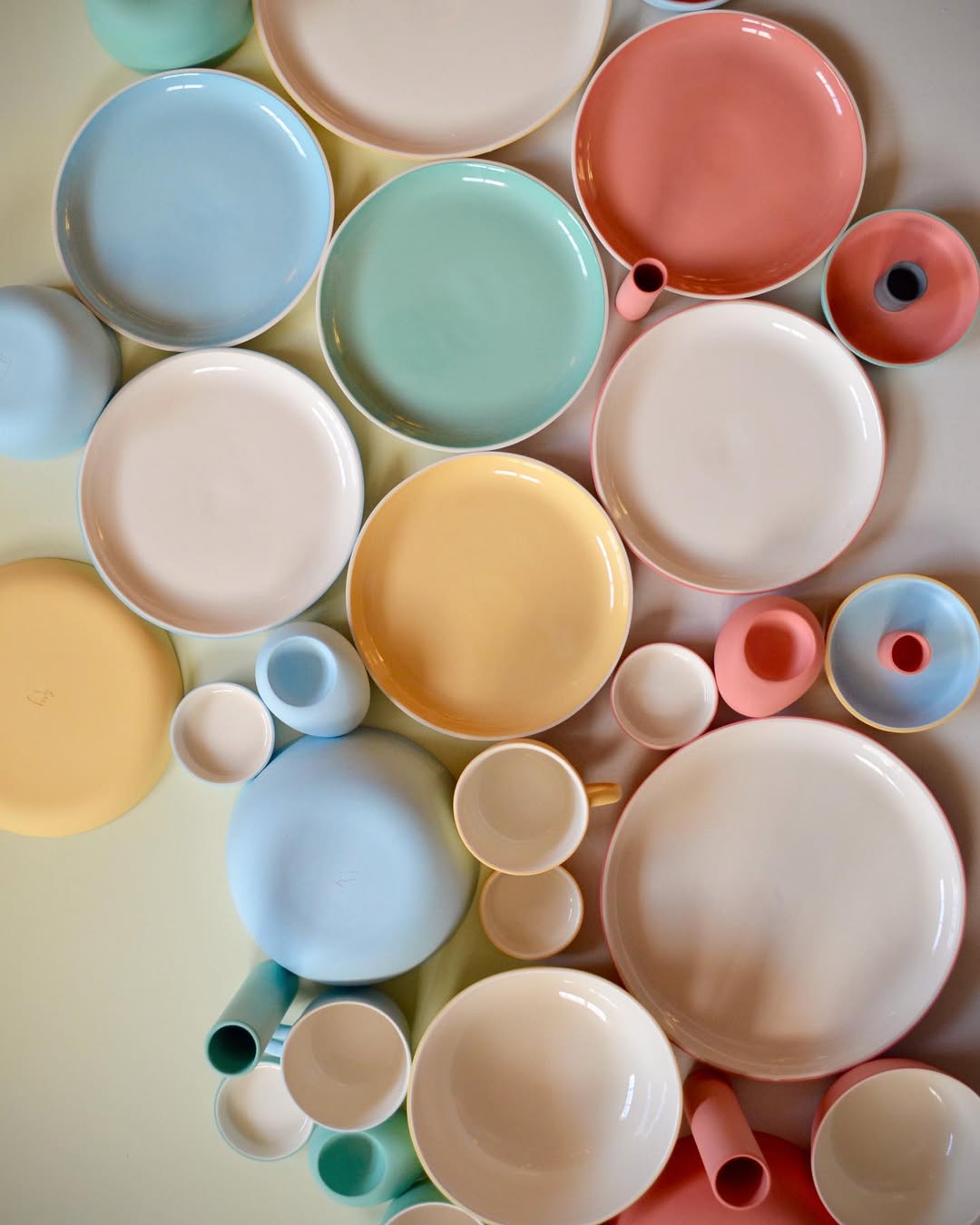
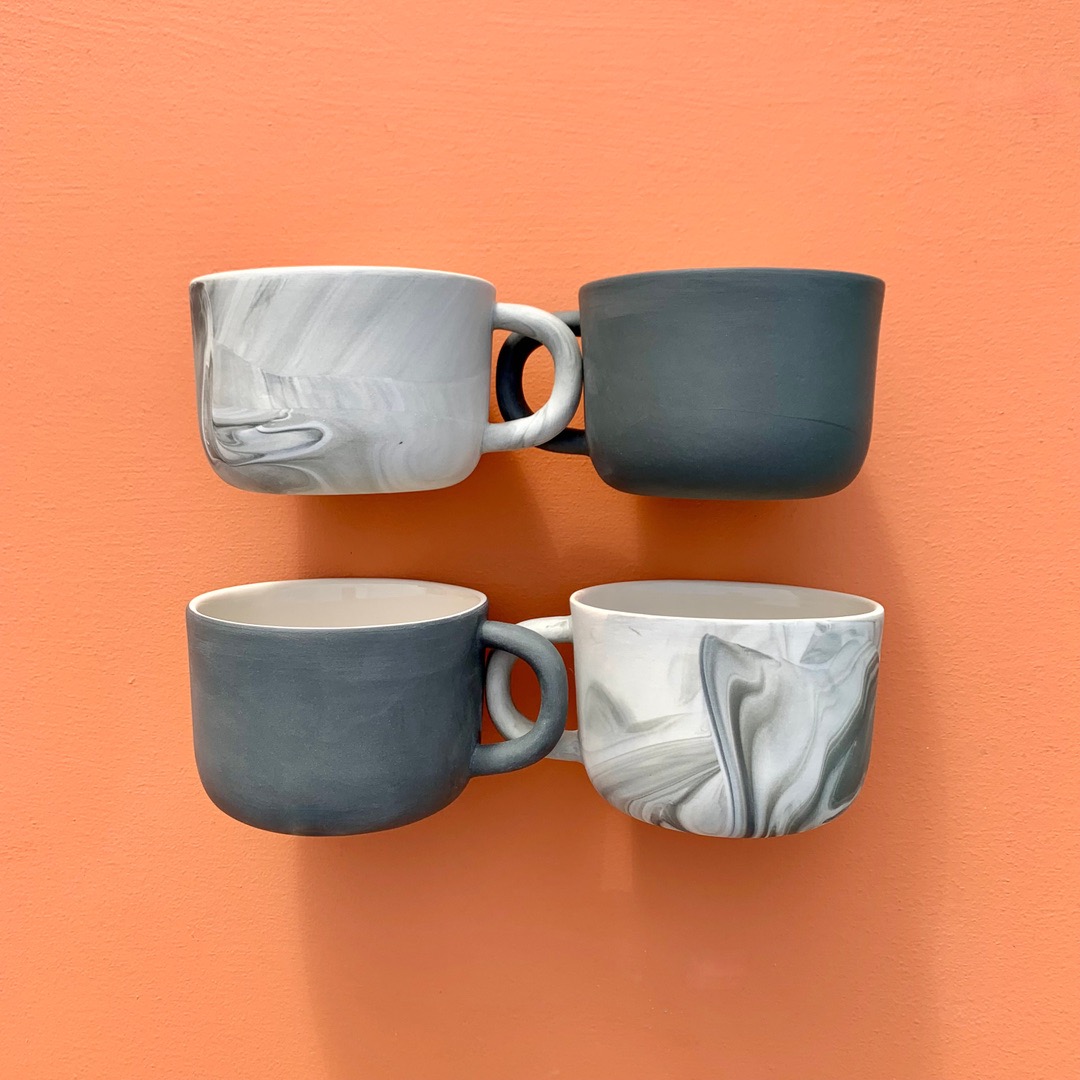
I love working with porcelain, although it can be very challenging! The material is very delicate and prone to mistakes, but the final finish is very smooth and has a luxurious feel. This love of working with porcelain stems from my time at university, and the freedom of experimenting with mixing colours into porcelain and testing the translucency. I started out making porcelain lights before moving onto tableware.
5. Can you tell us about a favourite piece you’ve created and the story behind it?
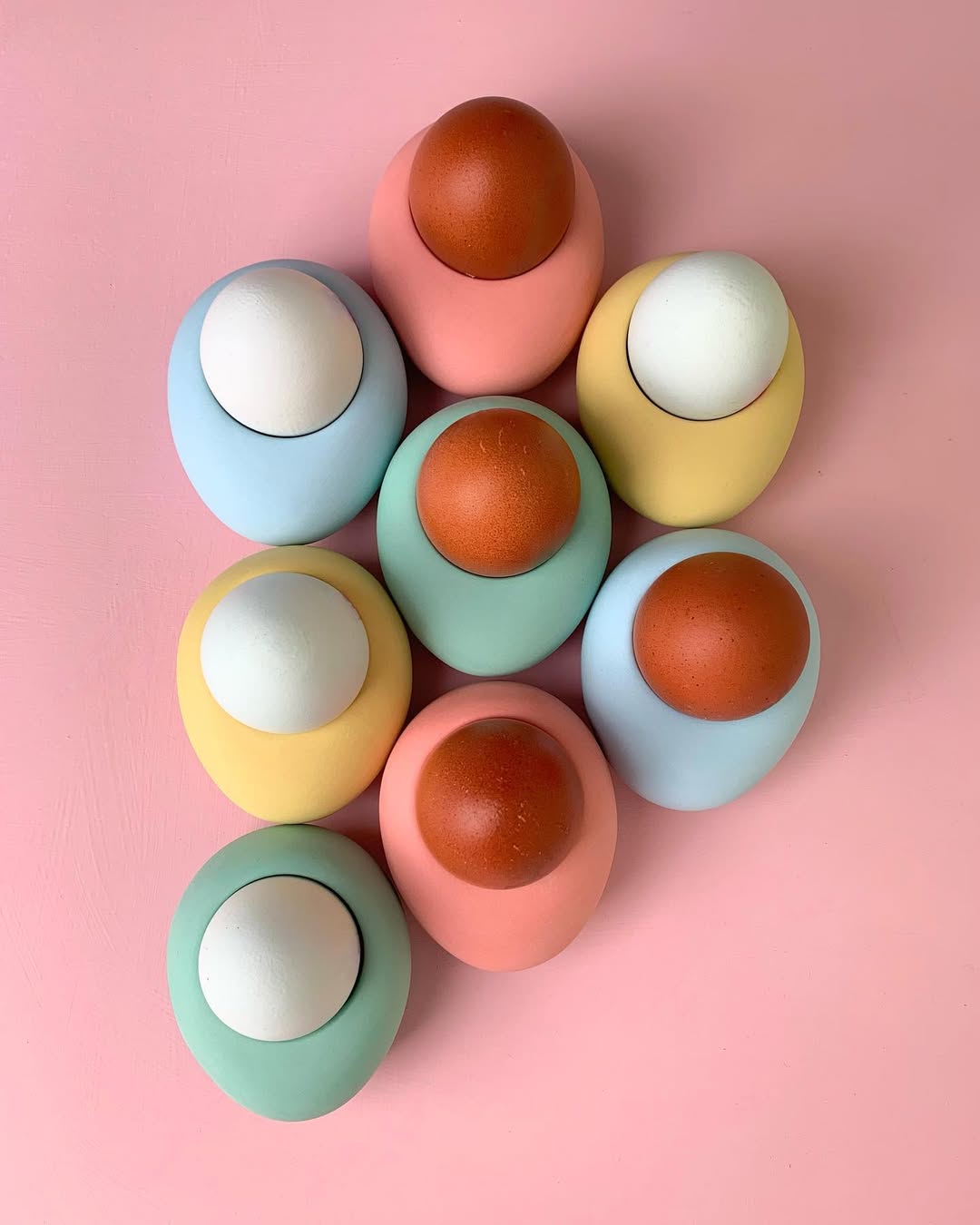
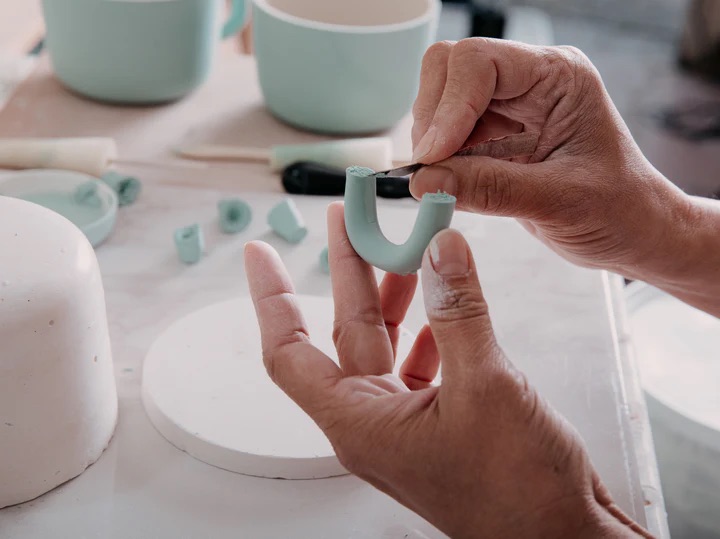
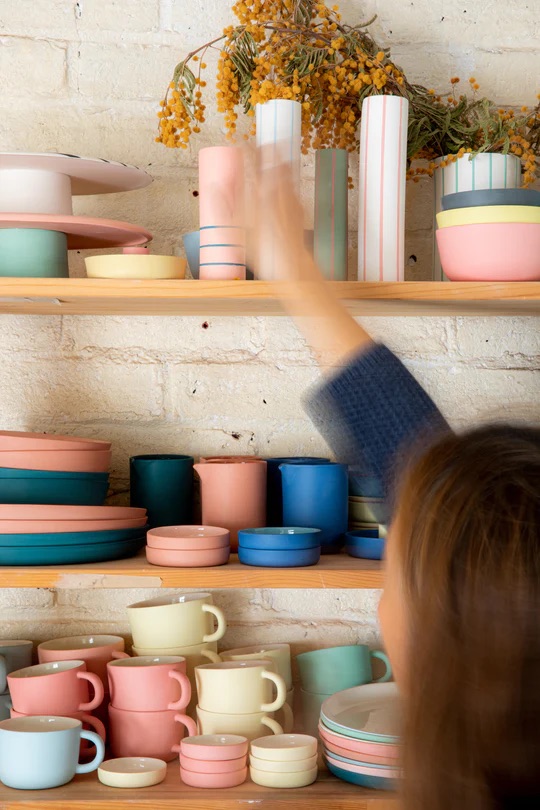
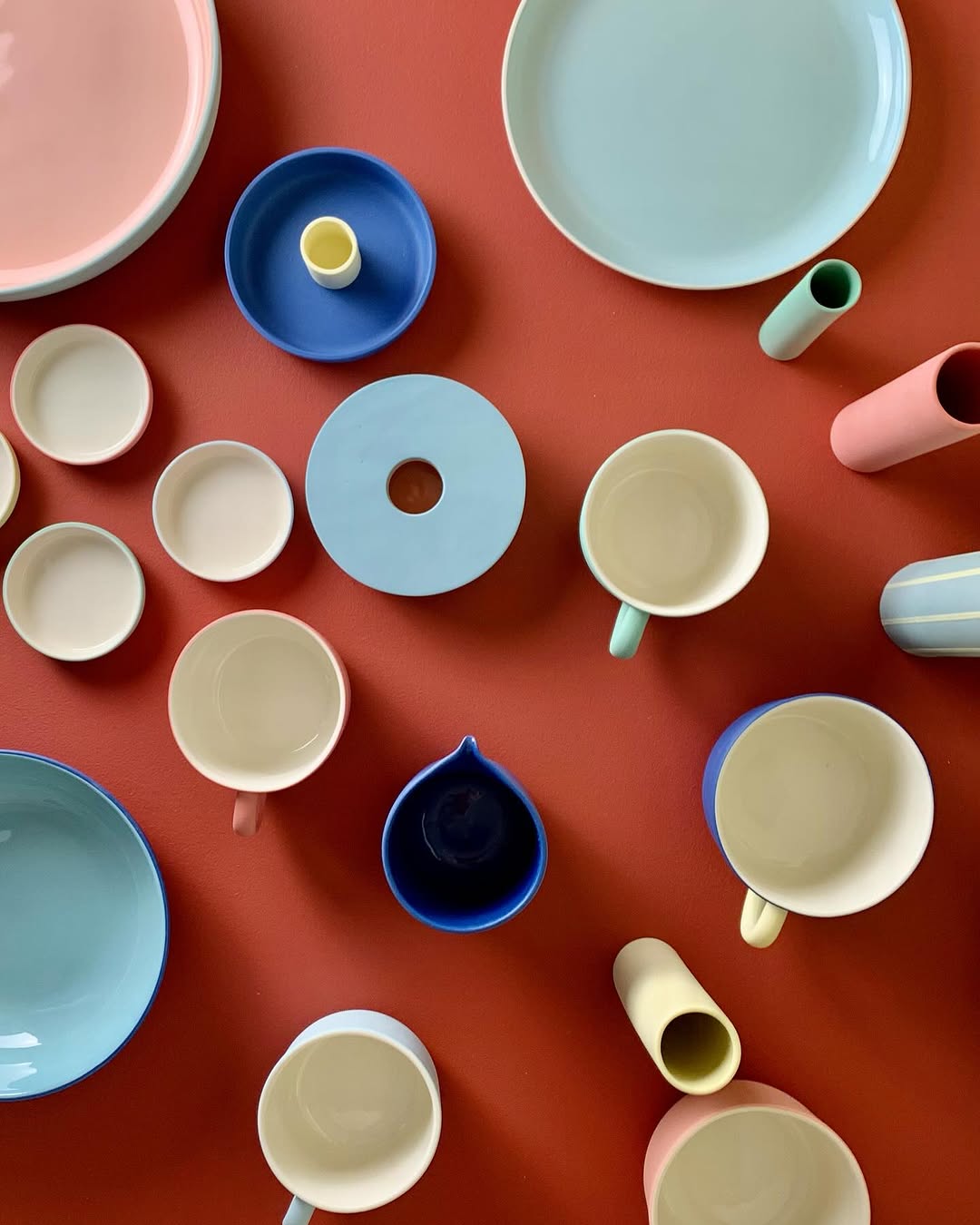
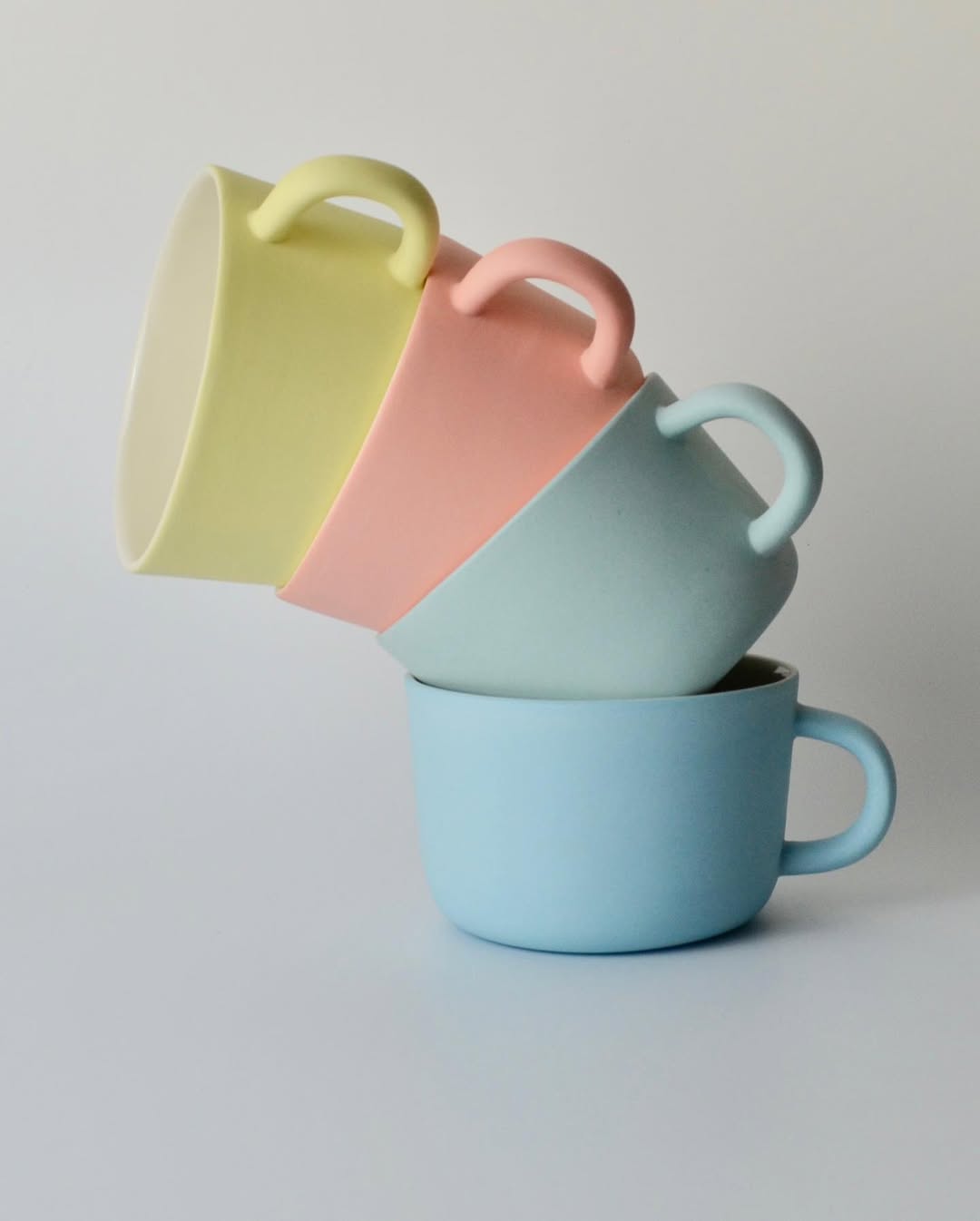
The Kelly Egg Cup is my favourite piece in my collection. It is named after one of my dear friends, Kelly, whom I met 20 years ago and who has supported me throughout my creative career. The shape of the egg cup is very tactile and lovely to hold. There are eight colours in the collection.
Creative process
6. What does a typical day in your studio or workshop look like?
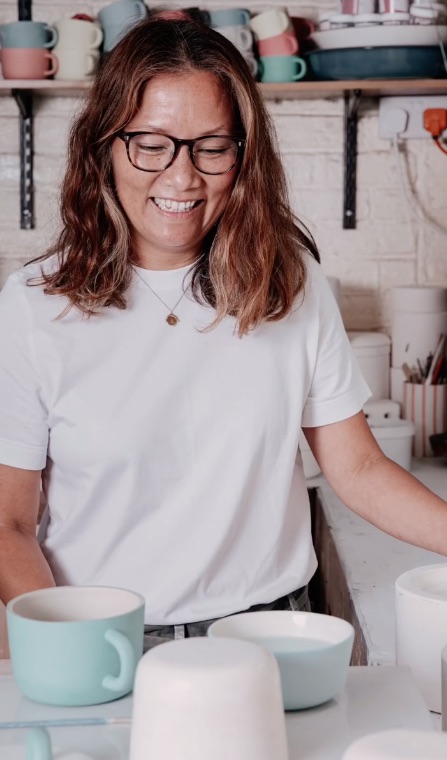
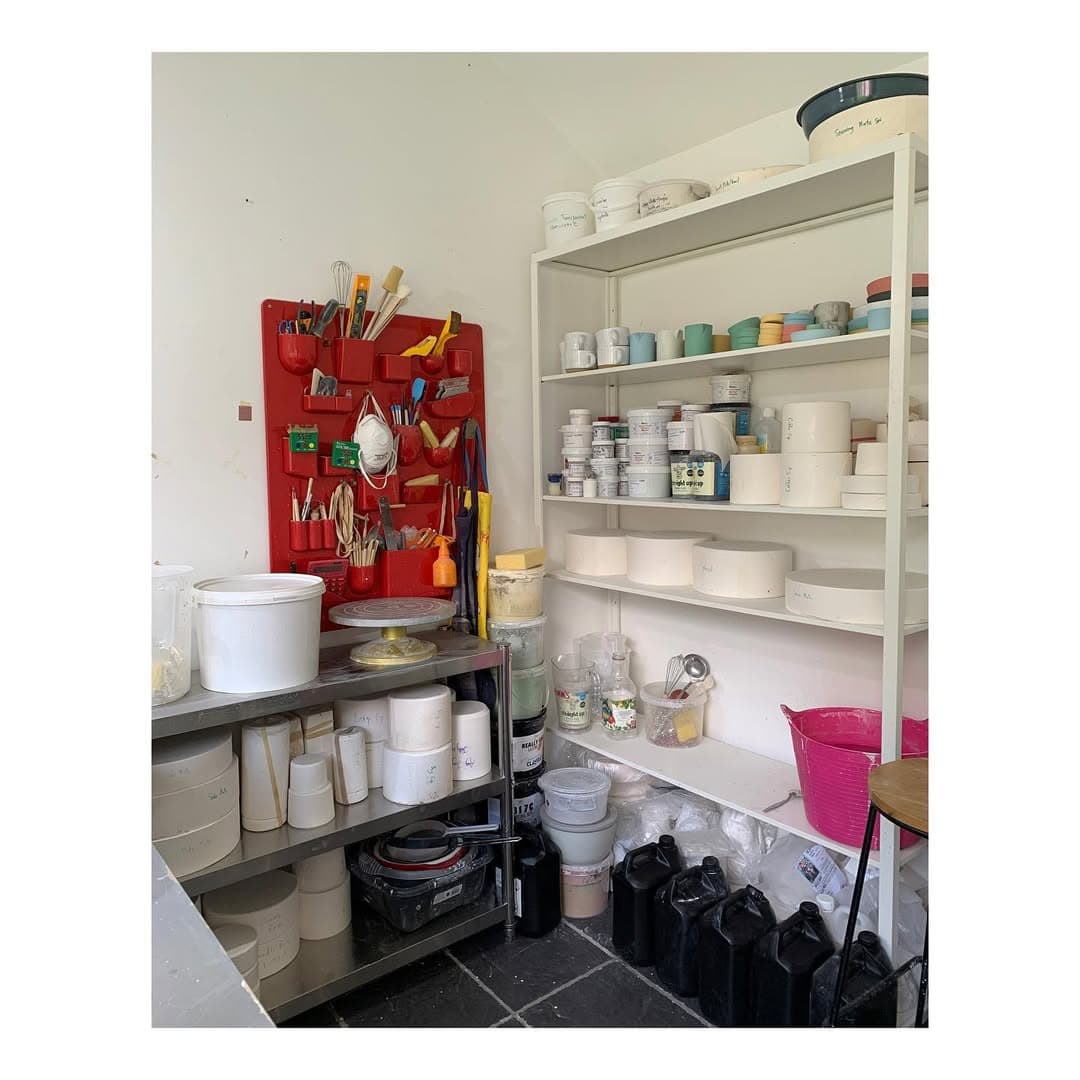
My studio is in my garden at home. After the school drop-off and a dog walk, I spend my time in the studio making, casting, and mixing new colours. Each piece requires time and patience to create. Porcelain is a strong material but also very delicate, requiring care and attention. I work in small batches—some days, I focus on casting new pieces. Each cast needs to be left in the mould overnight before being turned out to dry. I love spending time in my studio; it’s very calming and rewarding when everything comes out of the kiln perfectly.
7. Do you have any unique rituals or habits that help you stay creative?
Design and homeware have always been a real passion of mine. My love of food, design, and ceramics has featured regularly throughout my career, inspiring my creativity and work.
8. How do you handle creative blocks? Do you have any strategies or tips for overcoming them?
When I have a creative block, I keep making and experimenting. If I have an idea in my head, sometimes I need to create it first to see if it will work or not.
Challenges and successes
9. What’s the biggest challenge you’ve faced as a maker, and how did you overcome it?
Running a small business isn’t just about making. I build my own website, do all the photography, manage social media, handle customer service and enquiries—all alongside creating my work. The biggest challenge is balancing the creative side with the demands of running a business, as it needs to stay afloat. I’ve had to learn how to juggle multiple roles while ensuring my creativity isn’t compromised.
10. What’s been your proudest moment or achievement so far?
There have been many proud moments. One was when I participated in a craft fair for the first time, selling directly to customers and receiving great feedback. In my second year of business, several press outlets contacted me to feature my work. One of my dreams has been to supply a restaurant or hotel, and that became a reality last year—my egg cups are now being used and admired in a hotel establishment.
Inspiration
11. Where do you draw inspiration from for your work? What sparks your imagination and creativity?
My work is very colourful, and I love creating vibrant ceramic pieces. My inspiration for colours comes from the architecture around the world, such as the vibrant buildings in Miami and the colourful houses on the hills of the Amalfi Coast.
12. Do you have a favourite artist, maker, movement, or tradition that has influenced your craft?
I admire the work of many ceramic artists. Their creativity and craftsmanship inspire me, and I draw influence from various styles and techniques within the ceramic community.
13. How does colour influence your practice; is it an important part of your process? Do you have a particular palette or favourites? Any go-to sources for colour inspiration?
Colour plays a significant role in my work. I love working with vibrant hues, and my palette is often inspired by the colours found in architecture around the world—such as the bold buildings in Miami or the colourful houses on the hills of the Amalfi Coast. These vibrant scenes spark my imagination and influence the colours I choose for my ceramic pieces.
Perspectives and goals
14. What do you want people to feel when they experience your work?
I want people to enjoy looking at, holding, and using my work, whether for decoration or when eating from it.
15. What are you currently working on, and what excites you most about it?
I’m working on adding a lighting range to my collection, which I’m really excited about.
Advice and reflection
16. What advice would you give to someone starting out as a maker?
Just do it—make, experiment, and keep it simple. Not everything will work, but great work can come from accidental mistakes.
17. If you could go back to the start of your career, what advice would you give your younger self?
Keep going and stick with it, even when it’s tough. It will be rewarding in the end.
Closing thoughts
19. Where can people find your work, and how can they support you?
You can find my work on my website, aeyglom.com, where you’ll also find a list of stockists. I also attend craft fairs and maker markets—details are available on my Instagram story.
Aeyglom ceramics embody precise craftsmanship, vibrant colours, and thoughtful design, resulting in beautiful pieces that bring joy and elegance to everyday living. Inspired by global architectural hues and crafted with meticulous care, Aey’s work invites people to experience the simple pleasures of handcrafted beauty.
Explore Aey’s latest collections and follow her creative journey:
Support Aey by exploring her ceramics online, discovering her collections at craft fairs and markets, and staying connected through her website and Instagram.
Meet the Maker: The Thoughtful Ceramics of Ali Hewson
In this Q&A, we chat with ceramicist Ali Hewson about her artistic journey from illustration to ceramics, the joy she finds in working with clay, and how historical research deeply informs her practice. Ali shares insights into her mindful use of materials, the daily rhythms of her studio life, and the constant balancing act between work and rest. We also explore her thoughtful approach to sustainability, inspiration from historical ceramics, and her advice for emerging makers.

1. Can you tell us a bit about yourself and your artistic journey?
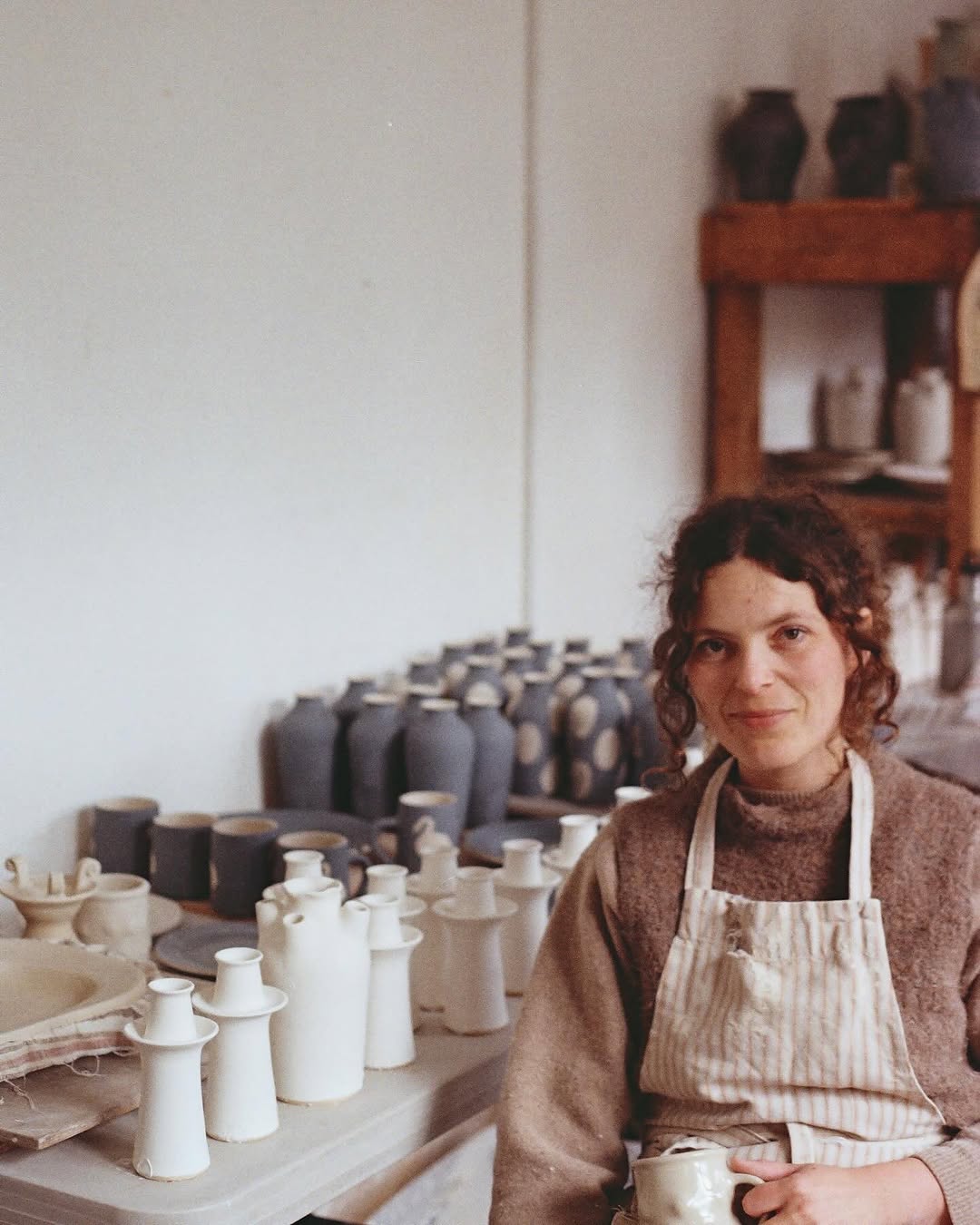
I started making ceramics whilst on my Foundation at Camberwell College of Art, then carried on throughout my degree (in illustration). It was only after moving to Norfolk when I could get a proper studio that I was able to properly see through my ideas in clay, and 11 years later am still in the same studio building! Drawing still plays a huge part in my work, as does research into historical ceramics from all over the world.
2. What inspired you to pursue your craft? Was there a defining moment or influence that sparked your passion?
I just love ceramics and clay, it is endlessly interesting to me.
Your craft
3. How would you describe your work in three words?
Thoughtful… I don’t know any more sorry
4. What materials or techniques do you use, and why are they important to your process?
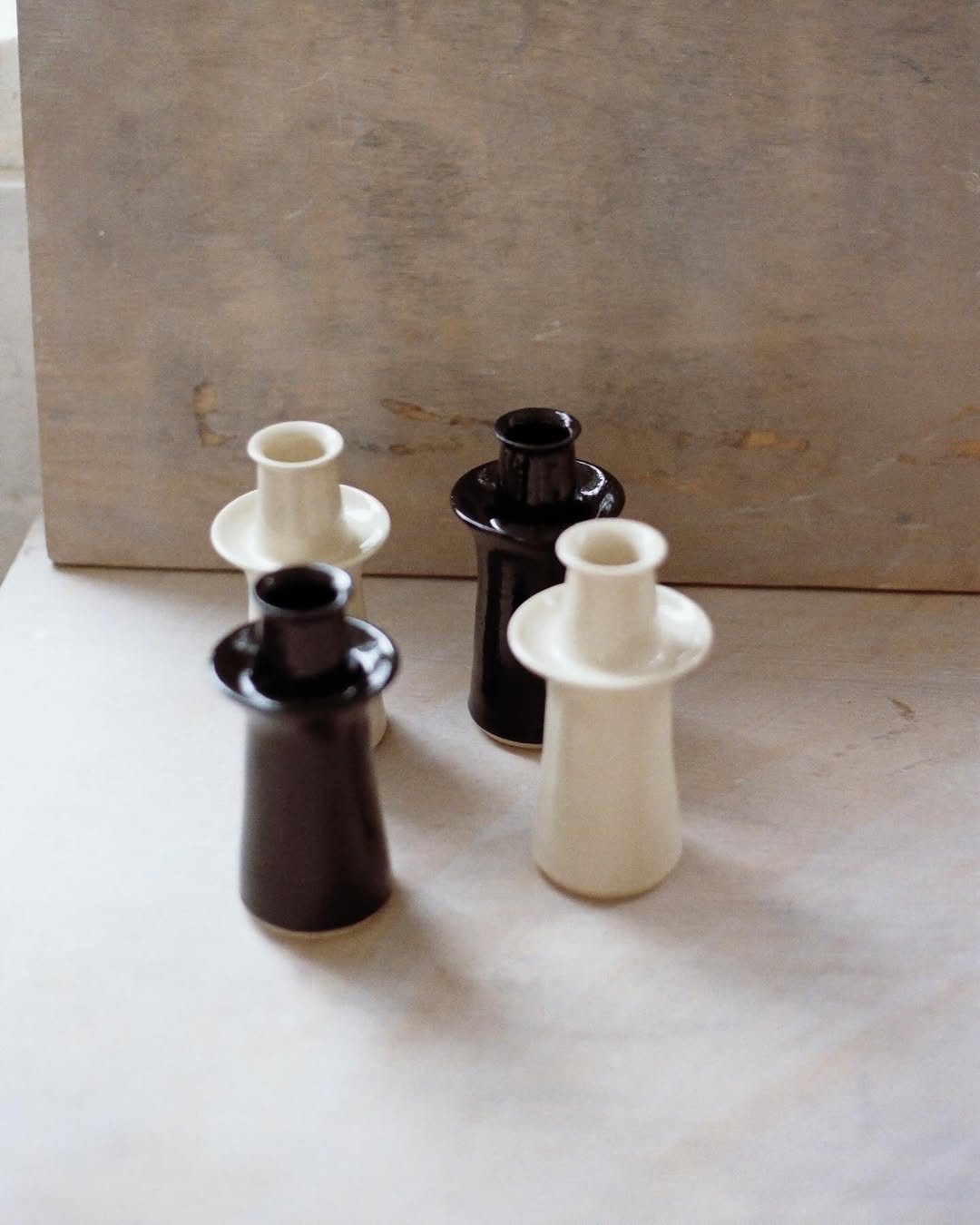
I use a small group of materials- the corner stones being metal oxides and a German white clay. All my slips/ colouring comes from this starting point. I think this helps tie everything together, whilst also ensuring I have minimal waste in the studio and can recycle as much of the materials I use as possible. This is important to me both environmentally, and in terms of giving myself boundaries whilst creating work- otherwise the options for what you can do in clay are limitless!
5. Can you tell us about a favourite piece you’ve created and the story behind it?
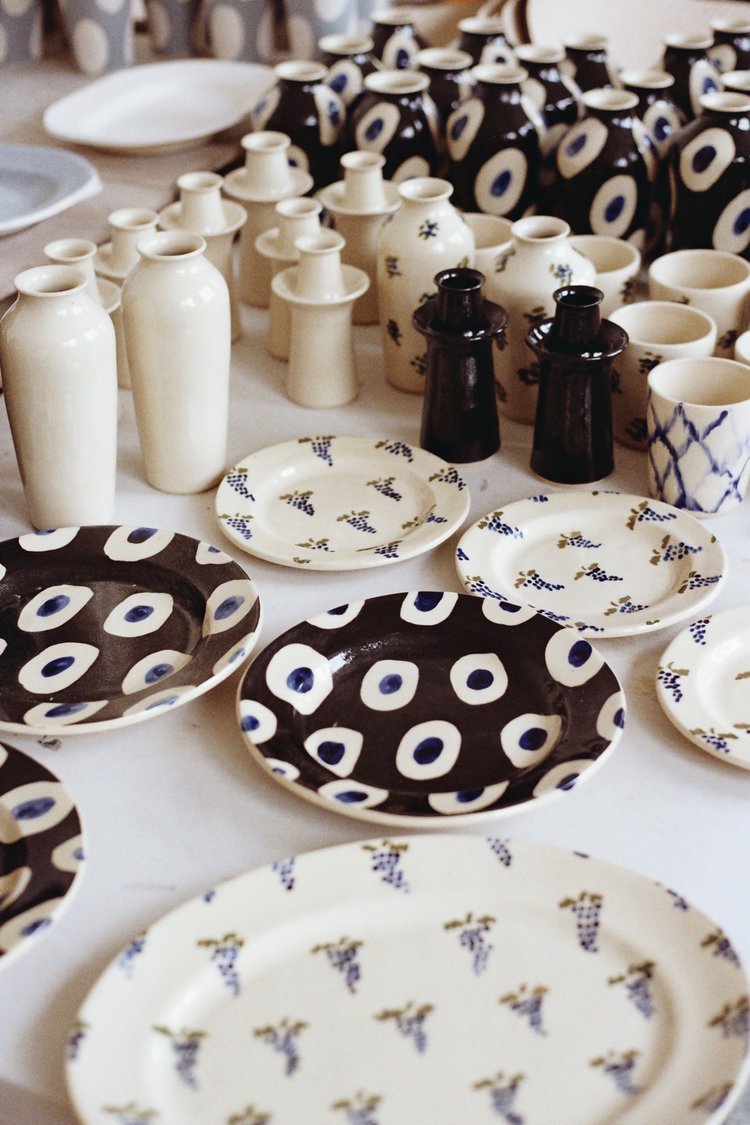
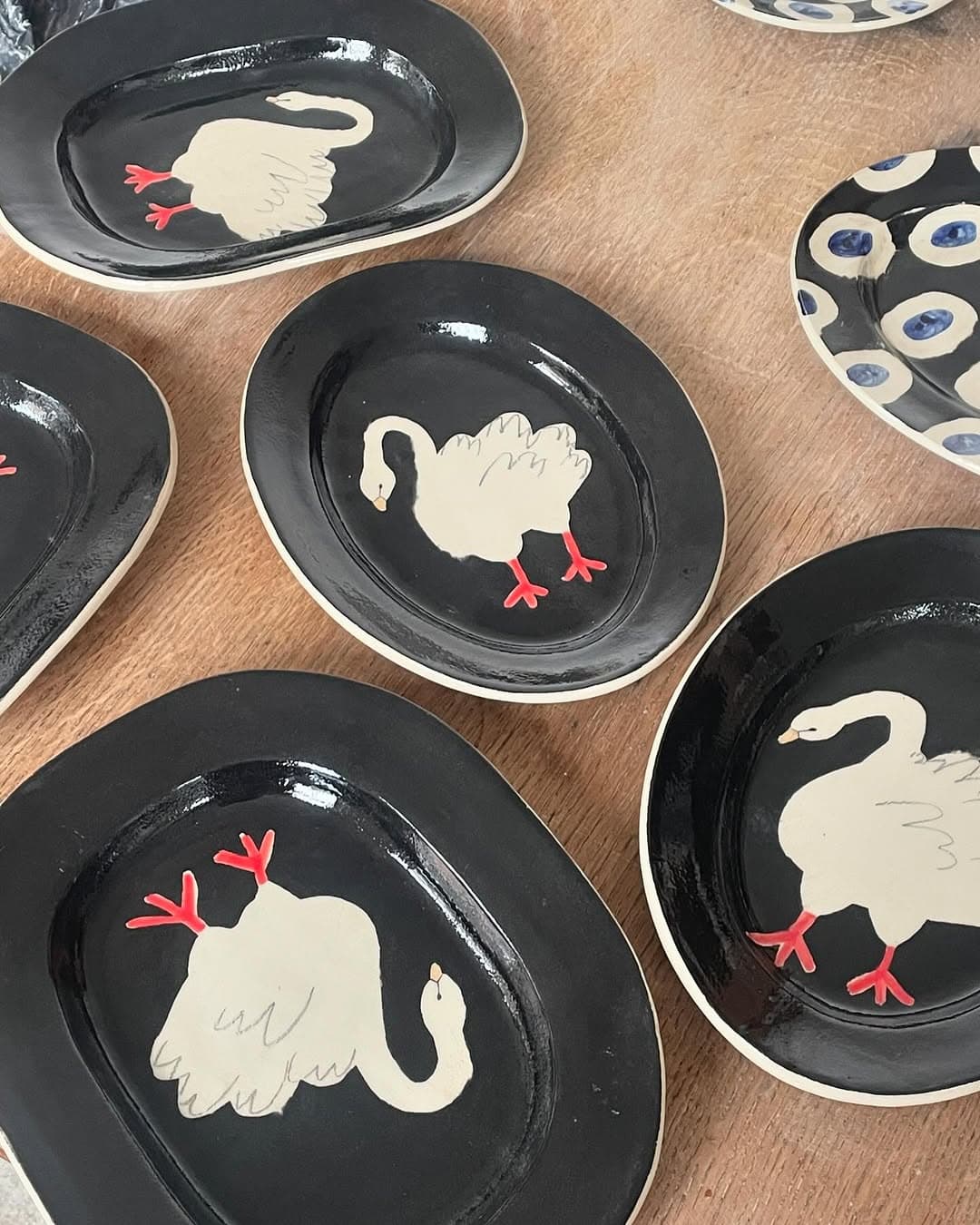
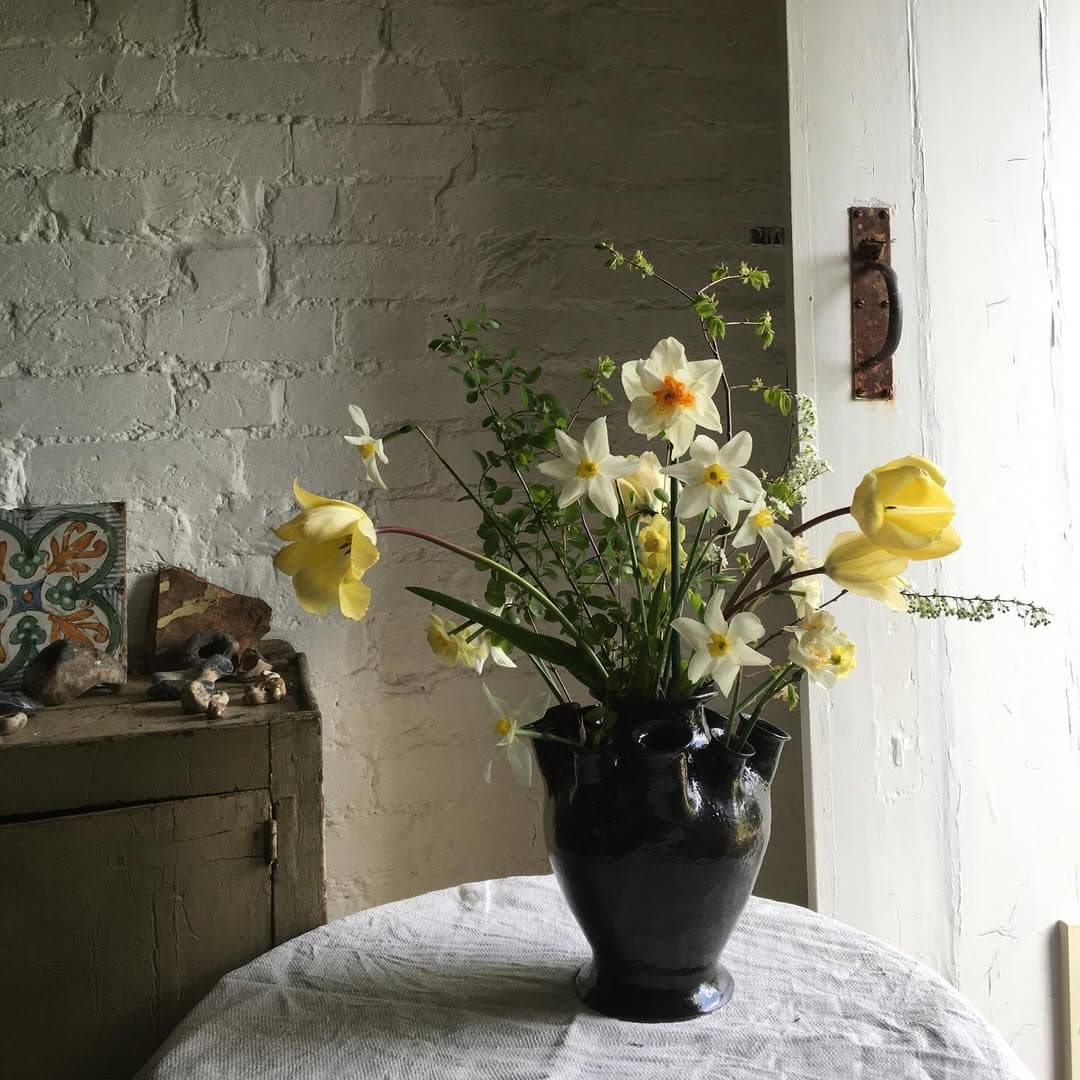
I particularly love working on repeated motifs, swans and grapes come up a lot in my work. There isn’t really a story behind it just comes from looking and processing things around me.
Creative process
6. What does a typical day in your studio or workshop look like?
I normally have quite a mixed day as I do everything myself, from packing to admin to making. I start with a swim at the local pool on my way in, then usually make a coffee and a to do list/ check urgent emails. My studio looks over factory rooftops and I’m lucky to see a lot of sky from inside, but I try and get outside either to eat lunch or have a walk to my local Oxfam to get some fresh air! I try and group jobs together but a day can get quite hectic and full of different tasks/processes. In ceramics it’s super important how each day runs into the next in the studio, so it takes a fair bit of planning in regards to what you do on day one then day two etc. I normally end the day with a post office run or a trip to the kiln. I listen to music or podcasts pretty much all day long, if anyone has any recommendations please let me know!
7. Do you have any unique rituals or habits that help you stay creative?
Not unique- just looking at things! I try and spend as much research time as possible in museums, or doing first hand research through mudlarking. Research books are the next best and are endlessly inspiring to me.
8. How do you handle creative blocks? Do you have any strategies or tips for overcoming them?
Probably by doing the above! Seeing my favourite pieces in museum collections always makes me feel inspired again.
Challenges and successes
9. What’s the biggest challenge you’ve faced as a maker, and how did you overcome it?
Balancing my time in the studio and having a life outside of it! Still working on it, but this year I took most of January off and that definitely helped mentally reset me from the mindset of everything will fall apart if I’m not in the studio 24/7. When I have big deadlines I can end up being in the studio until gone midnight, every day of the week- it just leads to burnout.
10. What’s been your proudest moment or achievement so far?
Going full time about 4 years ago, and somehow managing to keep in going, is the thing I’m proudest of.
Inspiration
11. Where do you draw inspiration from for your work? What sparks your imagination and creativity?
Historical ceramics from around the world
12. Do you have a favourite artist, maker, movement, or tradition that has influenced your craft?
Too many, I particularly love 17th century London delftware and slipware though.
13. How does colour influence your practice; is it an important part of your process? Do you have a particular palette or favourites? Any go-to sources for colour inspiration?
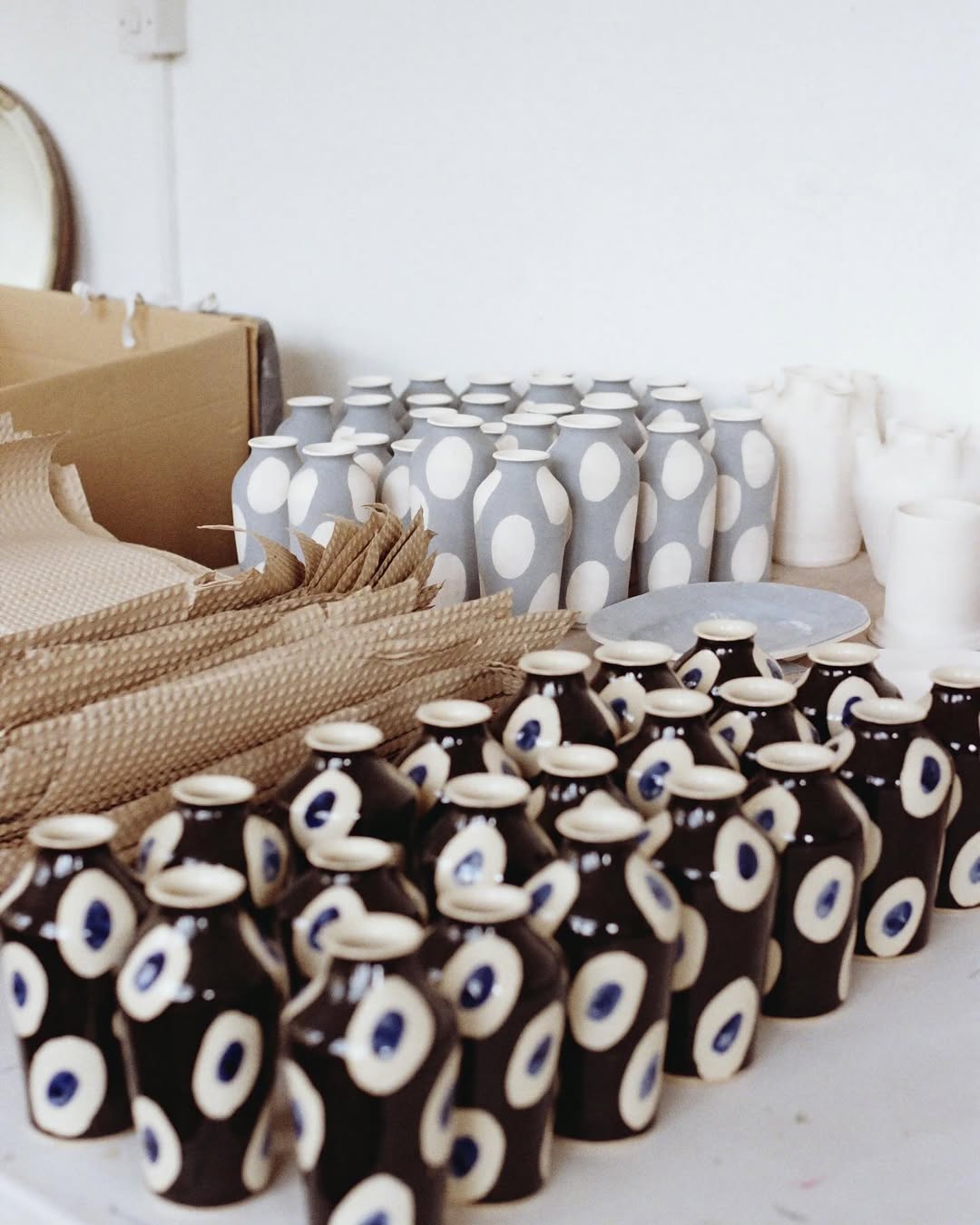
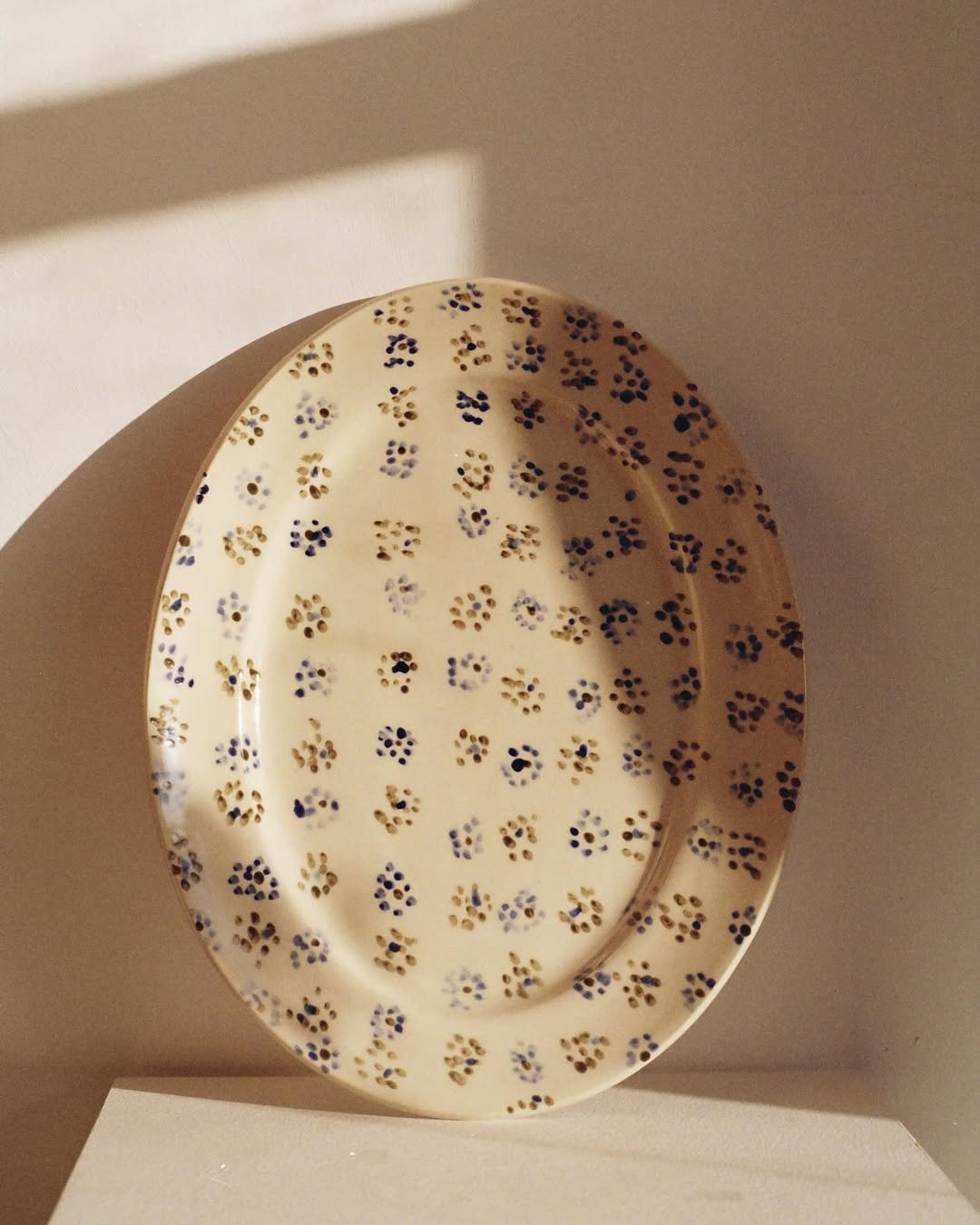
The colour palette I use is drawn directly from my materials- so cobalt blue, iron red/brown, an off-white clay, black slip. They are inherently natural and soft and go together, I somehow end up wearing all the same colours as my work too!
Perspectives and goals
14. What role does your environment play in shaping your creativity?
It informs how I choose materials and how I structure my business- I am very careful about making tests and aware that once ceramics are fired they last for thousands and thousands of years. I normally make pieces to order so I know that everything going in the kiln has a home to go to.
15. What do you want people to feel when they experience your work?
I’d like them to enjoy using, or living with my work
16. What are you currently working on, and what excites you most about it?
I am currently working on some special collaborations which I’m excited to share soon
Advice and reflection
17. What advice would you give to someone starting out as a maker?
Stay true to yourself, be thoughtful and considerate
18. If you could go back to the start of your career, what advice would you give your younger self?
I would try to give myself more confidence, I always have imposter syndrome!
Closing thoughts
19. If you could collaborate with any artist, past or present, who would it be and why?
Maybe Josef and Annie Albers as a duo. I’ve always been interested in art education and I admire how this feeds into their work. Plus they had a great research collection of objects at home, and their work is also great obviously.
20. Where can people find your work, and how can they support you?
They can find my work at alihewson.co.uk
And support my through signing up to my newsletter, or ordering through my shop — thank you!
Ali Hewson’s ceramics embody simplicity, timeless elegance, and thoughtful craftsmanship, creating pieces designed to be cherished for generations. Her commitment to sustainability and careful consideration of materials results in objects that effortlessly blend beauty and function.
Explore Ali’s latest collections and follow her creative journey:
Discover Ali’s Work:
Support Ali by subscribing to her newsletter and exploring her beautifully crafted ceramics online.
Meet the Maker: Hal Haines' vibrant approach to visual storytelling
In this Q&A, we chat with Hal Haines about his transition from photography into multidisciplinary making and growing his vibrant world of ceramics, lighting and paintings. Hal shares insights into his creative process, the influence of personal experiences on his work, and the joy of combining different materials and techniques.
We discuss the challenges of valuing one’s work, finding inspiration in everyday moments, and the importance of authenticity in a rapidly changing creative landscape.

1. Can you tell us a bit about yourself and your artistic journey?
I have always been creative, and when I got to the age where I had to specialise in a particular area – as a profession – I found it incredibly hard to choose something. I worked as a photographer for 8 years, mostly for travel and lifestyle projects, and I loved the documentary/visual storytelling part of that work, as well as manipulating light and colour. Though I continued to draw and paint, and occasionally work in 3D during this time, it wasn’t until the covid lockdowns that I had an opportunity to really explore this side of my practice.
Picking up a camera begins the artistic journey into photography. As a medium it’s quite accessible, solely down to the individual to make something of it. Pursuing a craft is much more complicated; you need access to facilities and materials and some sort of instruction. You also need a lot of time, and freedom to play, to make mistakes and the grace to learn from them. The first three months of the pandemic gave me time, for the first time in a very long time.
2. What inspired you to pursue your craft? Was there a defining moment or influence that sparked your passion?
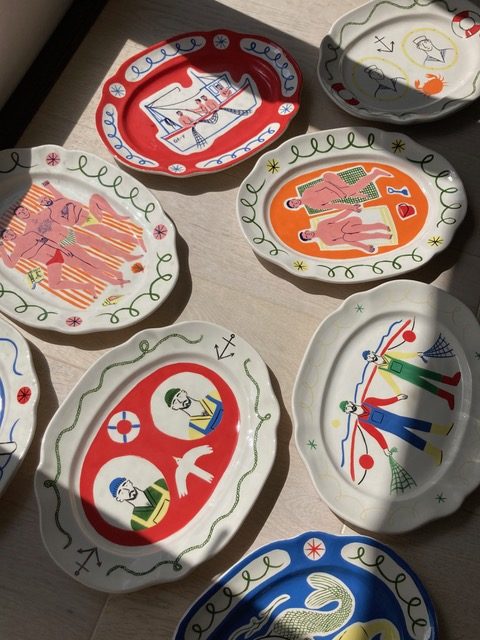
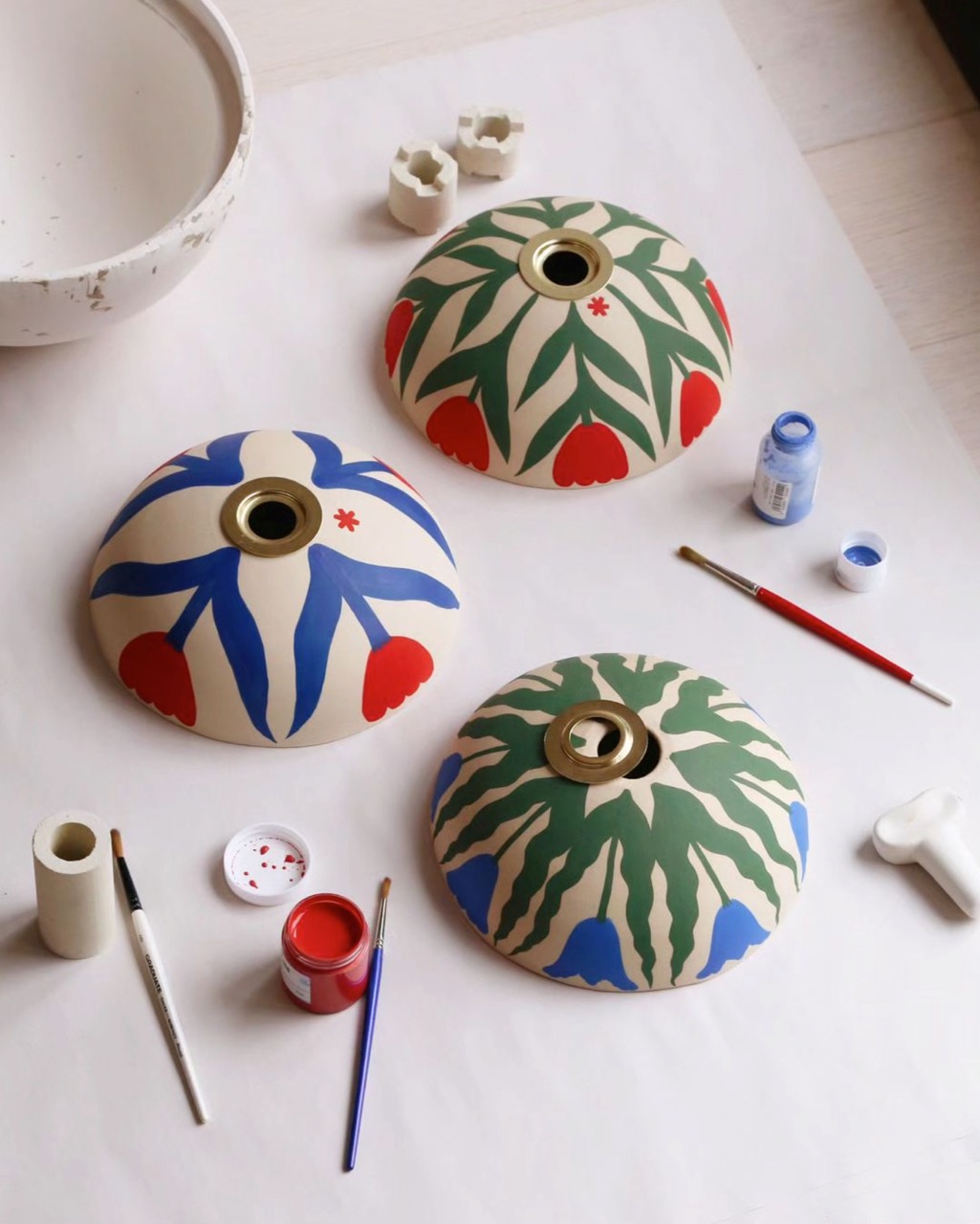
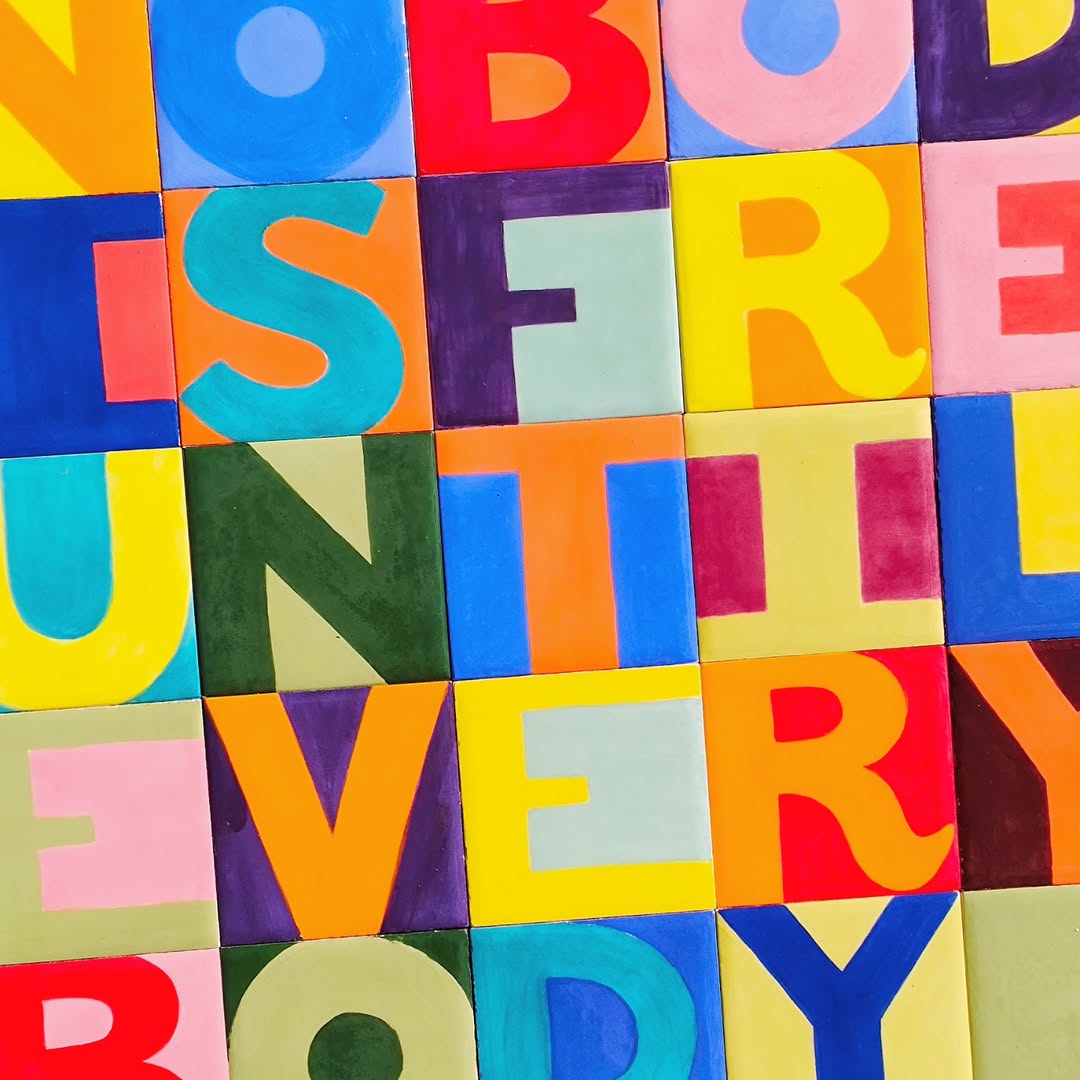
I’m still not sure I would define myself by one particular craft or process. I use different techniques as a way of expressing my ideas or telling stories, usually influenced by my own life experiences. Queerness, nature, pop culture, human connection, food and drink, I like to explore a wealth of topics. The visual language I have developed: vivid, playful imagery and a combination of textures and colours, is woven through all the pieces I make, whether they are ceramic, wood, textile or a painting on paper.
Your craft
3. How would you describe your work in three words?
Charming, Vibrant, Familiar
4. What materials or techniques do you use, and why are they important to your process?
Ceramic, Paint, Wood, Metal, Fabric, Pencil, Crayon, Paper, they are all important, individually and in the context of each other.
5. Can you tell us about a favourite piece you’ve created and the story behind it?
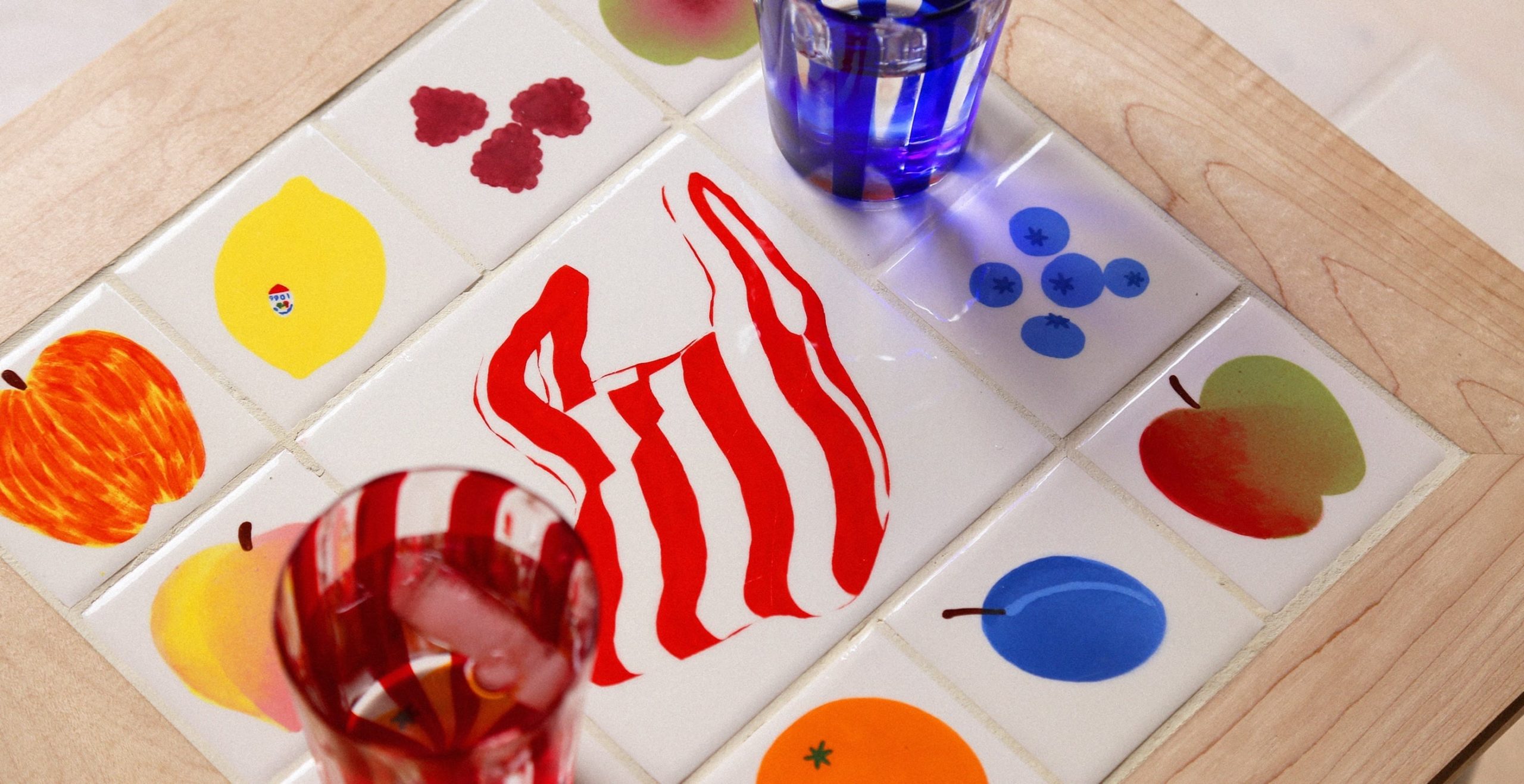
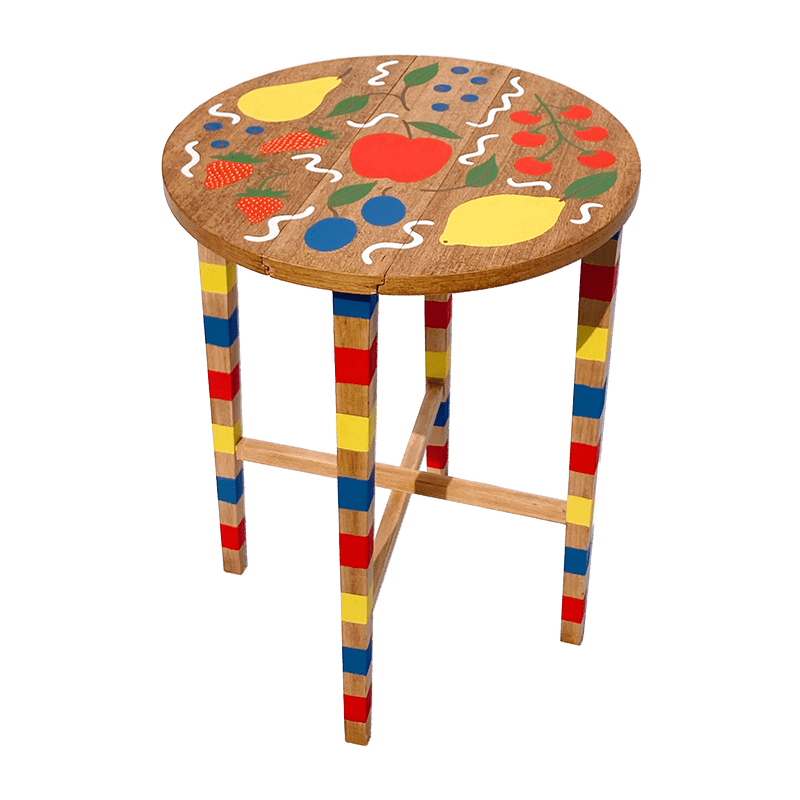
The ‘Fruity’ table I made in 2023, for which I painted and waxed a midcentury end table, was one of two tables I painted for a show of my work at Pentreath and Hall; I wanted to make some larger scale pieces for the window of the pop-up space. It’s still a favourite of mine because it felt like a pivot in my creative process, a marriage of several techniques I had been exploring, and a foray into functional furniture pieces. Since then, combining materials like wood with ceramic, or paint with fabric, has been engrained into how I approach new projects.
Creative process
6. What does a typical day in your studio or workshop look like?
I have decided to try and stick to three studio days a week and reserve the other two (or sometimes four) for the business side of my work. A typical studio day looks something like this:
Sit down, stand up, make a cup of coffee, sit down, scratch head, put on a podcast, paint in hyperfocus for three to four hours while snacking from my lunchbox intermittently, leave the studio for a period of time, return with another coffee, procrastinate for ten to fifteen minutes, work in hyperfocus for the rest of the day.
7. Do you have any unique rituals or habits that help you stay creative?
Audio is essential for me. Music or podcasts, occasionally reality TV, if I forget my earphones it’s all over for me. I find rituals are extremely important, but I often shift from one to another. I will do something habitually for a period of time and then move on. I used to burn a particular scent of St Eval candle in my studio every day, or drink a specific Pukka tea infusion (one with fennel), or binge a full podcast series back to back from beginning to end.
8. How do you handle creative blocks? Do you have any strategies or tips for overcoming them?
Do something else. Instead of sitting at my desk for hours in suspense I just step back, whether it’s to create something different, or work on another project, or in fact just take the rest of the day off and possibly go to the pub. My justification for this is: if I was an athlete and I had a foot injury, I wouldn’t try to keep running, would I?
Challenges and successes
9. What’s the biggest challenge you’ve faced as a maker, and how did you overcome it?
There are lots of challenges to face, it can be pretty gruelling at times, but I think the biggest one for me has been knowing my worth. Making something and putting it out into such a vast, varied market is a challenge indeed. There are so many tiers of maker, from day one hobbyists to established artisans. You have to assert yourself somewhere – and hope that consumers agree! The same goes for working with brands, or galleries, or collaborations: knowing the value of your artistry is essential.
10. What’s been your proudest moment or achievement so far?
I did an exclusive collection of pieces for Paul Smith at the very start of 2021, a couple of months after launching my website, and I’m still so proud of that project. I think because it was such an affirmation at the very beginning, it gave me the confidence to just go for it thereafter.
11. What’s your favourite quote you’ve ever heard about your work? Who said it, or what was the name of the publication?
“Please let me know when you get this in!! Love”
- Amy Sedaris

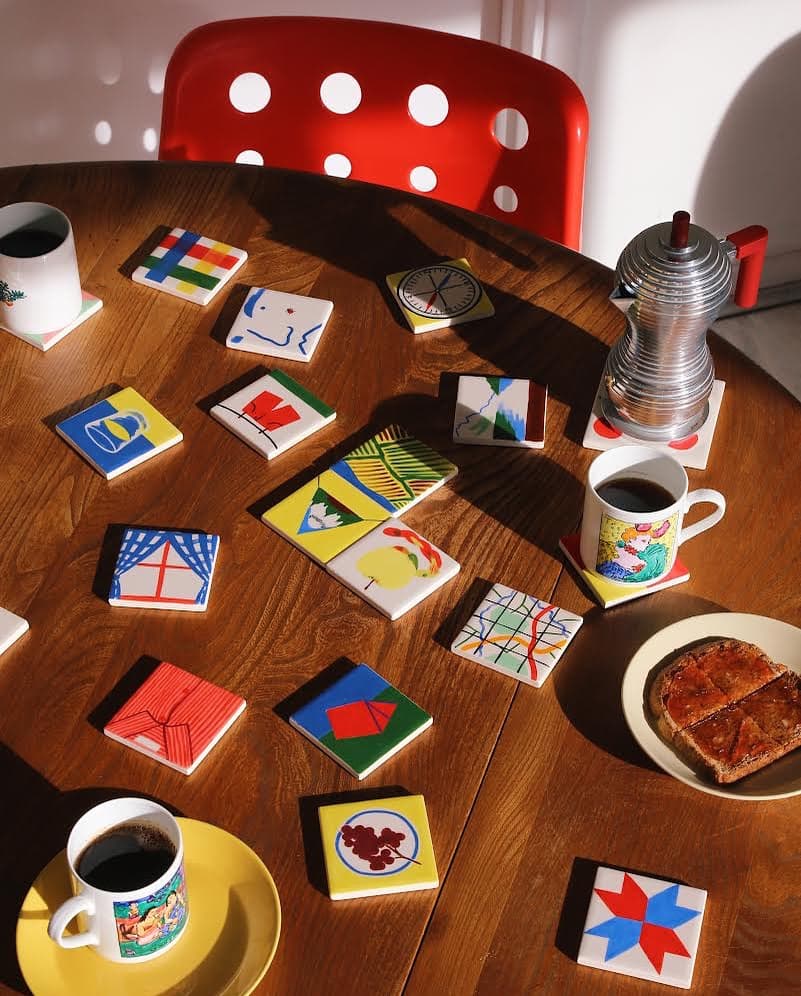
Inspiration
12. Where do you draw inspiration from for your work? What sparks your imagination and creativity?
Inspiration is truly everywhere. I am always looking, and recording with my camera or in a notebook. It can really be anything, from a conversation I had to an old cushion in a charity shop, to my allotment in springtime or vintage supermarket packaging.
13. Do you have a favourite artist, maker, movement, or tradition that has influenced your craft?
I love colourful, mid century visual communication – illustrators like Dick Bruna and Richard Scarry, or graphic design by Paul Rand – as well as modern 90s interiors; metal, glass, pops of colour, ambient lighting.
14. How does colour influence your practice; is it an important part of your process? Do you have a particular palette or favourites? Any go-to sources for colour inspiration?
I think it’s fair to say that colour is an essential part of my process. Though my work is very vibrant, I definitely have a palette I stick to. I like to keep my colours clean, without a lot of mixing between, and only have one red, one yellow, one orange, a light green and a dark green, sticking to primary, secondary and occasionally tertiary groups. The colours I use in my ceramics are limited because they are caused by chemical reactions, but these tend to be the colours I replicate in my paintings and prints as well.
Perspectives and goals
15. What role does your environment play in shaping your creativity?
I’m neuro divergent, so my relationship with my environment can be rather complex. I’m overly sensitive to light and sound, so I can get very distracted and overwhelmed if the conditions aren’t conducive. Sometimes I feel like I might explode, often just because I can’t find my earphones. Other times I think I must seem ridiculous for how enthusiastic I can be for the right sounds or the right light, or colours, or shapes. A nice beam of sunlight or a song produced by
William Orbit is like drinking a Redbull! I also like to surround myself with things that are visually stimulating – reflective silver surfaces, complimentary colours, my River Cafe Cookbook or Alessi kettle get double points.
16. What do you want people to feel when they experience your work?
I often get told that my work feels nostalgic, which I like. I guess I’m trying to create something timeless, that feels fresh and exciting, but also familiar.
17. What are you currently working on, and what excites you most about it?
I’m working on a collection of prints and a new series of ceramic lampshades. I also have some secret projects on the way and I’m most excited about sharing those!
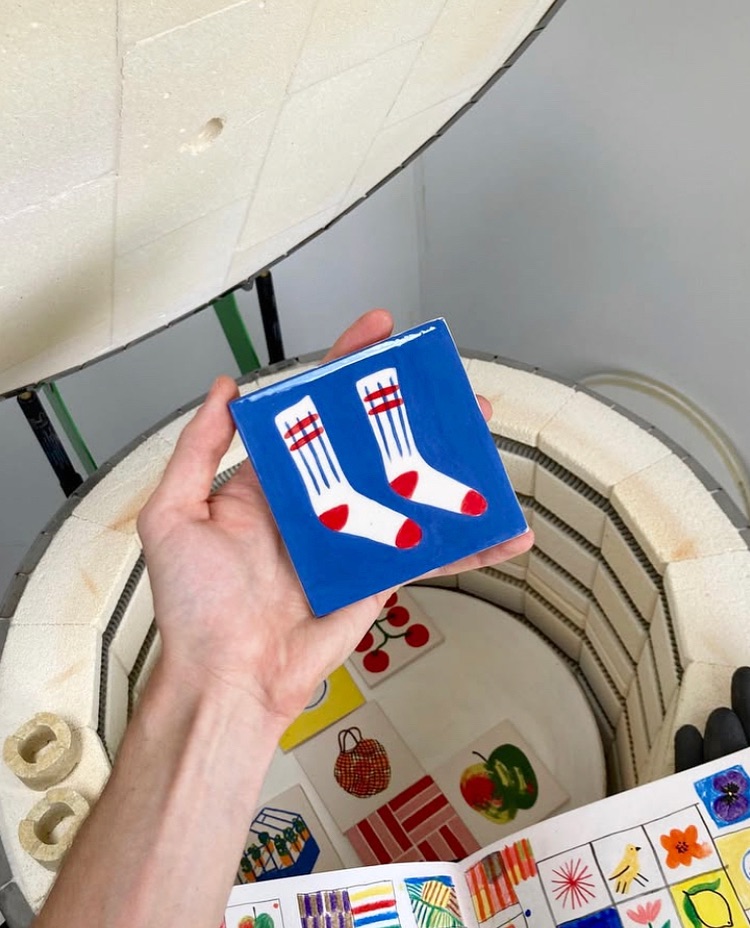
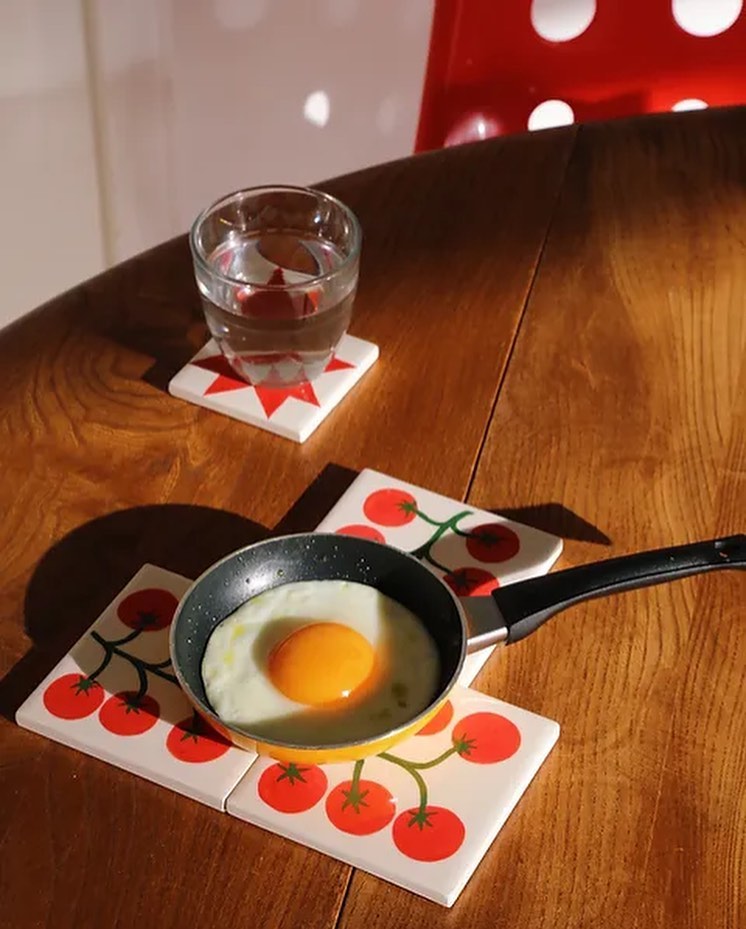
Advice and reflection
18. What advice would you give to someone starting out as a maker?
There is definitely a pressure to conform to trends, especially on social media. My advice would be to do your own thing, listen to your instincts, and find your own references. Always strive for substance and longevity over instant gratification!
19. If you could go back to the start of your career, what advice would you give your younger self?
If it feels right, go for it. And always get it in writing!
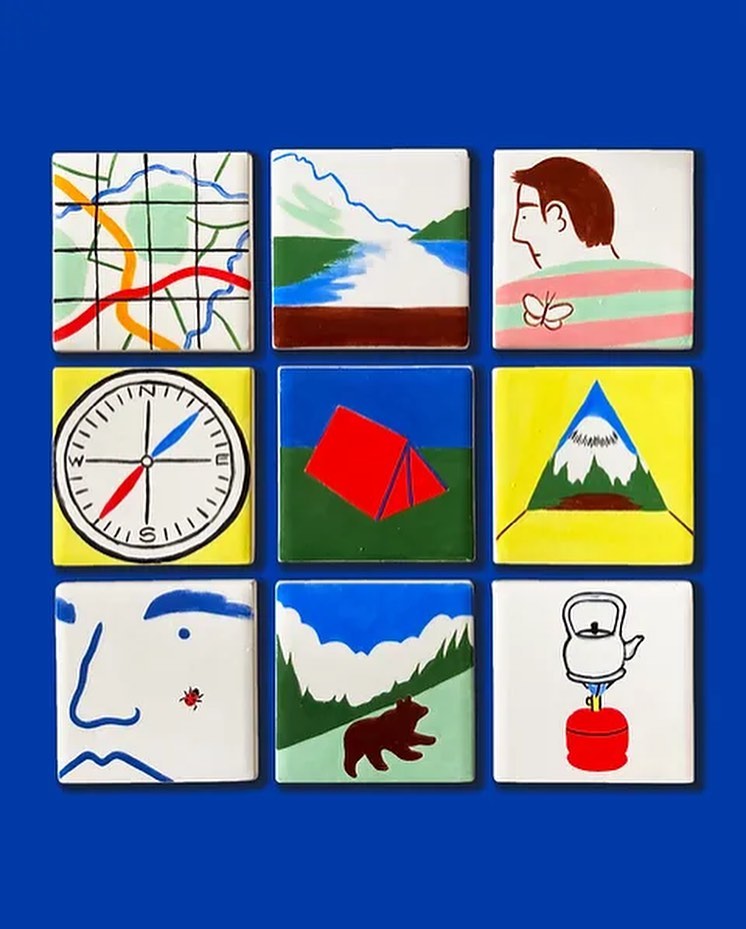
Closing thoughts
20. If you could collaborate with any artist, past or present, who would it be and why?
I would have loved to work with Sir Terence Conran. I feel an affinity for his outlook and his principles, and I admire his entrepreneurial spirit, as well as his appreciation for details. He once said that the four hallmarks of good design were “simplicity, beauty, functionality and surprise” – qualities I strive for in everything I make.
21. Where can people find your work, and how can they support you?
I sell most of my work exclusively on my website, halhaines.studio, as well as some collaborations with other brands and designers. The best way to keep up to date is through my newsletter, sign up here!
Hal’s pieces sit at the intersection of playfulness, charm and functionality. From ceramics to bespoke furniture pieces, he always strives to create something that is both characterful and useful.
Explore Hal’s latest collections and follow his creative journey:
Support Hal by exploring his website and staying connected through his newsletter for updates on new projects and collaborations.
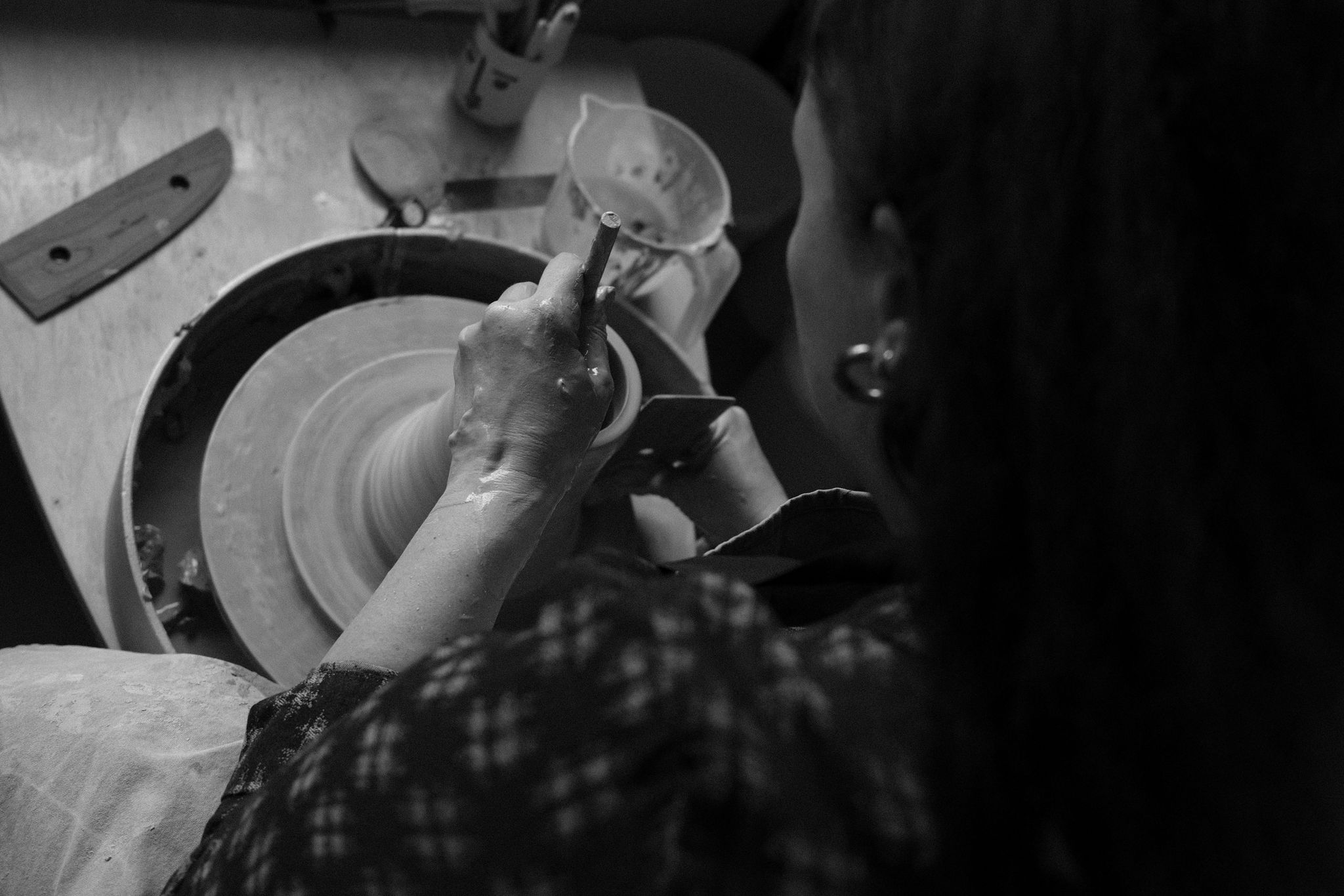
Rituals for Creativity by K.S.Creative
Creativity is deeply personal, and over the years, I’ve realised that every artist has their own rituals—small, grounding habits that set them up to have a productive day creating.
As a ceramicist and founder of K.S. Creative Pottery, I have always been fascinated by the rhythms and routines that shape the creative process. Whether it’s a quiet morning moment, the hum of a favourite playlist, or the tactile act of working with clay, these rituals not only influence my own practice but also offer insight into how other makers find their flow.
In this article, I explore the role of these daily habits, drawing on my own experiences and those of fellow makers, to understand how creativity is nurtured through ritual and routine.
The Playful Palette: Bold & Unexpected Combinations
Some makers are drawn to the joy and surprise of working with unconventional colour combinations.
“It’s my moment to pause before the day gets going.”
Pottery is a process of transformation—both for the clay and for me as an artist. It requires patience, precision, and focus to navigate the many stages, from preparation and glazing to firing. While every maker finds their own way of working, we all share a commitment to balancing technical skill with creative expression.
For me, starting the day right is essential. Whether it’s a cup of coffee, a walk in the countryside, or simply taking a quiet moment before stepping into the studio, these rituals create a sense of calm before the physical process of making begins.
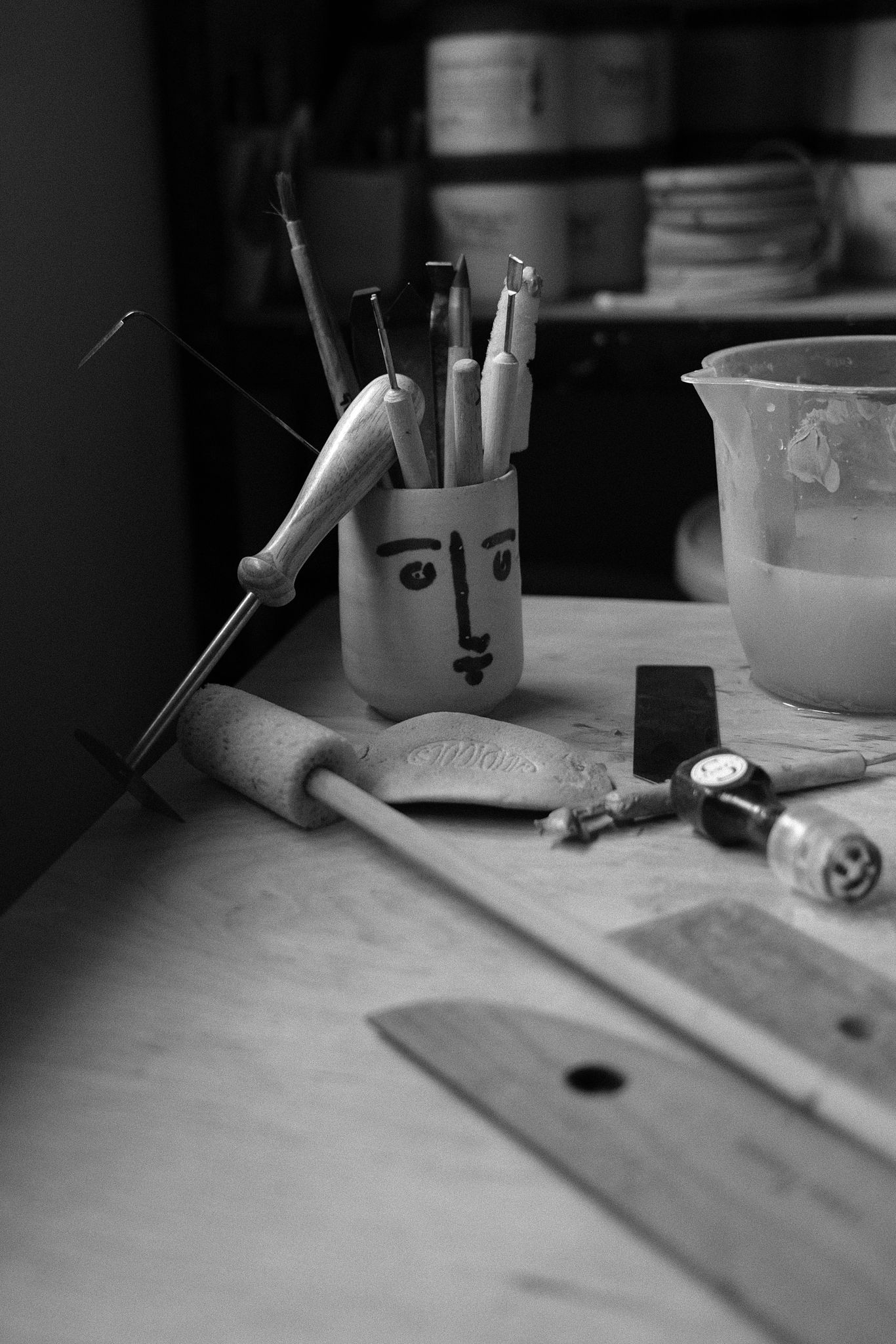
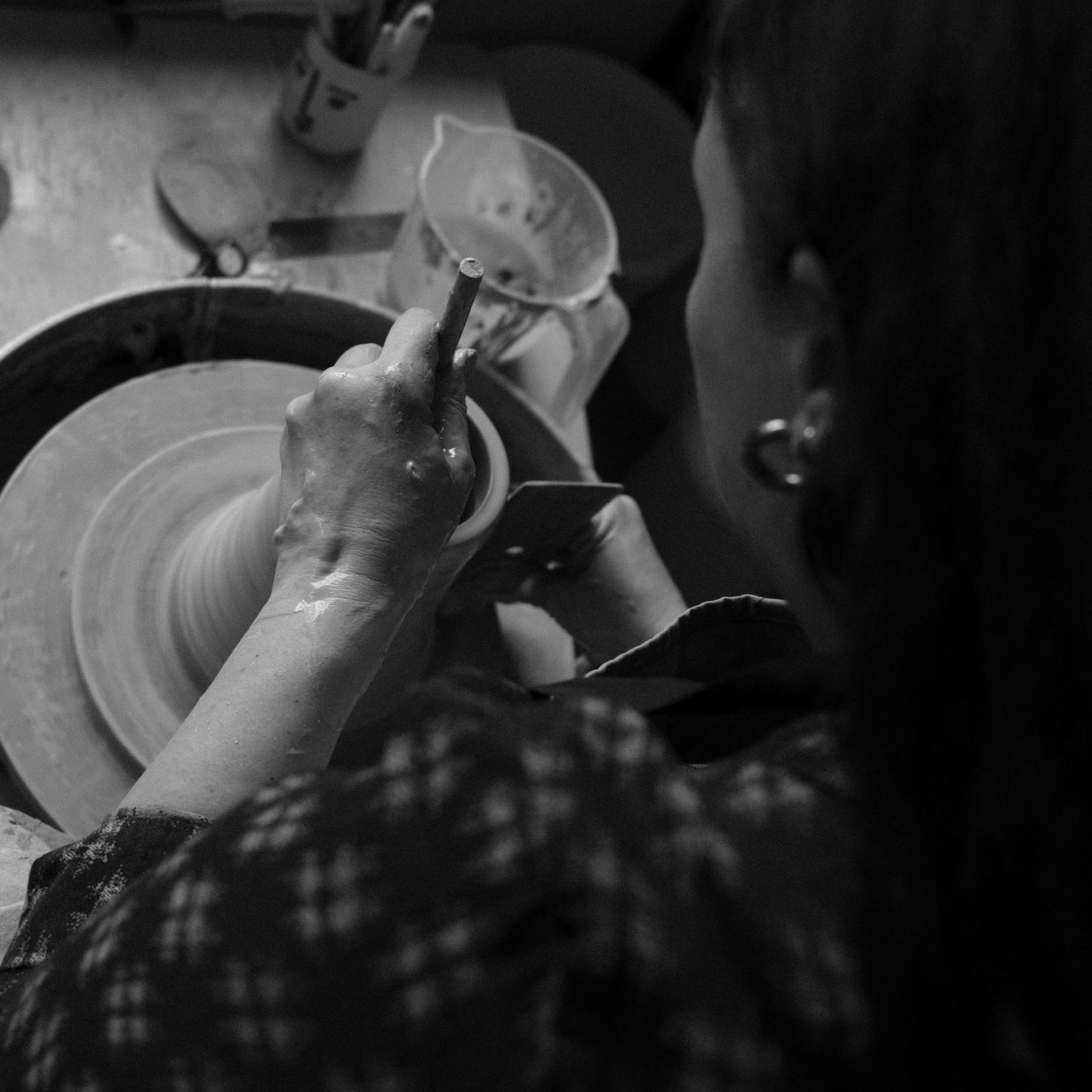
Once I’m in the studio, the environment plays a crucial role in shaping my creativity. Some makers thrive in silence, while others need sound to keep them focused on their work. I tend to have music, a podcast, or the radio playing in the background. I love Guy Garvey’s voice—it helps set the tone for the day and keeps me engaged while working.
My fellow maker Hal Haines embraces shifting rituals:
“I find rituals extremely important, but I often shift from one to another. I used to burn a particular scent of St Eval candle in my studio every day, or drink a specific Pukka tea infusion (one with fennel), or binge a full podcast series from beginning to end.”
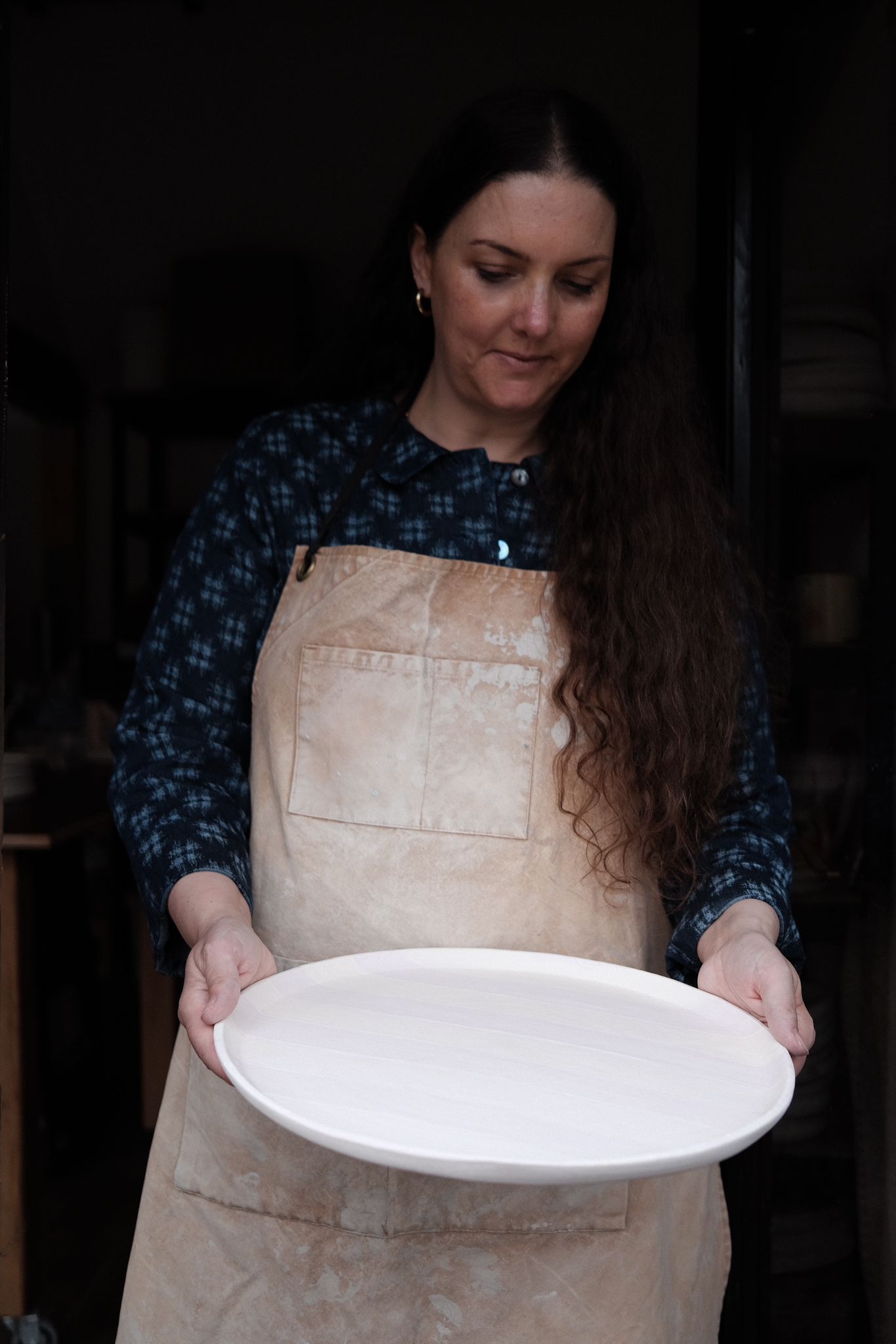
Subtle & Natural: A Muted, Calming Approach
While some makers embrace bold contrasts, others prefer a more understated, calming palette.
Making in clay is both enjoyable and rewarding—often described as therapeutic—but it is also physical and demanding. It takes skill and practice to master the craft, from centering clay on the wheel to achieving the perfect glaze finish.
Leaving space for creativity is just as important as mastering the technical aspects of pottery. Artists and makers understand that inspiration cannot be forced, and allowing room for spontaneity can lead to some of the most meaningful work.
“I make sure to give myself the freedom to experiment — Some of my best pieces have come from moments where I simply let the clay guide me.”
Hodge Potts
Hains echoes this sentiment, emphasising the importance of curiosity:
“If you don’t leave room for exploration, you risk losing the joy in making.”
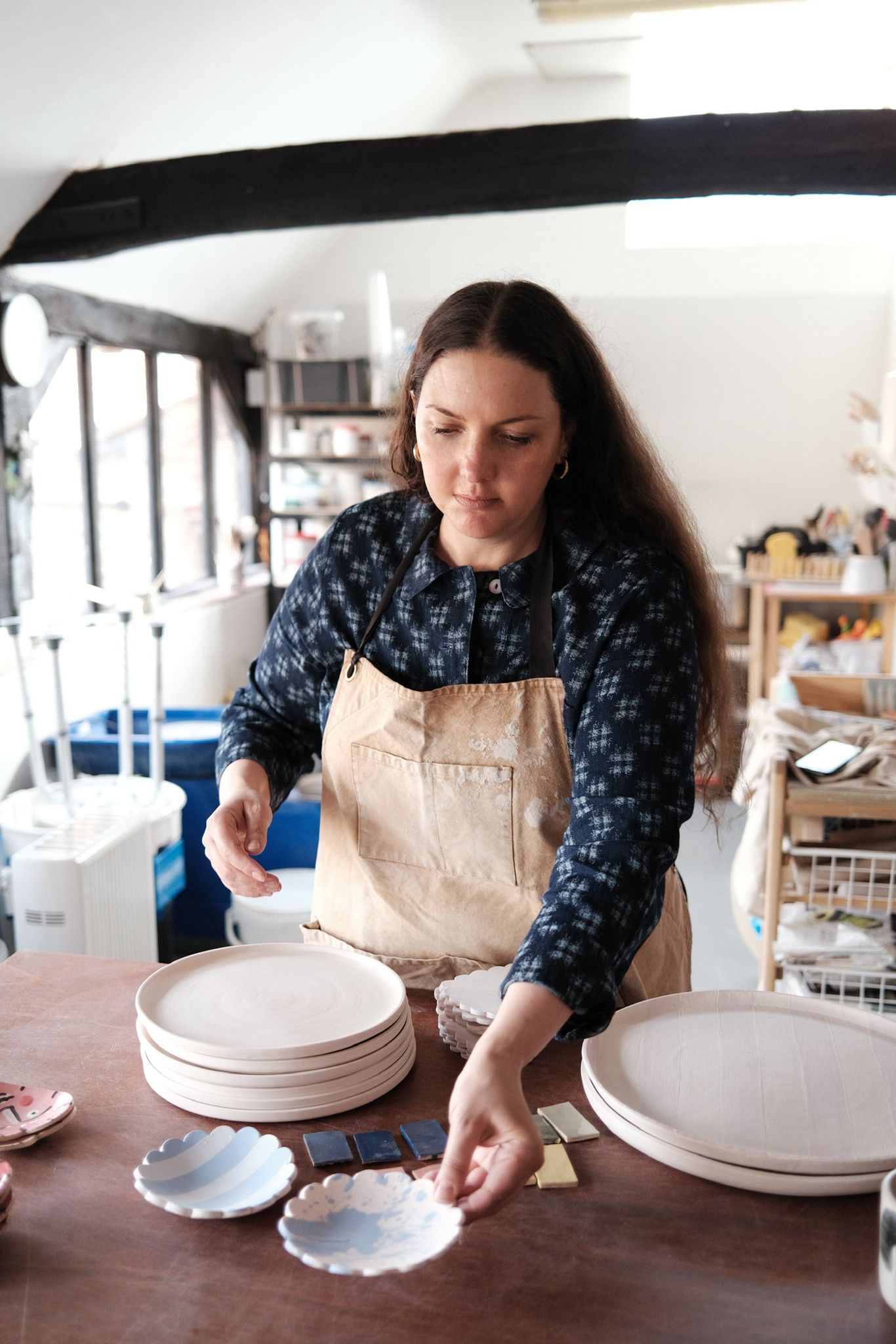
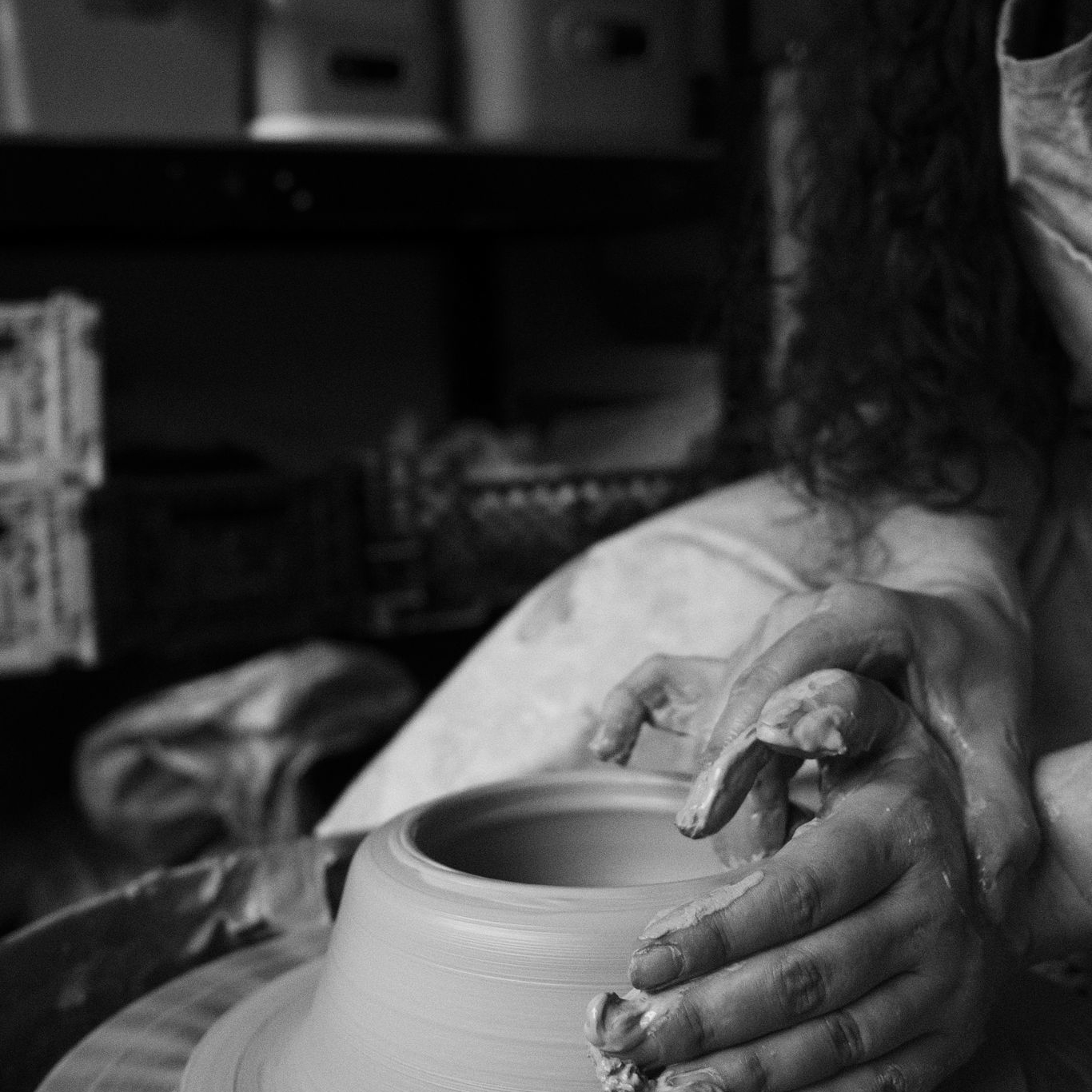
Having structure is important—especially when making to order or working to deadlines—but leaving room for spontaneity is crucial for true creativity. It allows new ideas to develop naturally.
Maker Hodge Potts shares a similar approach:
“I don’t start with a fixed plan for every piece. I allow myself to be inspired by the material, responding to it as I go.”
Hodge Potts
I see value in both approaches:
“Some artists thrive on routine, while others embrace the unknown. There’s no right or wrong—it’s about what allows the creativity to come through.”
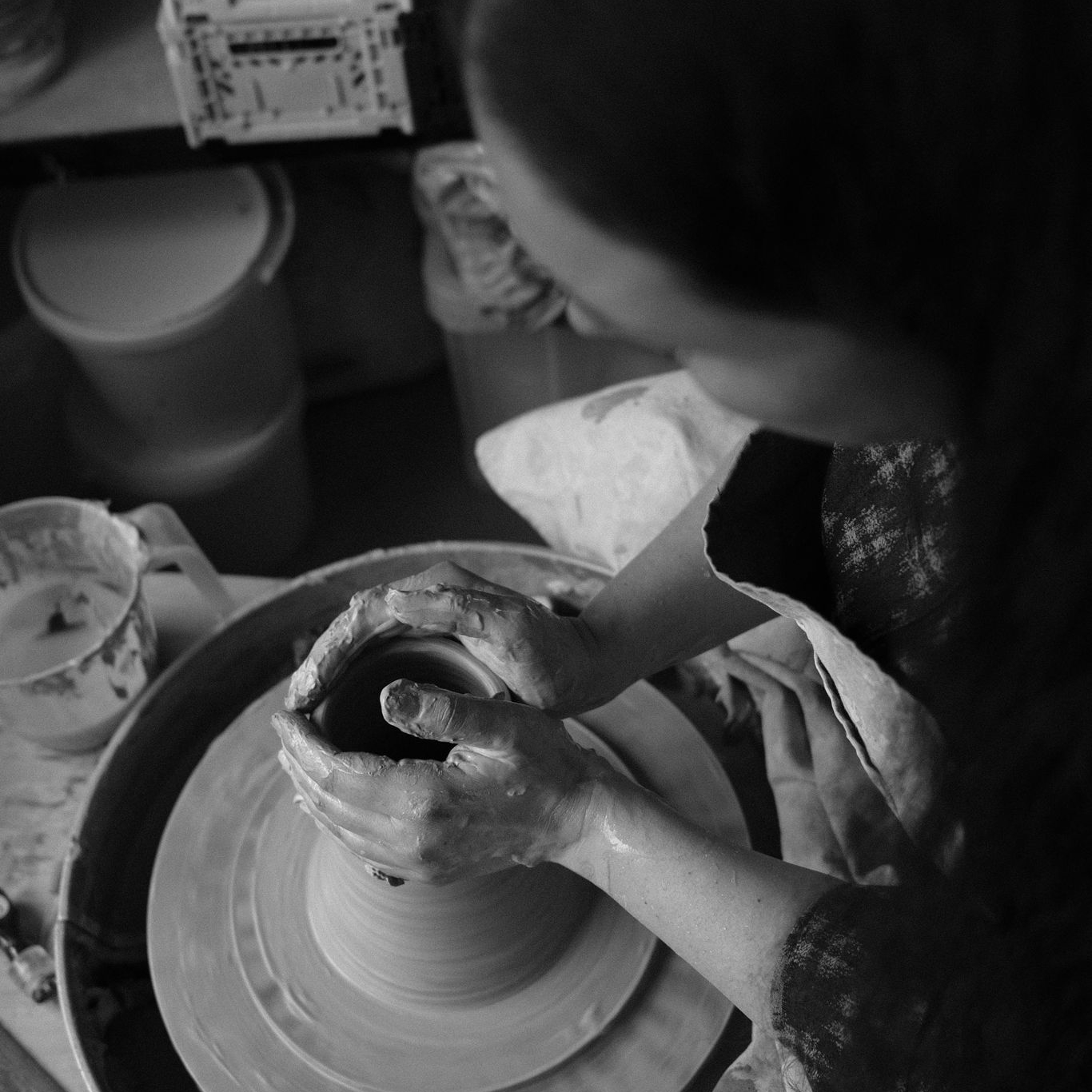
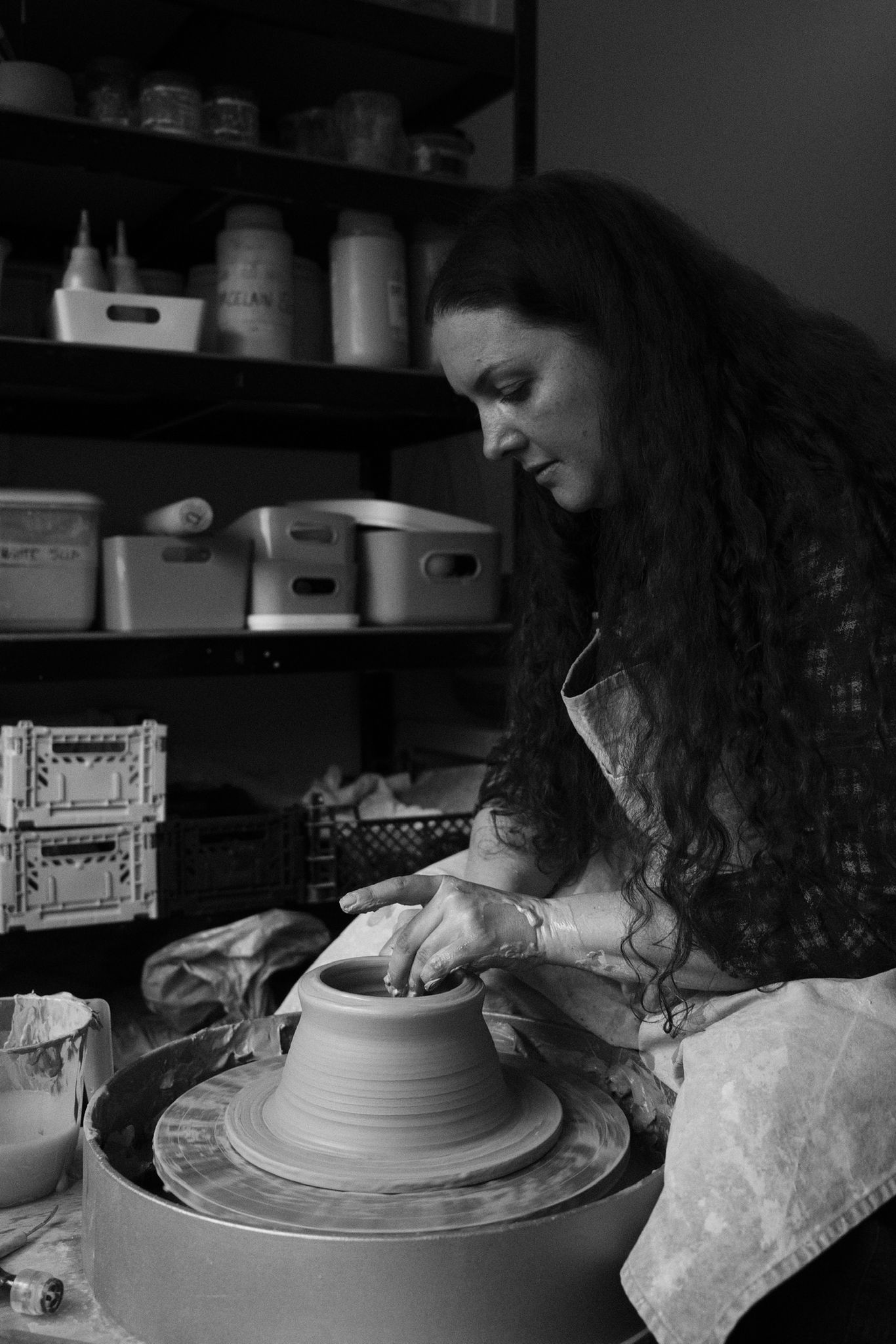
Colour as a Personal Connection: From Sketches to Confidence
For some makers, the colour selection process is about more than just aesthetics—it’s about building confidence in their creative choices.
For me, the beauty of pottery is in its balance between function and meaning. Every object carries the marks of its maker. “Showing the maker’s hand” is a term commonly used, but it’s not just about the physical marks—it’s about the process and rituals that brought the piece to life.
A handmade mug, for example, has throwing rings at its centre—marks left where fingers pulled up the walls of clay. Its glaze will be unique, with speckles and variations from the kiln’s unpredictable reactions.
A cup of tea in a handmade mug will always feel more special.
Earthy & Grounded: A Love for Natural Hues
For some makers, colour is deeply rooted in the materials they work with, enhancing the natural beauty of their craft.
“At the heart of it all is the joy of making.”
Ali Hewson
Hal Haines adds:
“If you don’t leave room for exploration, you risk losing the joy in making.”
Every artist has their own way of working, but rituals remain a common thread. These small acts shape the creative process and give meaning to making.
There’s something beautiful about the way creatives build their own rhythm.
“It’s a reminder that making is just as much about the process as it is about the finished piece.”
We could all choose to produce our pieces in a factory—but we don’t.
We want to feel the clay.
We choose to create with our own hands.
We enjoy the process—and it is the process that makes each piece unique.
There is so much that goes into making pottery, but it is these small rituals that keep us focused and enable us to produce beautiful pieces that people want to own and treasure.
Photography by: Imogen Love
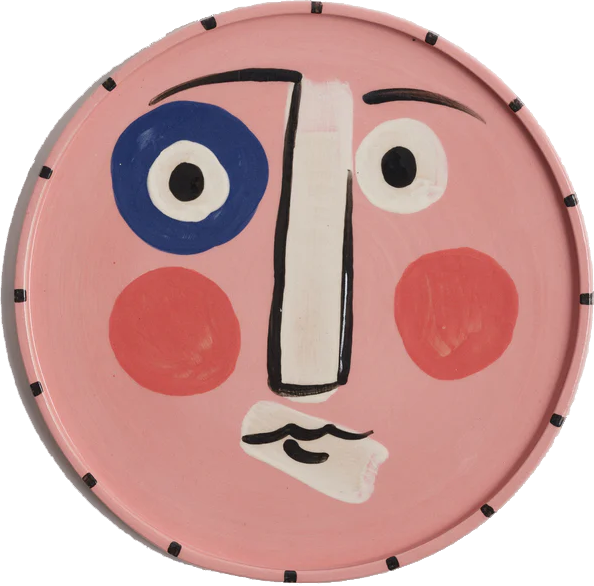
About the author
K.S. Creative Pottery
Kate Sellers is a multi-disciplinary creative and the founder of K.S. Creative Pottery, a boutique pottery studio set in the idyllic Kent countryside. With a background as a prop stylist and set designer, her artistic journey has been shaped by a love for creating and a keen eye for detail. She turned to pottery as a way to slow down, reconnect with hands-on making, and bring her vision for timeless, meaningful homeware to life.
Discover more about her work and explore her latest pieces by visiting her Maker Page.

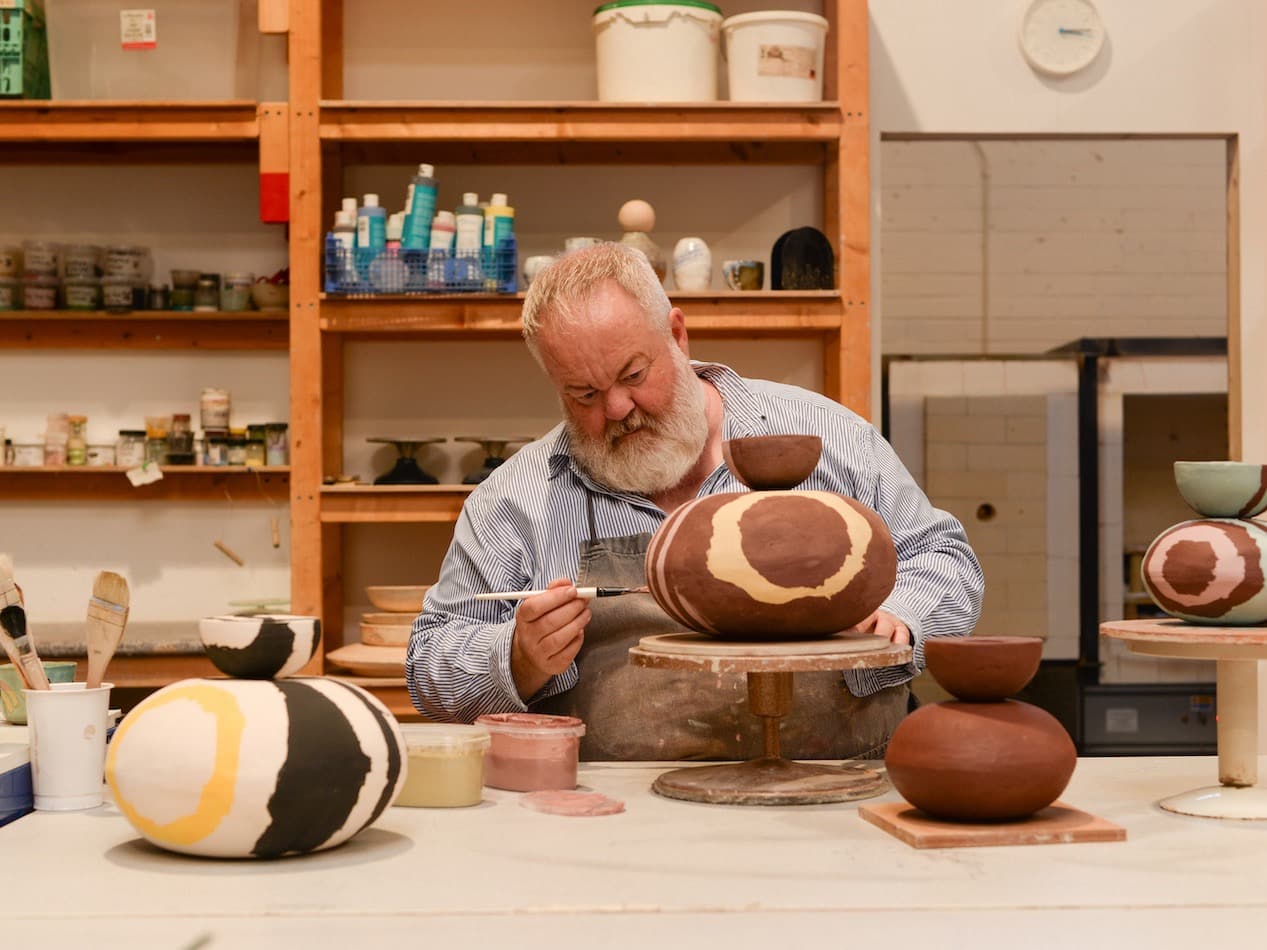
Ceramics
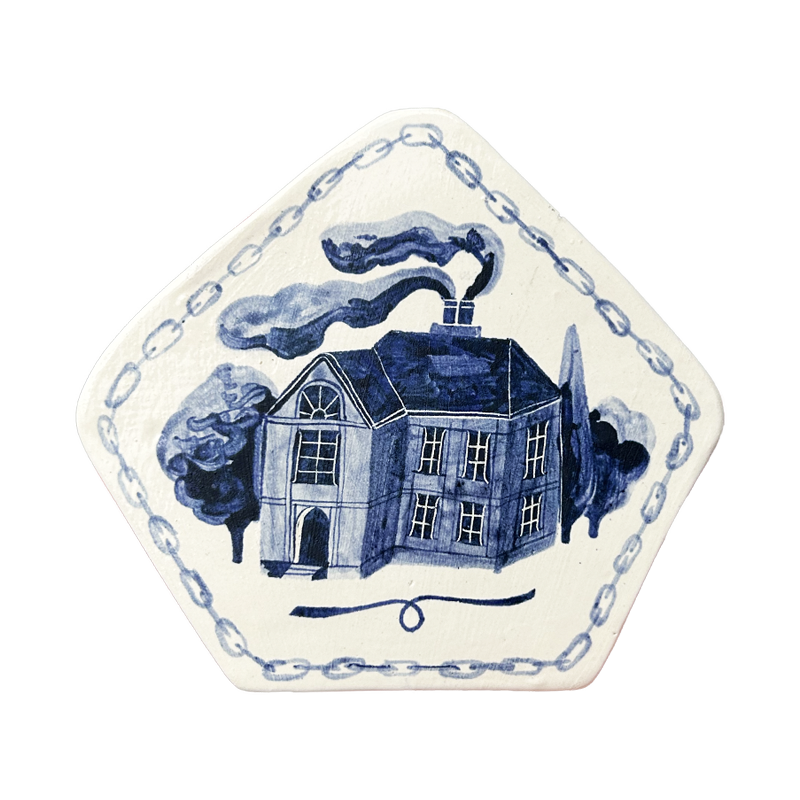
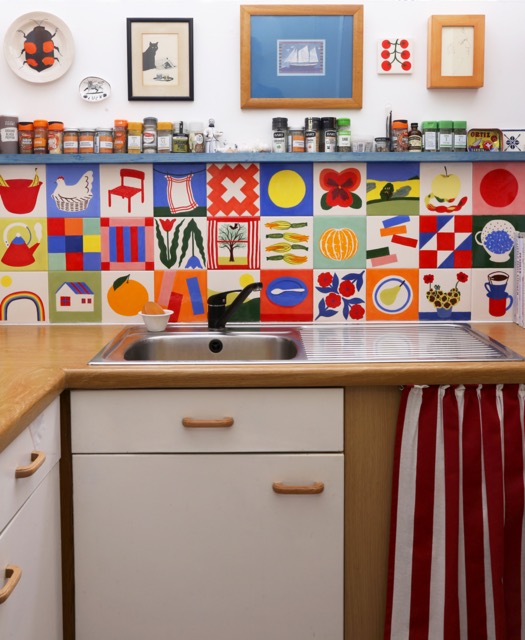
Eddie Knevett, K.S.Creative.Pottery and HoodMor take a graphic approach to their ceramics, decorating with abstract portraits, for a contemporary twist on classic forms. Eddie uses torn paper resist to create his bold coloured vases, whereas Kate creates a selection of plates, unique candle-holders and tableware in brightly coloured slips. HoodMor’s Libby and Nicola produce useful yet playful homewares, homing in on texture and celebrating the unexpected.
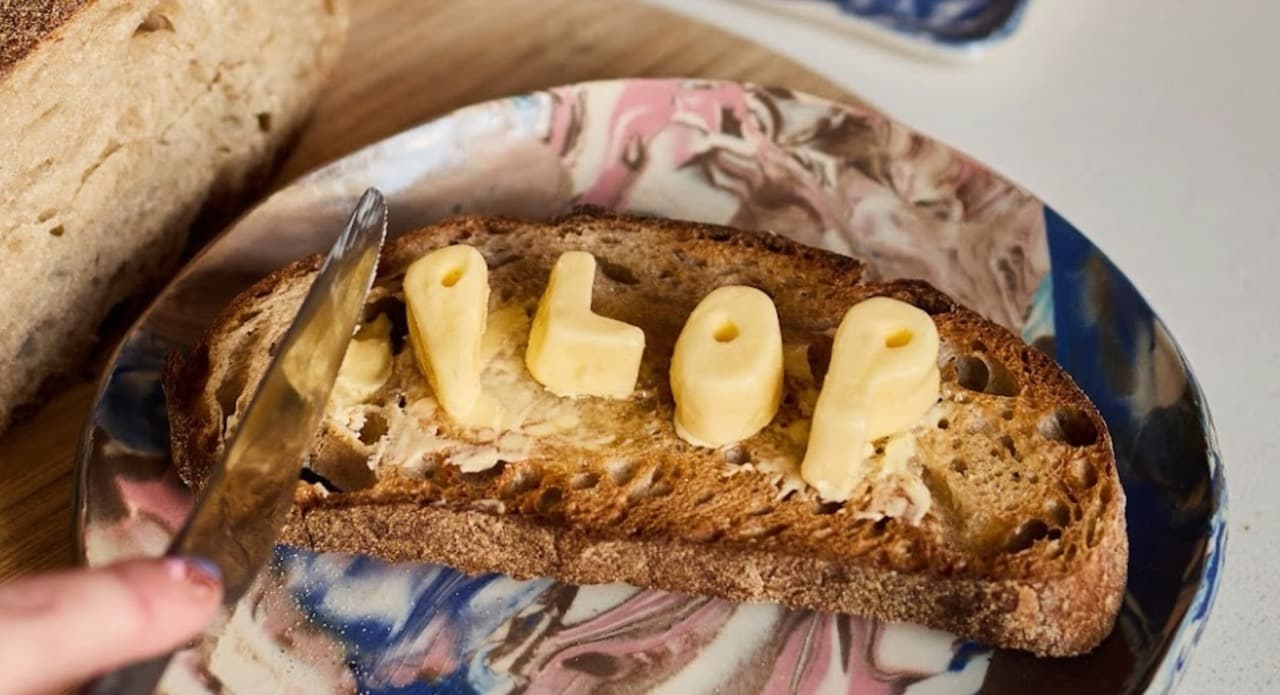
Ali Hewson and Katie Boccaccini Meadows’ work have a modern take on traditional functional forms. Ali utilises black and white slips for her classic, elegant vases and platters, creating pieces befitting of modern or traditionally dressed homes. Katie uses simple glazes to finish her functional ware, giving texture to handles with knotted rope or painting her plates with ethereal cloud designs.
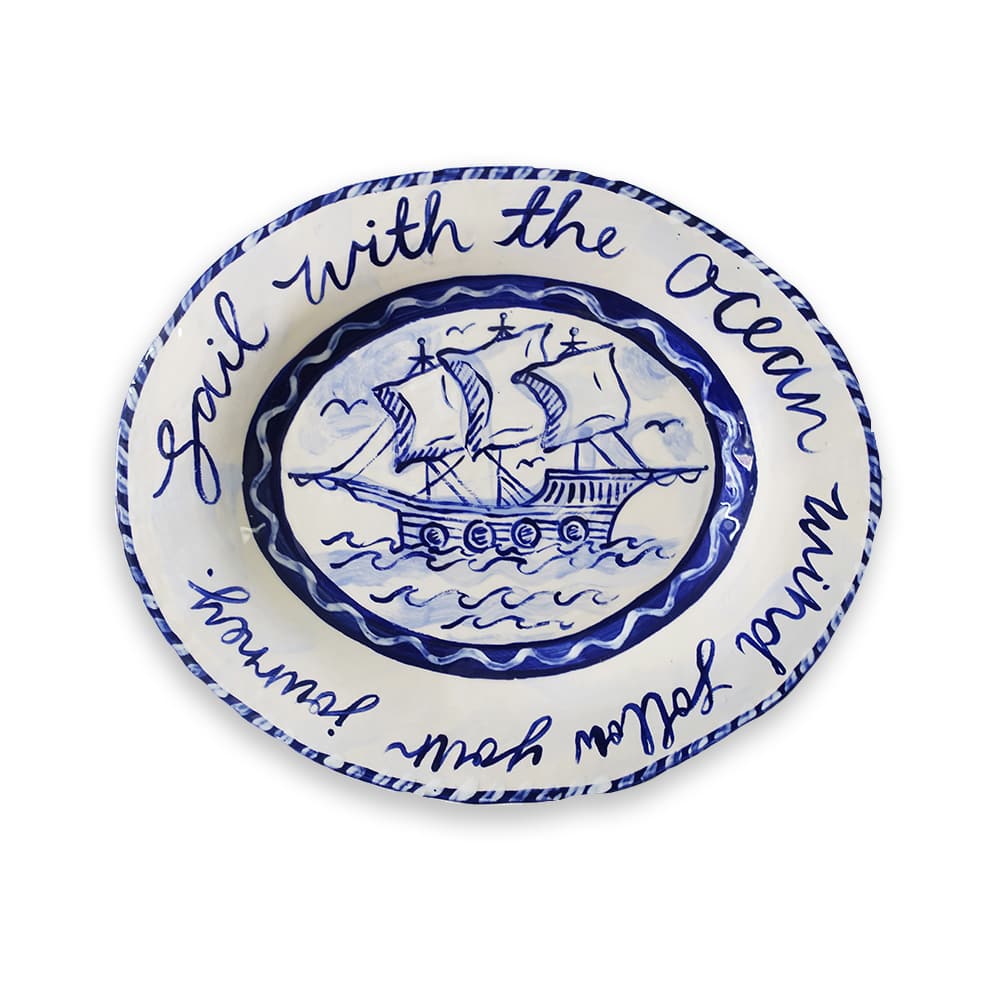
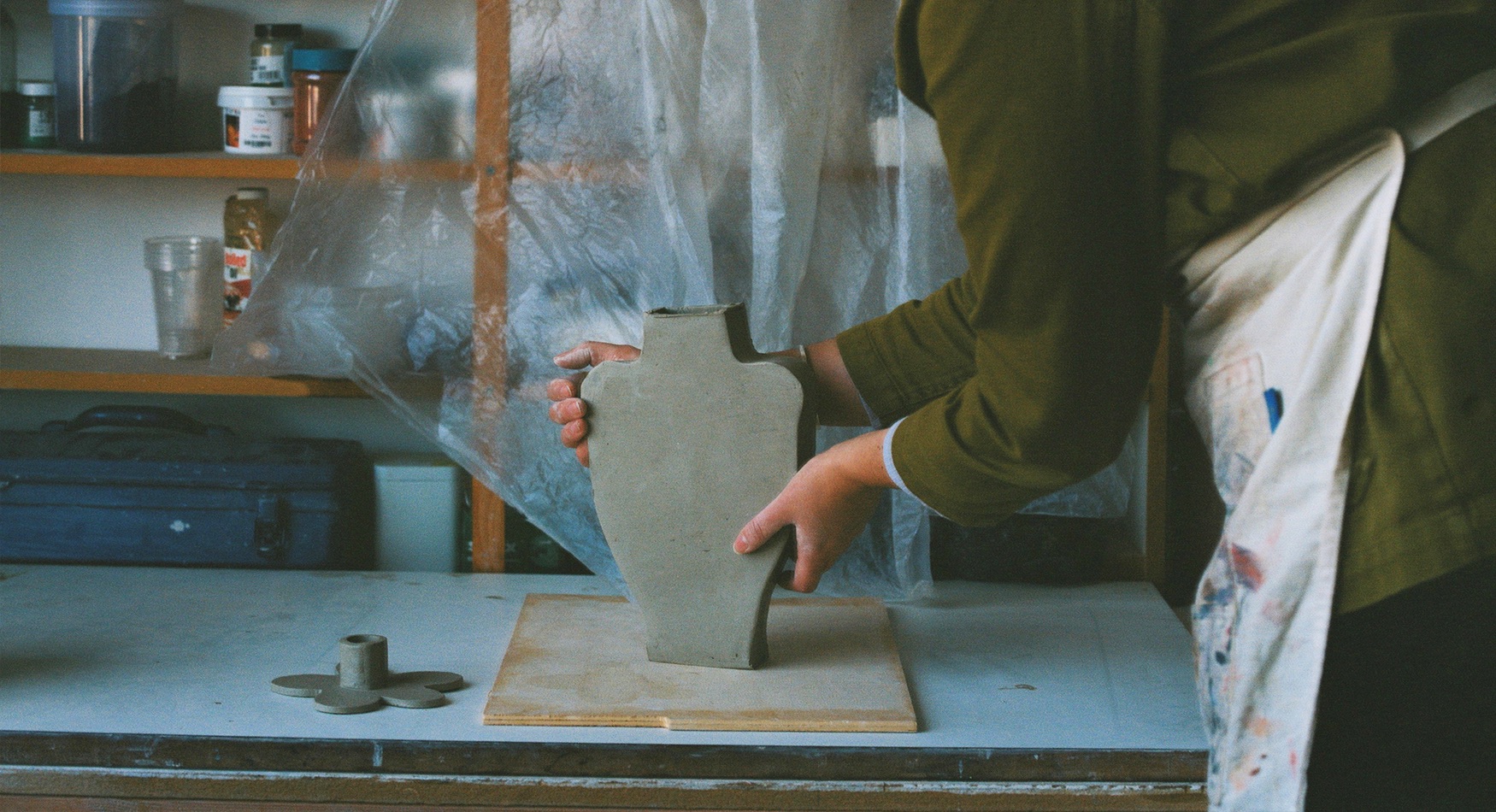
The artists at Harlie Brown, and PLOP pottery adopt a playful approach to tableware through ‘Nerikomi’ and experimenting with scale. Harlie is famous for her twisted handles and splattered, colorful glazes, as well as her husband’s hand painted French motif plates. Scarlett of Plop uses brightly coloured marbled clay to create wavy-edged plates and butter dishes that are a contemporary twist on classic kitchenware.
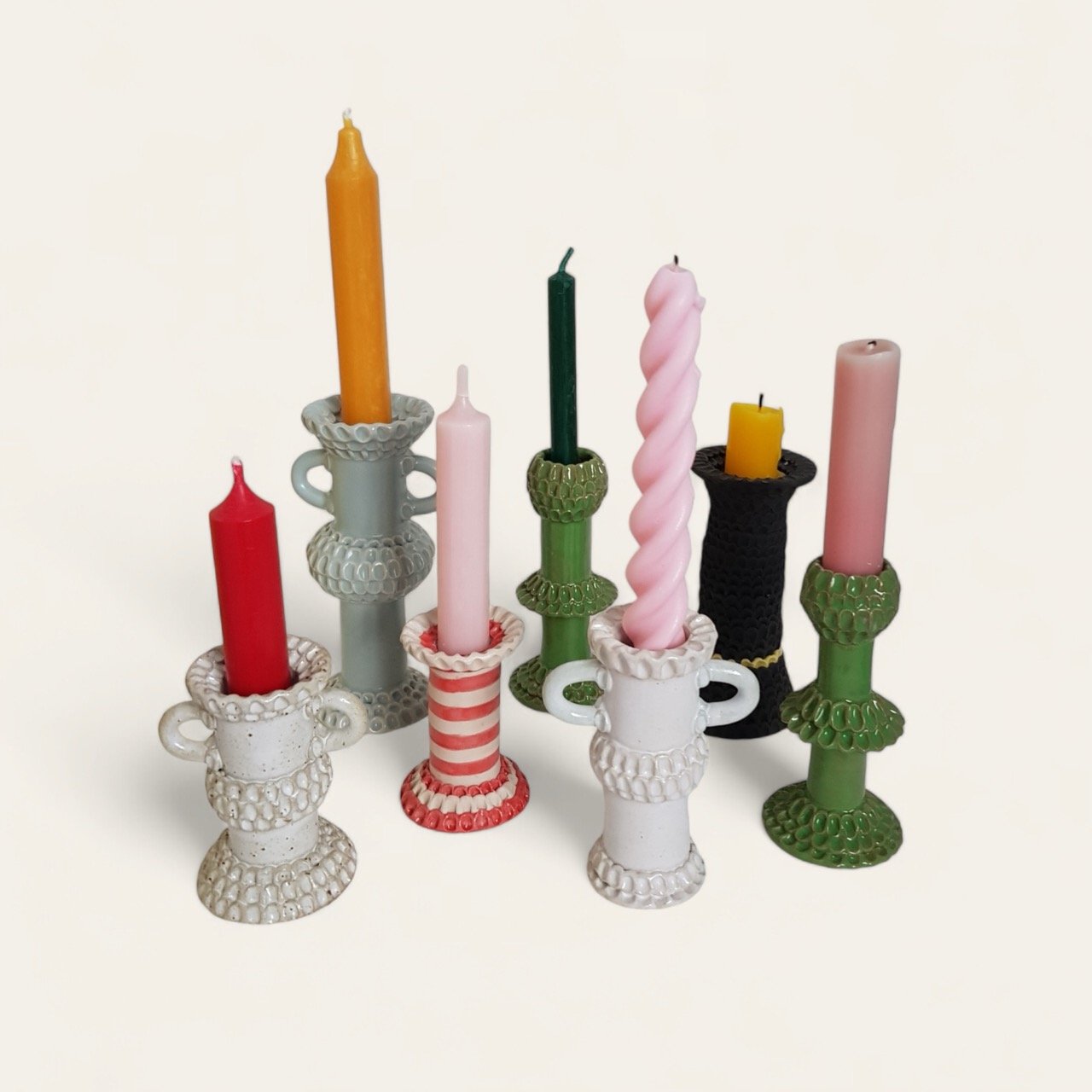
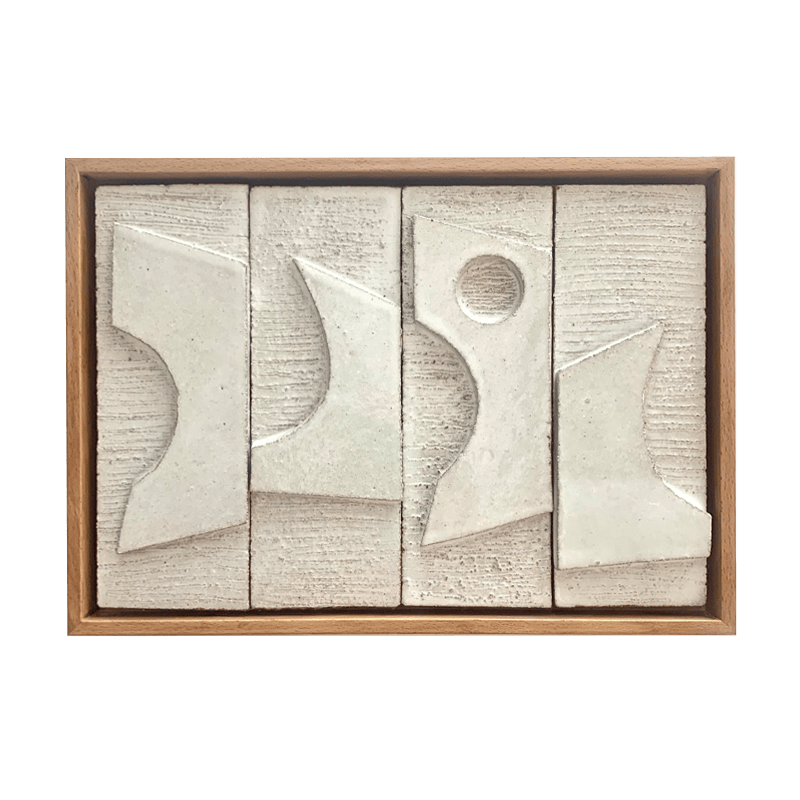
Some of our artists oeuvre is sculptural. Nick Passmore’s work utilises ceramics as a medium for creative expression with her beautiful wall-hanging panels. Superfluities and Joanna Ling offer a delicate and elegant approach, producing pieces with soft fluid lines. Working in porcelain, Joanna creates fine, raw pinched-edge tableware while Catherine of Superfluties is much inspired by vintage glass to sculpt the wavy edges of her lamps and vases.
Playful messages and a fine art approach characterise the work of Ruth Wilde, Meredith Adams and Evie May Adams. Ruth hand paints plates and mugs in a naive style with lines from poems and remembered song lyrics. Thoughts of romance, nostalgia and melancholy make these very collectable items. Meredith’s hand-built plates are also decorated with sentimental messages that she handpaints on each one. Evie too paints intricate illustrations and text on her porcelain dishes, influenced by medieval folklore, wildlife and script. In these pieces, ownership is given to her viewer, encouraging connection with each item making it a treasured in the home.
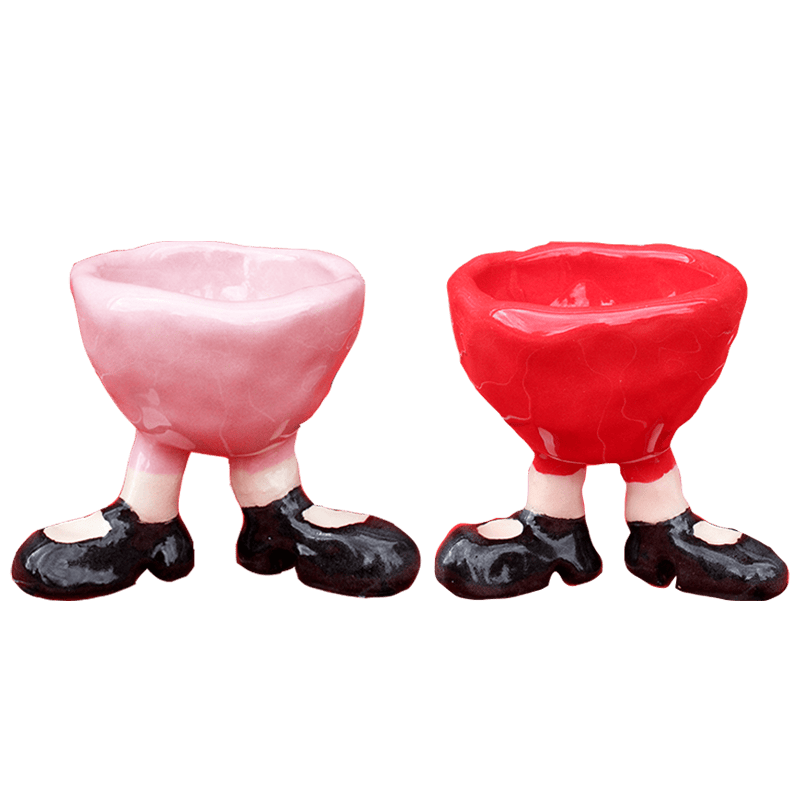
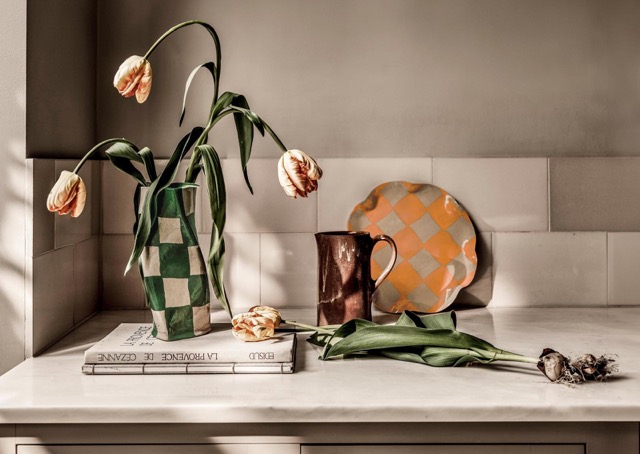
Daisy Tortuga makes in multiple mediums including ceramics, her work is sculptural and painterly with childlike illustrations that deal with deeply personal issues. Hal Haines’ also makes characterful ceramics that make observations and tell stories through his bold use of illustration and contemporary design. These collectables would be a talking piece in any home.
Aeyglom, Rosie Gore, Hodge Potts, Lizzie Scarlett Towndrow and Lorraine Robbins focus on bold colours and designs, creating eye-catching work full of interest. Aeyglom has cups and bowls in subtly coloured porcelain with soft bases that feel comforting to hold. Rosie Gore’s platters are painted with bright patterns while Nikki of Hodge Potts makes striped candle holders; both iconic in the modern homeware market. Lizzie Scarlett Towndrow creates in both ceramics and textiles and has a unique approach to design. Using historical forms adapted with a modern approach in muted colours. With a fine art background Lorraine decorates her pieces with fun designs and a playful palette.
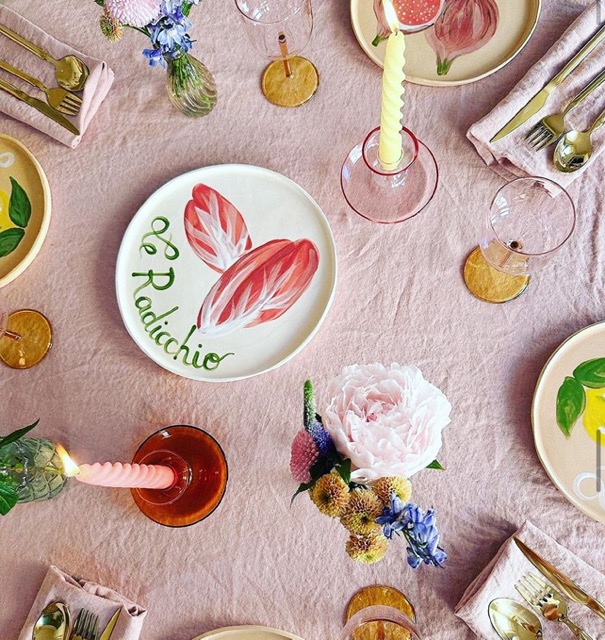
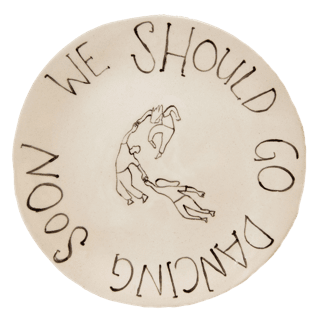
The diverse range of ceramic artists on MAKERS MADE showcases the versatility and enduring appeal of ceramics. Through their innovative techniques, commitment to sustainability, and dedication to artistic expression, these artists are shaping the future of ceramics and ensuring its continued relevance in our homes and lives.