Meet the Maker: Hal Haines' vibrant approach to visual storytelling
In this Q&A, we chat with Hal Haines about his transition from photography into multidisciplinary making and growing his vibrant world of ceramics, lighting and paintings. Hal shares insights into his creative process, the influence of personal experiences on his work, and the joy of combining different materials and techniques.
We discuss the challenges of valuing one’s work, finding inspiration in everyday moments, and the importance of authenticity in a rapidly changing creative landscape.

1. Can you tell us a bit about yourself and your artistic journey?
I have always been creative, and when I got to the age where I had to specialise in a particular area – as a profession – I found it incredibly hard to choose something. I worked as a photographer for 8 years, mostly for travel and lifestyle projects, and I loved the documentary/visual storytelling part of that work, as well as manipulating light and colour. Though I continued to draw and paint, and occasionally work in 3D during this time, it wasn’t until the covid lockdowns that I had an opportunity to really explore this side of my practice.
Picking up a camera begins the artistic journey into photography. As a medium it’s quite accessible, solely down to the individual to make something of it. Pursuing a craft is much more complicated; you need access to facilities and materials and some sort of instruction. You also need a lot of time, and freedom to play, to make mistakes and the grace to learn from them. The first three months of the pandemic gave me time, for the first time in a very long time.
2. What inspired you to pursue your craft? Was there a defining moment or influence that sparked your passion?
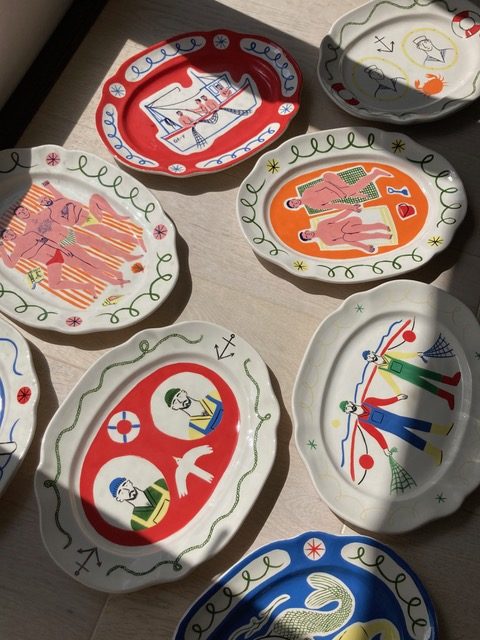
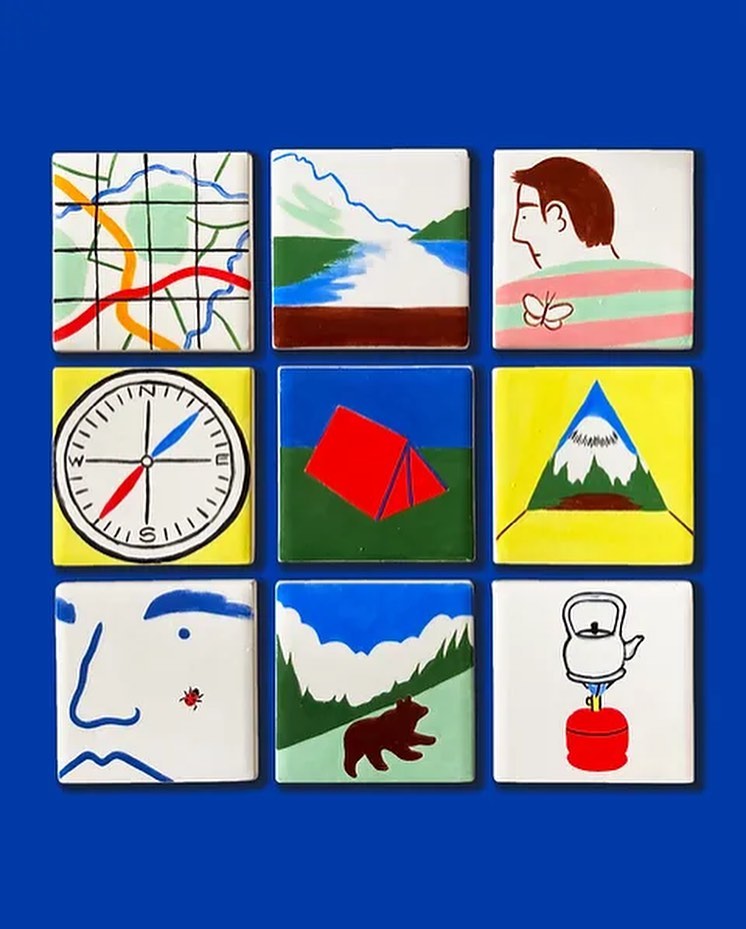
I’m still not sure I would define myself by one particular craft or process. I use different techniques as a way of expressing my ideas or telling stories, usually influenced by my own life experiences. Queerness, nature, pop culture, human connection, food and drink, I like to explore a wealth of topics. The visual language I have developed: vivid, playful imagery and a combination of textures and colours, is woven through all the pieces I make, whether they are ceramic, wood, textile or a painting on paper.
Your craft
3. How would you describe your work in three words?
Charming, Vibrant, Familiar
4. What materials or techniques do you use, and why are they important to your process?
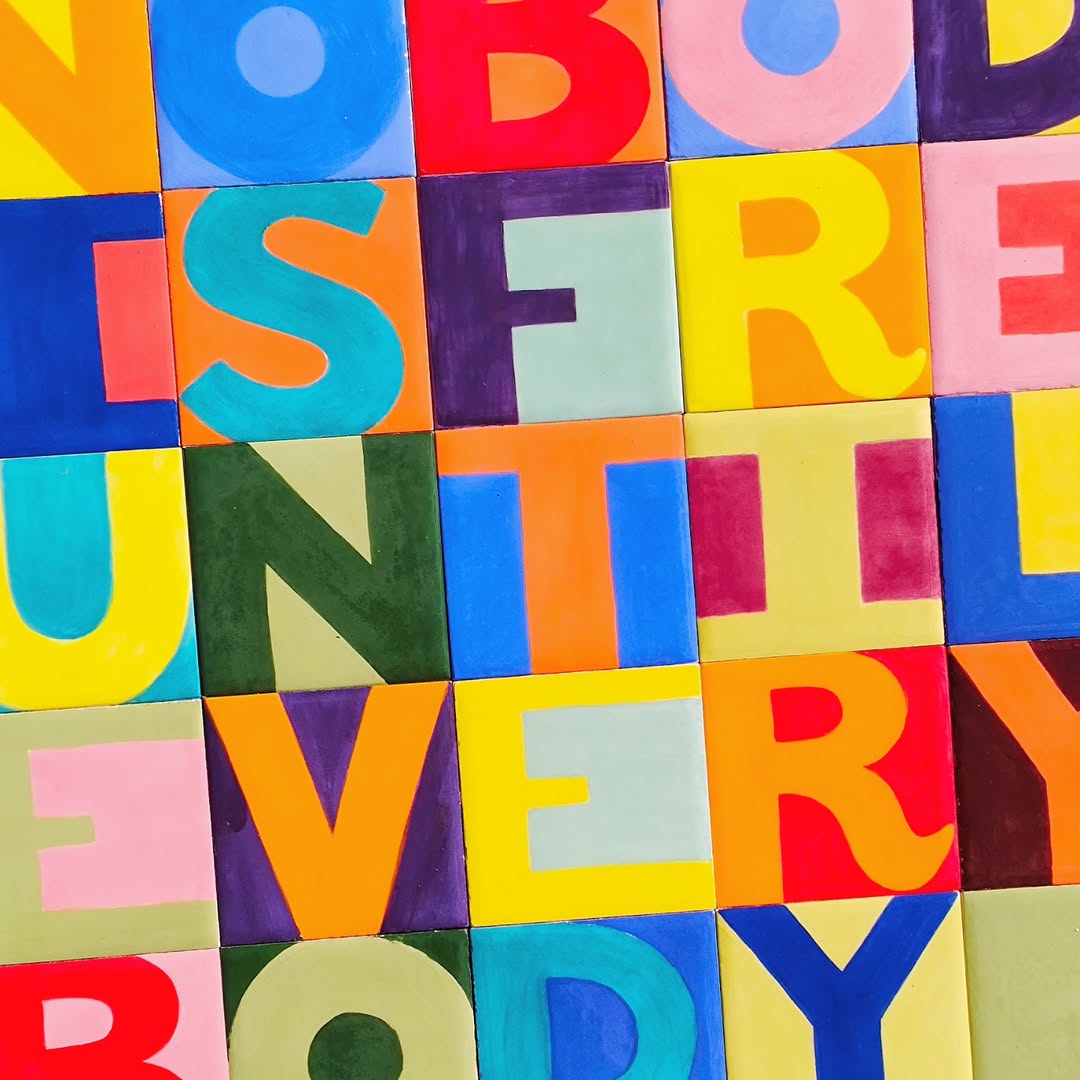
Ceramic, Paint, Wood, Metal, Fabric, Pencil, Crayon, Paper, they are all important, individually and in the context of each other.
5. Can you tell us about a favourite piece you’ve created and the story behind it?
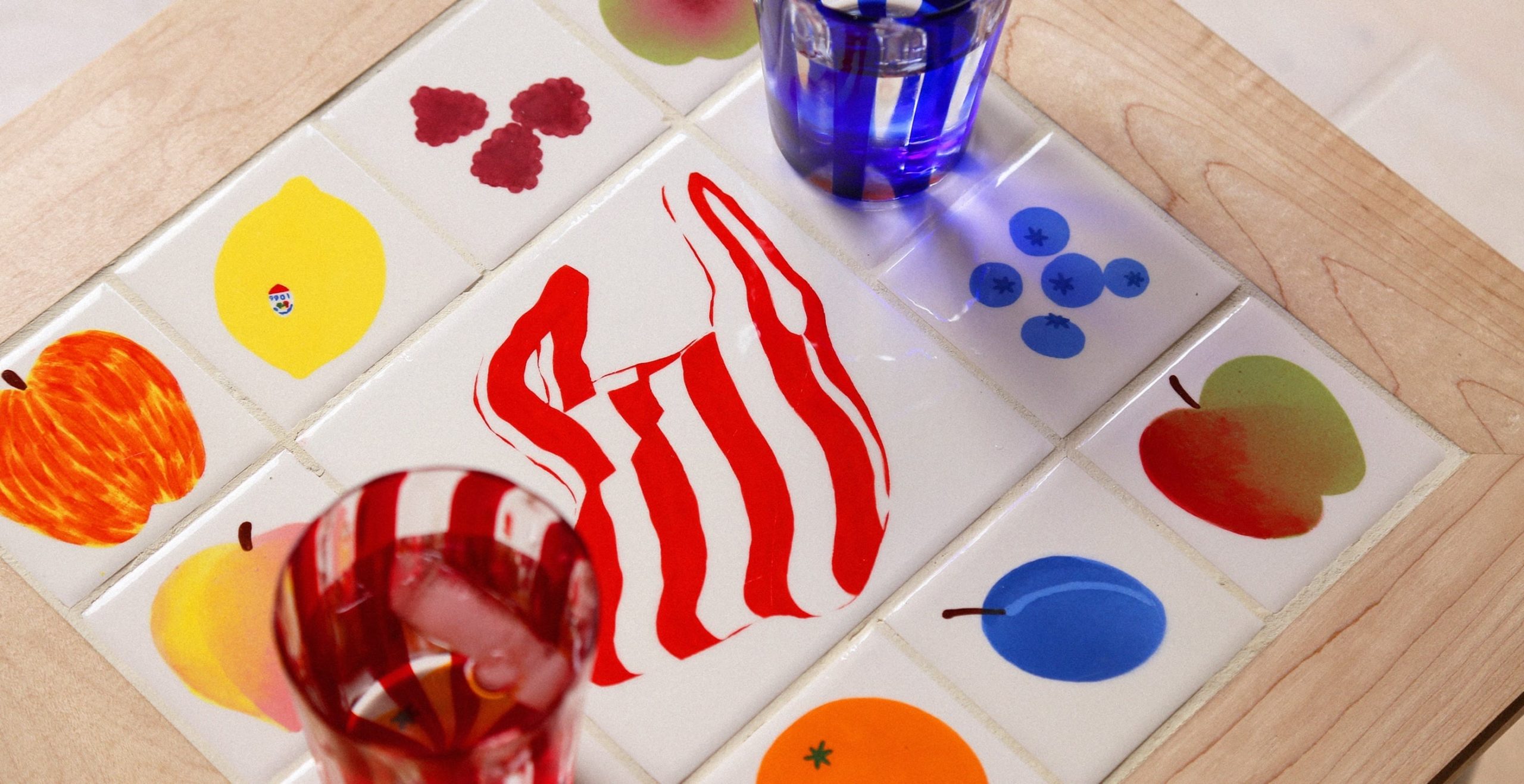
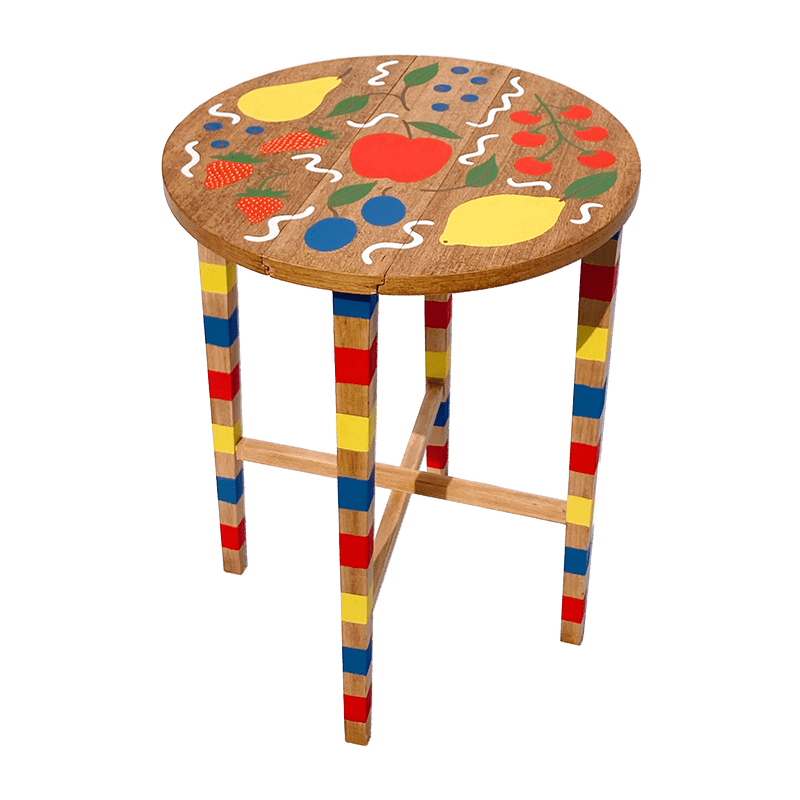
The ‘Fruity’ table I made in 2023, for which I painted and waxed a midcentury end table, was one of two tables I painted for a show of my work at Pentreath and Hall; I wanted to make some larger scale pieces for the window of the pop-up space. It’s still a favourite of mine because it felt like a pivot in my creative process, a marriage of several techniques I had been exploring, and a foray into functional furniture pieces. Since then, combining materials like wood with ceramic, or paint with fabric, has been engrained into how I approach new projects.
Creative process
6. What does a typical day in your studio or workshop look like?
I have decided to try and stick to three studio days a week and reserve the other two (or sometimes four) for the business side of my work. A typical studio day looks something like this:
Sit down, stand up, make a cup of coffee, sit down, scratch head, put on a podcast, paint in hyperfocus for three to four hours while snacking from my lunchbox intermittently, leave the studio for a period of time, return with another coffee, procrastinate for ten to fifteen minutes, work in hyperfocus for the rest of the day.
7. Do you have any unique rituals or habits that help you stay creative?
Audio is essential for me. Music or podcasts, occasionally reality TV, if I forget my earphones it’s all over for me. I find rituals are extremely important, but I often shift from one to another. I will do something habitually for a period of time and then move on. I used to burn a particular scent of St Eval candle in my studio every day, or drink a specific Pukka tea infusion (one with fennel), or binge a full podcast series back to back from beginning to end.
8. How do you handle creative blocks? Do you have any strategies or tips for overcoming them?
Do something else. Instead of sitting at my desk for hours in suspense I just step back, whether it’s to create something different, or work on another project, or in fact just take the rest of the day off and possibly go to the pub. My justification for this is: if I was an athlete and I had a foot injury, I wouldn’t try to keep running, would I?
Challenges and successes
9. What’s the biggest challenge you’ve faced as a maker, and how did you overcome it?
There are lots of challenges to face, it can be pretty gruelling at times, but I think the biggest one for me has been knowing my worth. Making something and putting it out into such a vast, varied market is a challenge indeed. There are so many tiers of maker, from day one hobbyists to established artisans. You have to assert yourself somewhere – and hope that consumers agree! The same goes for working with brands, or galleries, or collaborations: knowing the value of your artistry is essential.
10. What’s been your proudest moment or achievement so far?
I did an exclusive collection of pieces for Paul Smith at the very start of 2021, a couple of months after launching my website, and I’m still so proud of that project. I think because it was such an affirmation at the very beginning, it gave me the confidence to just go for it thereafter.
11. What’s your favourite quote you’ve ever heard about your work? Who said it, or what was the name of the publication?
“Please let me know when you get this in!! Love”
- Amy Sedaris
Inspiration
12. Where do you draw inspiration from for your work? What sparks your imagination and creativity?
Inspiration is truly everywhere. I am always looking, and recording with my camera or in a notebook. It can really be anything, from a conversation I had to an old cushion in a charity shop, to my allotment in springtime or vintage supermarket packaging.
13. Do you have a favourite artist, maker, movement, or tradition that has influenced your craft?
I love colourful, mid century visual communication – illustrators like Dick Bruna and Richard Scarry, or graphic design by Paul Rand – as well as modern 90s interiors; metal, glass, pops of colour, ambient lighting.
14. How does colour influence your practice; is it an important part of your process? Do you have a particular palette or favourites? Any go-to sources for colour inspiration?
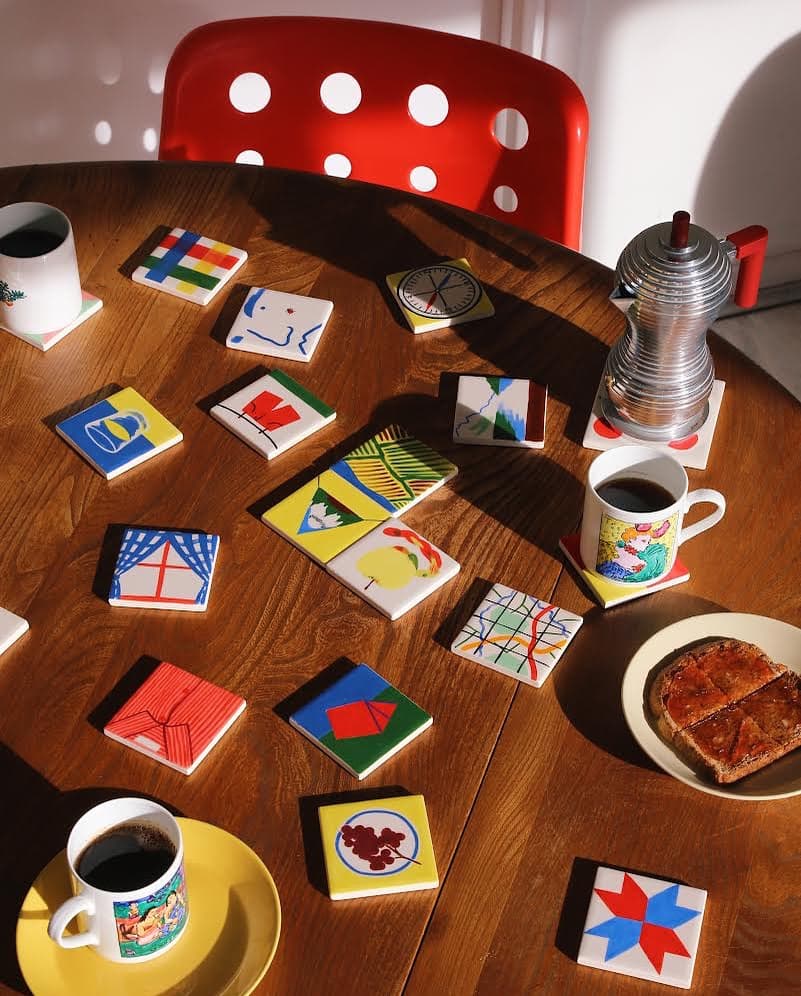
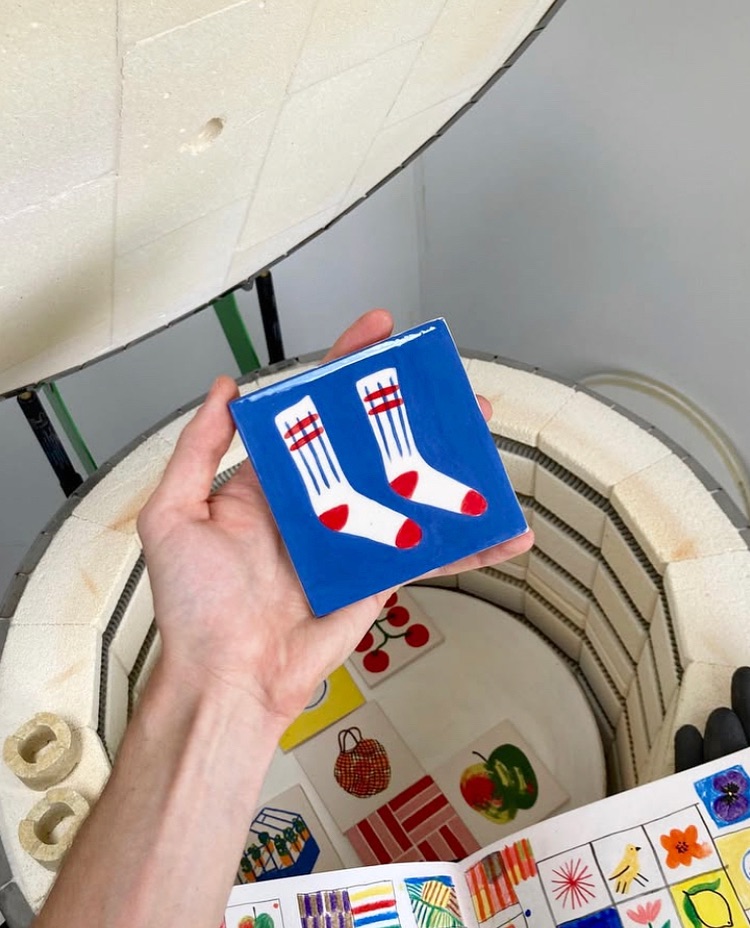
I think it’s fair to say that colour is an essential part of my process. Though my work is very vibrant, I definitely have a palette I stick to. I like to keep my colours clean, without a lot of mixing between, and only have one red, one yellow, one orange, a light green and a dark green, sticking to primary, secondary and occasionally tertiary groups. The colours I use in my ceramics are limited because they are caused by chemical reactions, but these tend to be the colours I replicate in my paintings and prints as well.
Perspectives and goals
15. What role does your environment play in shaping your creativity?
I’m neuro divergent, so my relationship with my environment can be rather complex. I’m overly sensitive to light and sound, so I can get very distracted and overwhelmed if the conditions aren’t conducive. Sometimes I feel like I might explode, often just because I can’t find my earphones. Other times I think I must seem ridiculous for how enthusiastic I can be for the right sounds or the right light, or colours, or shapes. A nice beam of sunlight or a song produced by
William Orbit is like drinking a Redbull! I also like to surround myself with things that are visually stimulating – reflective silver surfaces, complimentary colours, my River Cafe Cookbook or Alessi kettle get double points.
16. What do you want people to feel when they experience your work?
I often get told that my work feels nostalgic, which I like. I guess I’m trying to create something timeless, that feels fresh and exciting, but also familiar.
17. What are you currently working on, and what excites you most about it?
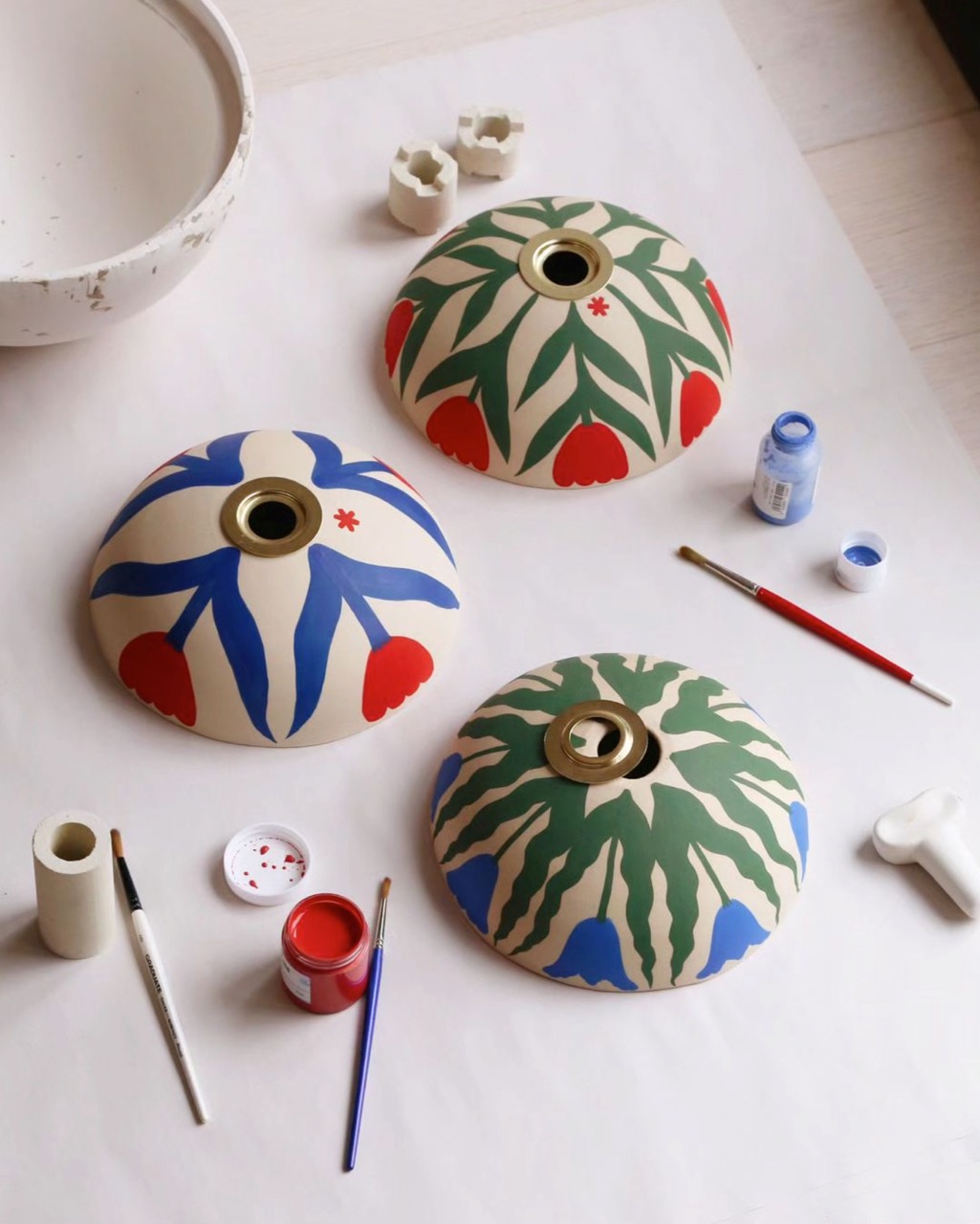
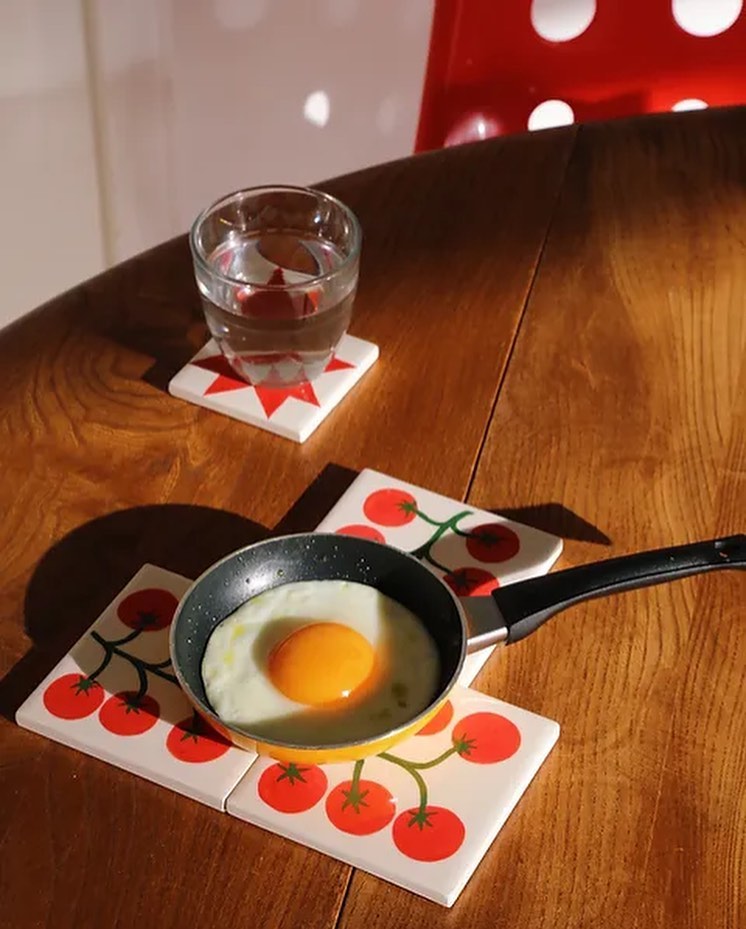
I’m working on a collection of prints and a new series of ceramic lampshades. I also have some secret projects on the way and I’m most excited about sharing those!
Advice and reflection
18. What advice would you give to someone starting out as a maker?
There is definitely a pressure to conform to trends, especially on social media. My advice would be to do your own thing, listen to your instincts, and find your own references. Always strive for substance and longevity over instant gratification!
19. If you could go back to the start of your career, what advice would you give your younger self?
If it feels right, go for it. And always get it in writing!
Closing thoughts
20. If you could collaborate with any artist, past or present, who would it be and why?
I would have loved to work with Sir Terence Conran. I feel an affinity for his outlook and his principles, and I admire his entrepreneurial spirit, as well as his appreciation for details. He once said that the four hallmarks of good design were “simplicity, beauty, functionality and surprise” – qualities I strive for in everything I make.
21. Where can people find your work, and how can they support you?
I sell most of my work exclusively on my website, halhaines.studio, as well as some collaborations with other brands and designers. The best way to keep up to date is through my newsletter, sign up here!
Hal’s pieces sit at the intersection of playfulness, charm and functionality. From ceramics to bespoke furniture pieces, he always strives to create something that is both characterful and useful.
Explore Hal’s latest collections and follow his creative journey:
Support Hal by exploring his website and staying connected through his newsletter for updates on new projects and collaborations.

Meet the Maker: The Bold, Colourful World of Emily Forgot
In this Q&A, we talk with Emily Forgot about her journey from commercial illustration to creating her distinctive artworks and assemblages.
Emily shares her insights on balancing commissioned projects with personal creations, the materials that drive her practice, and how architectural influences shape her bold and colourful aesthetic.
We also delve into her experiences overcoming creative challenges, finding inspiration in history and design movements, and her advice on navigating life as a creative professional.

1. Can you tell us a bit about yourself and your artistic journey?
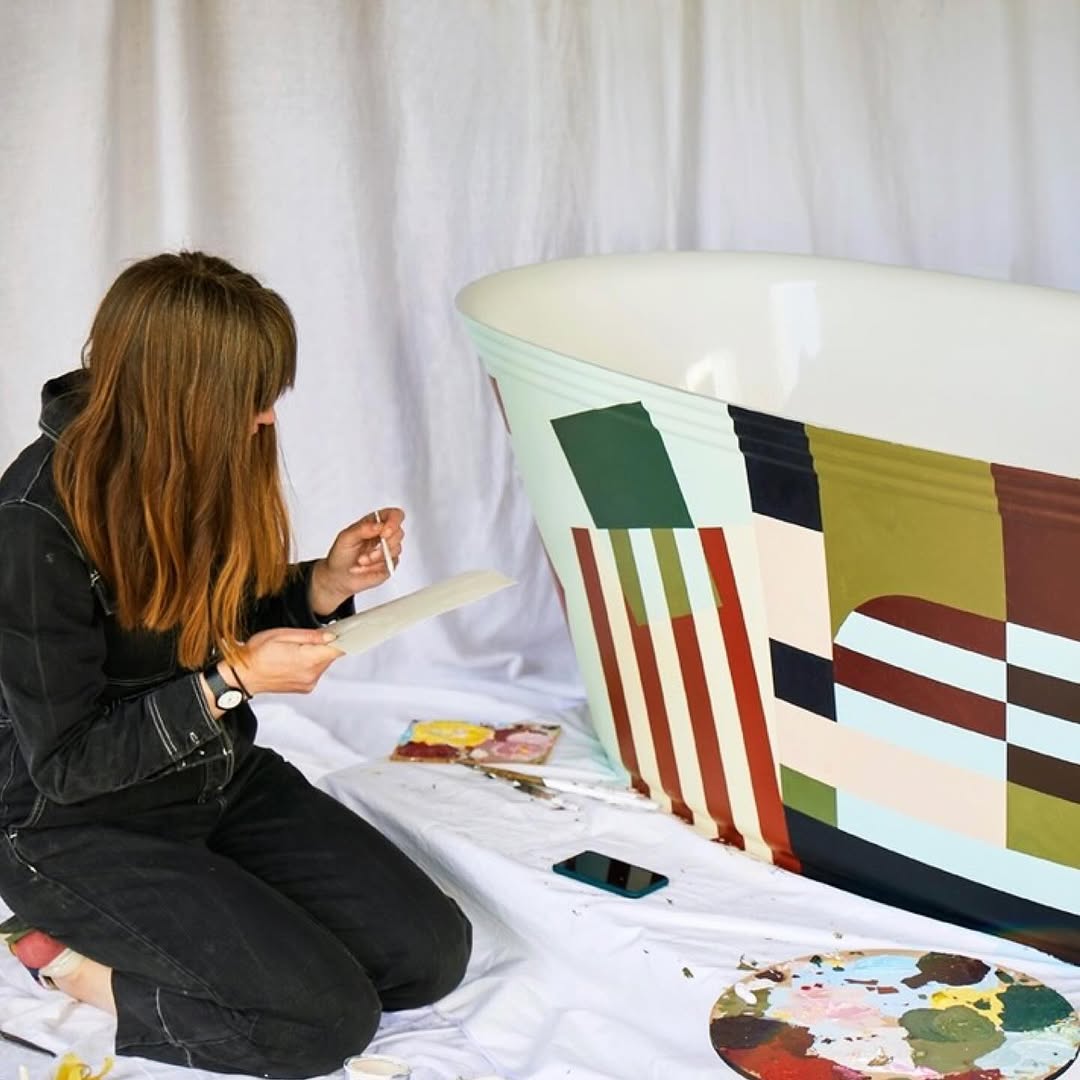
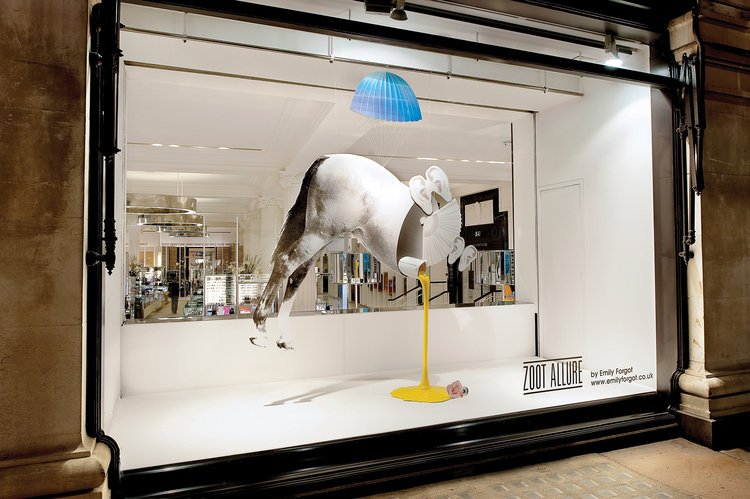
I started my creative career working as a commercial illustrator. I still do work with clients on collaborative projects but creating my own pieces both commissioned, for galleries and for my online shop has become a larger part of my practice over time.
2. What inspired you to pursue your craft? Was there a defining moment or influence that sparked your passion?
Its been an evolving process, and in many ways I feel the pursuit of my craft is often shifting. I definitely decided to work on more personal projects as I craved the freedom to direct my own output without commercial restraints. I enjoy the balance though of working to a brief set by a client and my own endeavours.
Your craft
3. How would you describe your work in three words?
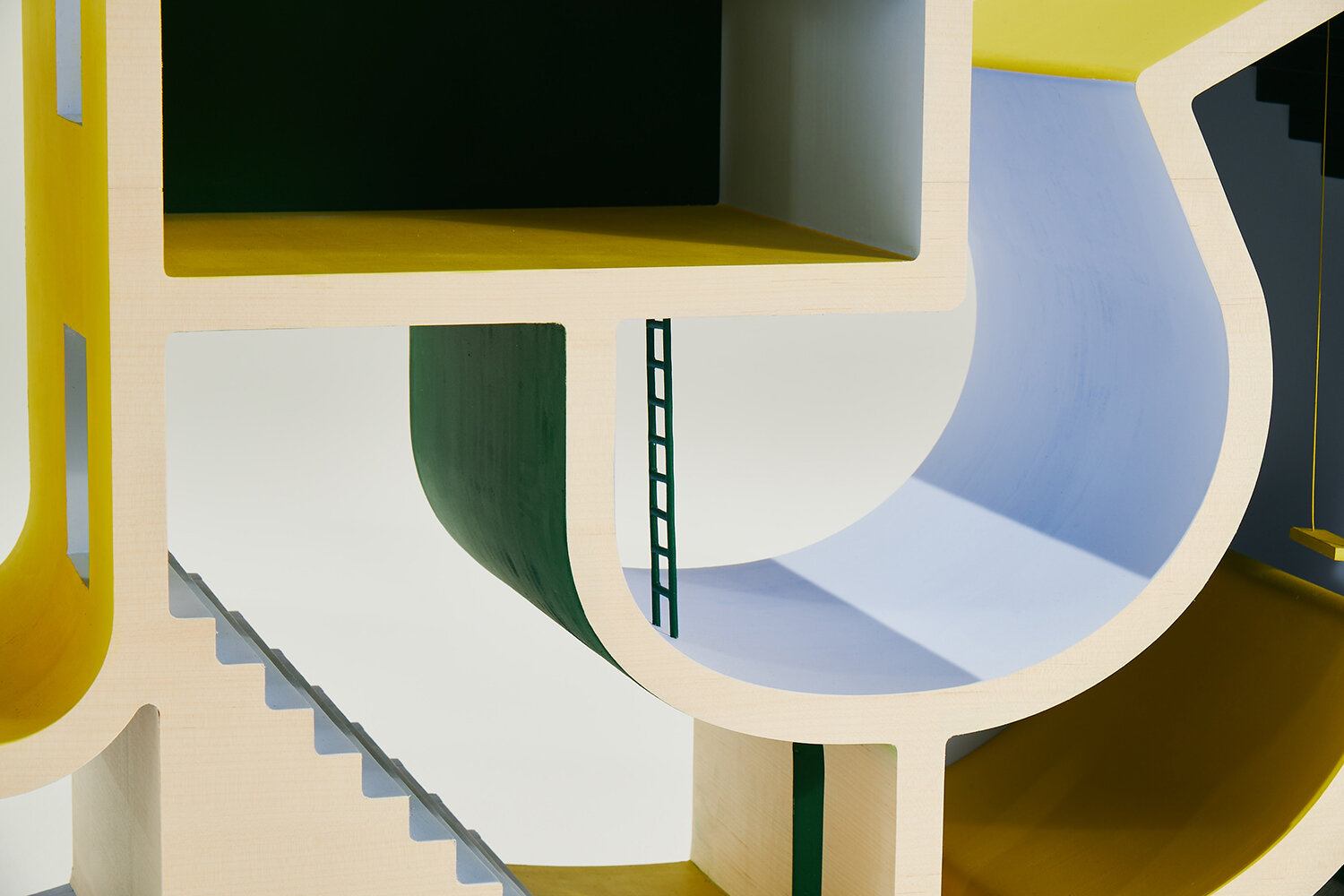
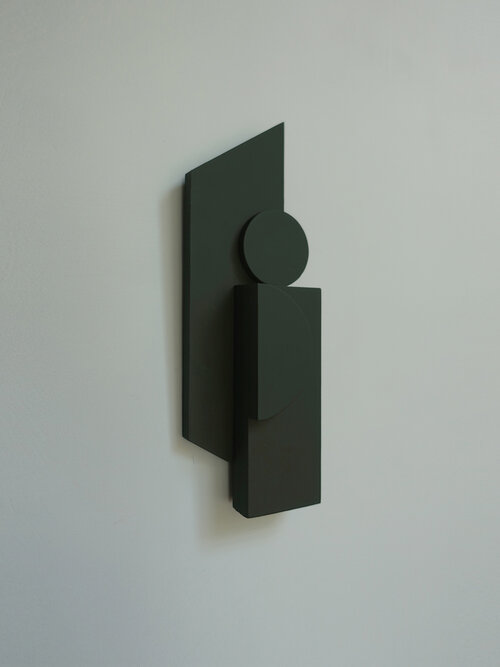
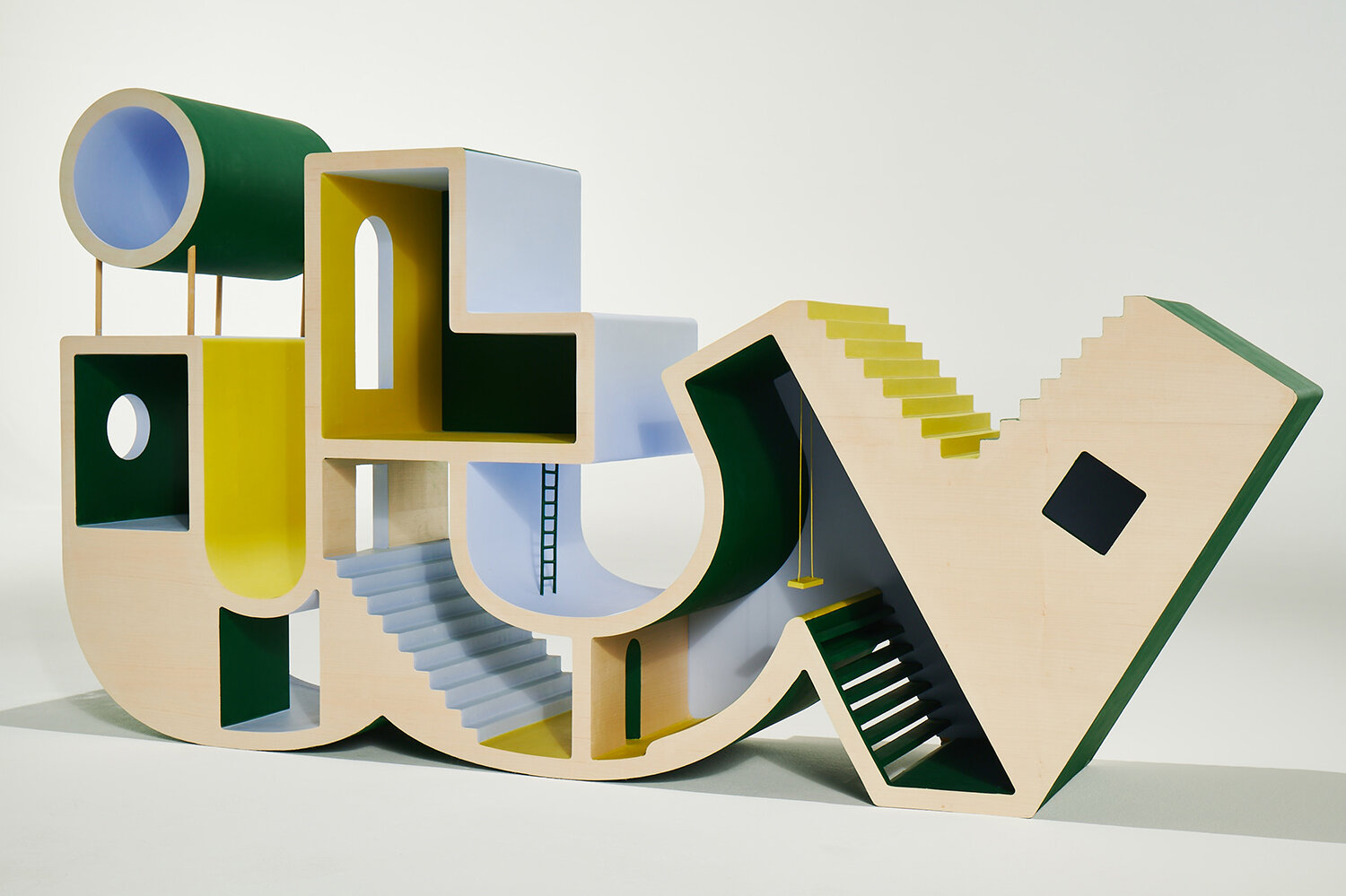
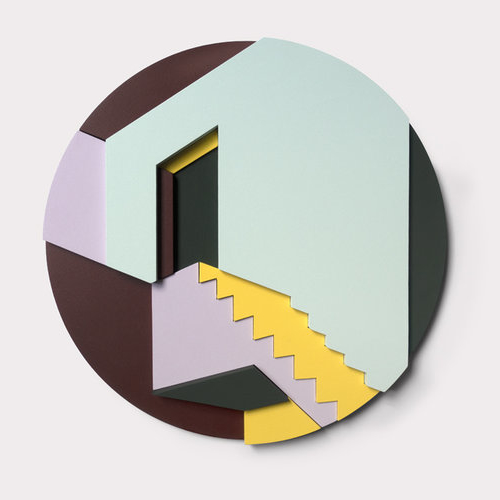
Bold, colourful, architectural
4. What materials or techniques do you use, and why are they important to your process?
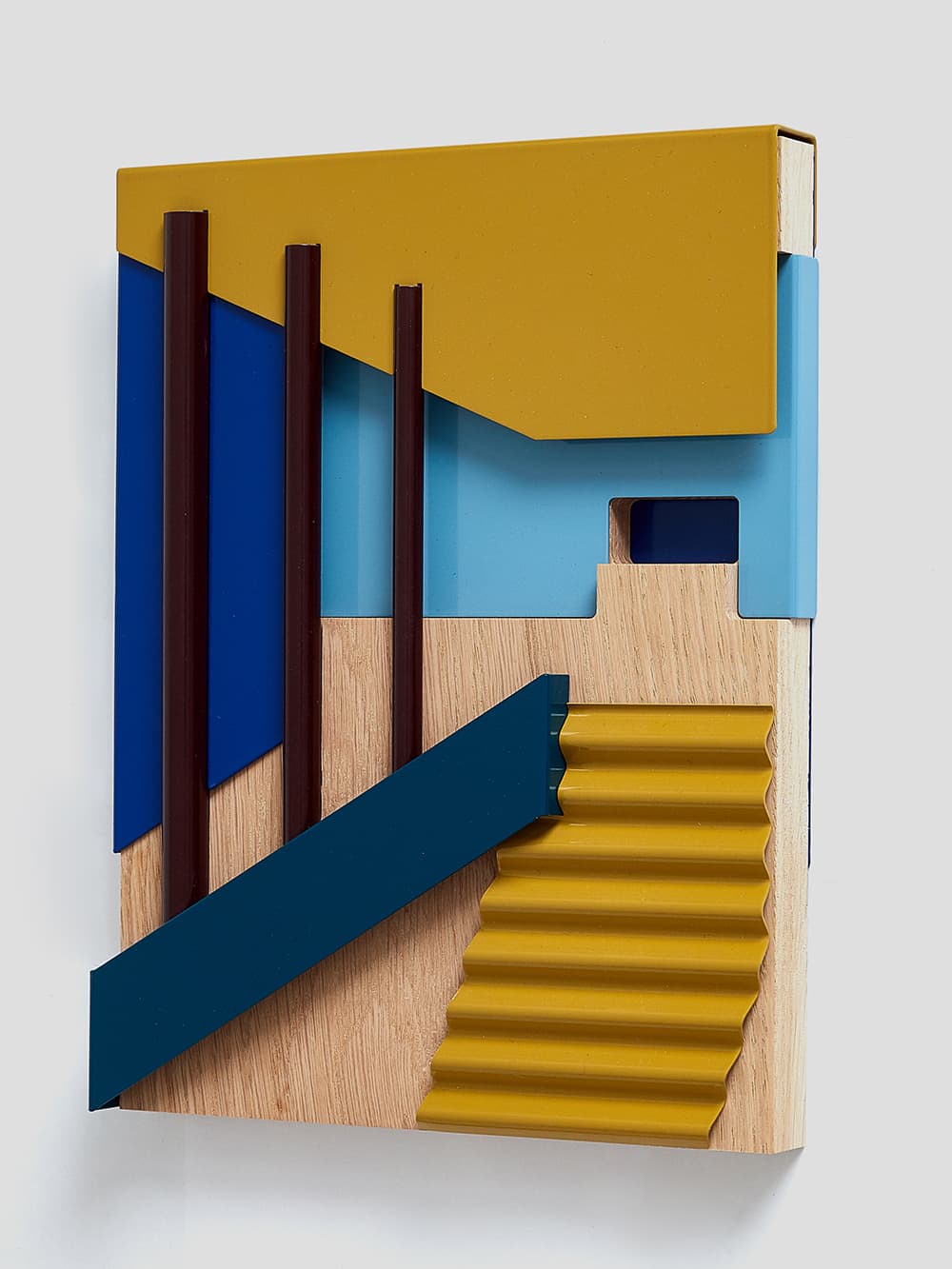
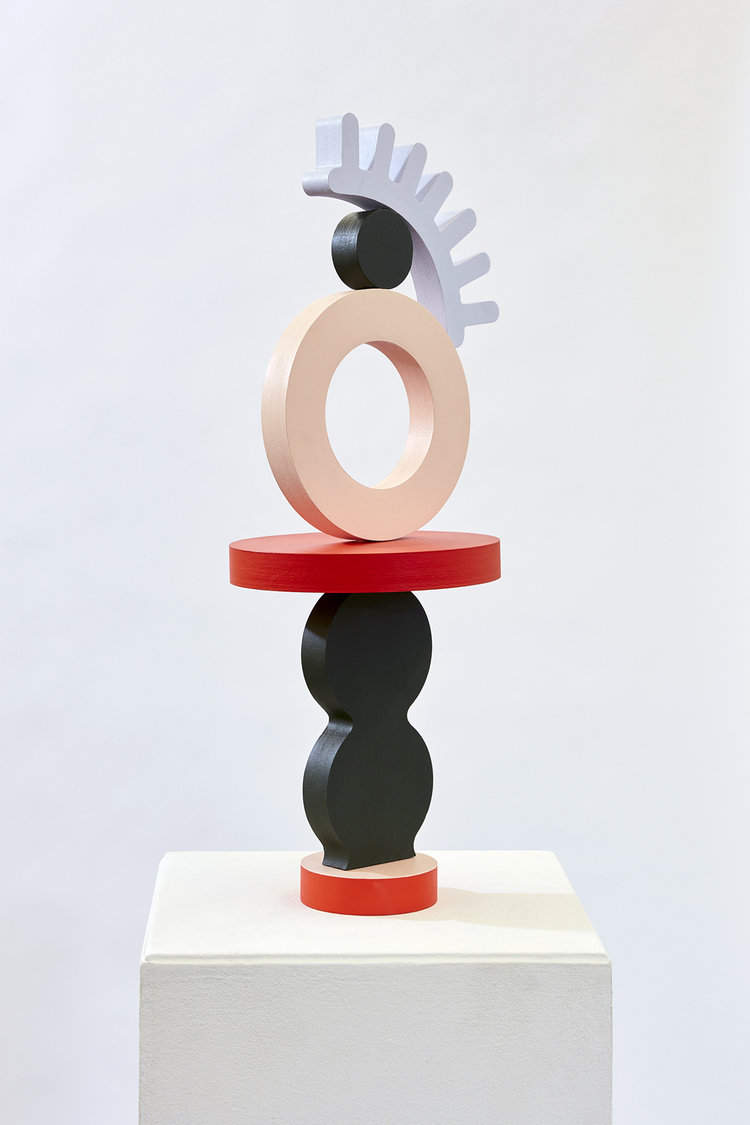
I’ve started using a lot of found papers in my collage work, I like how it adds a neutral tone to my overall colour palette but these found papers also give the pieces a lovely tactile quality. I also use wood in my assemblage pieces, usually poplar or ply when painted but I’m excited to explore more raw wood pieces using oak and cherry in the future. I love the robustness of working with wood.
5. Can you tell us about a favourite piece you’ve created and the story behind it?
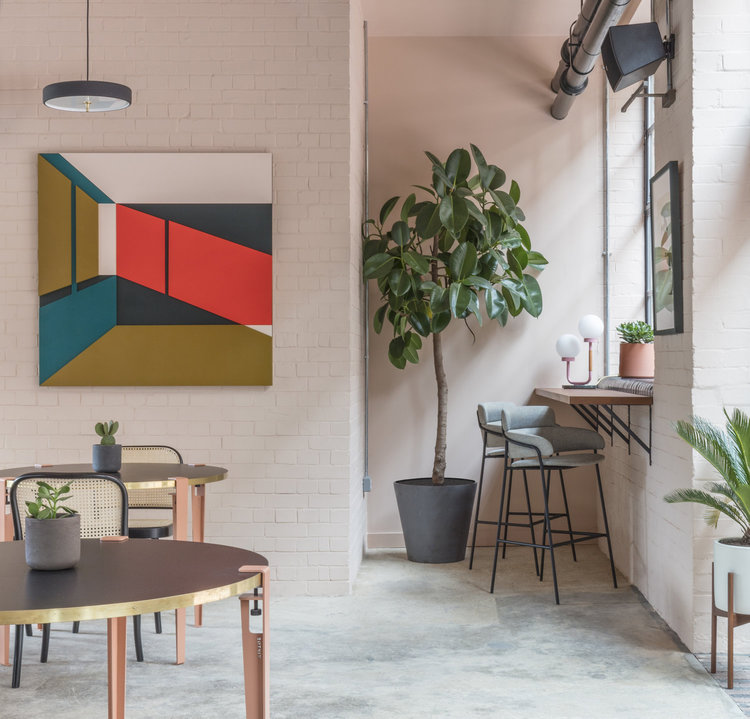
I recently completed a commission in a building that used to be a newspaper head quarters . I was inspired by the negative spaces of letterpress type blocks for the graphic shapes in the piece. I like when there is a hidden link or narrative in the artwork. That the viewer can see what they wish to but I know as the maker how the forms and the shapes developed. I love looking at the history of a building or site to find a cue about how to develop a piece of work.
Creative process
6. What does a typical day in your studio or workshop look like?
I try to get admin tasks done first thing so I can focus on the creative side of my business. Its lovely to have a few projects at different stages all running at the same time so I can be really productive. As one piece might be drying , I can start designing another, or exploring what colour palette I might use for the next piece and making sketches. I tend to use the late afternoon to do any packing or more mindless activities as its when my focus can begin to dwindle.
7. Do you have any unique rituals or habits that help you stay creative?
Forcing myself to take a brisk walk always seems to help with my creativity.
8. How do you handle creative blocks? Do you have any strategies or tips for overcoming them?
I think going to the library can be very helpful or just thumbing through some of my own books. I have a nice collection of vintage books and magazines in the studio. They explore different periods in art and design as well as different creative disciplines from architecture to fashion, fine art, graphic design and interiors. I’m usually guaranteed to find something that might spark an idea or find a new direction to get excited about.
Challenges and successes
9. What’s the biggest challenge you’ve faced as a maker, and how did you overcome it?
I think its often about construction, finding new ways to do something with any limitations that might be presented. and finding collaborators that care as much as you do about the final outcome can sometimes be a little tricky.
10. What’s been your proudest moment or achievement so far?
Many of them happened in a year I got totally burnt out so couldn’t enjoy them fully. Looking back Selling limited edition work in the V&A designed and inspired by the building felt like a great ‘pat on the back’ moment and having my home and work featured in my favourite magazine ‘World of interiors’ was a bit of a pinch me moment. But as i said the burn out has really made me re-assess the meaning of success and how I frame achievement.
11. What’s your favourite quote you’ve ever heard about your work? Who said it, or what was the name of the publication?
“Thats cool” – About one of my rugs I put on the landing at home – my 3 year old son : )
Inspiration
12. Where do you draw inspiration from for your work? What sparks your imagination and creativity?
I know it may sound cheesy but i really do draw inspiration from everywhere. I think it is this combination of multiple influences colliding with your own sensibility that makes your work truly your own and gives it that element of originality that we all crave as creative people.
13. Do you have a favourite artist, maker, movement, or tradition that has influenced your craft?
Its a real cacophony and changes often as I make new discoveries. I’ve loved revisiting the vibrant works of Sonia Delaunay lately, particularly her textiles and I got a great book on the Wiener Werkstätte recently. In terms of movements I love design movements that touched all areas of creativity from weaving to woodwork.
The Bauhaus, of course, being a perfect example of this multi disciplinary approach. I love early modernism but equally love to dip my toe in the less serious and more playful movements like Memphis of the 1980’s. I’m just excited to be a fan of it all and how it influences me often comes secondarily.
14. How does colour influence your practice; is it an important part of your process? Do you have a particular palette or favourites? Any go-to sources for colour inspiration?
Colour is a huge part in what makes my work unique to me. I love how intuitive building colour palettes can be. I don’t have a particular signature palette but the colours are often vibrant but with a little bit of earthiness to ground them. I often limit my palette too so usually no more than 3-4 colours. There is a great Japanese book on colour palettes that are extracted from kimonos that I love www.waterstones.com. Its a great resource if you are feeling like you need some guidance. I also love looking at fashion designers too and my own palettes are often led by the seasons.
"Thats cool"
— About one of my rugs I put on the landing at home. (my 3 year old son)
Perspectives and goals
15. What role does your environment play in shaping your creativity?
I think it plays a big role … just the right amount of mess, too much and its overwhelming.
16. What do you want people to feel when they experience your work?
Happy, energised, inspired …hopefully.
17. What are you currently working on, and what excites you most about it?
I’m working on some large scale commissions, both collage and wooden assemblages. Both are in the research stages and need to be inspired by the site they will be displayed so I’m in my favourite stage, exploring colour, shapes and architecture and making initial sketches.
Advice and reflection
18. What advice would you give to someone starting out as a maker?
Spend some time trying to figure out where your true passion and interest lies and don’t put too much pressure on the objects you make being your sole source of income at the start . I still have a few different ways that I make a living within the creative Industry and a large part of this is commissioned projects with set briefs. This excites me in different way to my more personal work but I think the self initiated creations would suffer if I relied solely on them to make ends meet.
19. If you could go back to the start of your career, what advice would you give your younger self?
I don’t know if i would offer any advice as think all the mistakes and wrong turns led me to where I am today. So perhaps it would just be, “You’re on the right path, keep going!” oh and also to trust my gut more, projects that even have a whiff of a red flag are usually going to be rife with issues.
Closing thoughts
20. If you could collaborate with any artist, past or present, who would it be and why?
I would have loved to have been Eileen Gray’s apprentice. Because she was an innovative genius and what more do you need in a mentor! I’m not sure if many of the designers and artists i admire would have really been up for the idea of collaborating, their focus was very much on their personal vision but to be honest I would be happy to just make tea and observe.
21. Where can people find your work, and how can they support you?
I have a website emilyforgot.co.uk that shares my commissioned projects and also has a shop, emilyforgot.co.uk/shop, I sell pieces through the galleries Partnership Editions and M.A.H and rugs through Floor story. I also run a Substack called Soft fascination, where I share inspirations both past and present, becoming a paid subscriber is a lovely way to support my practice too.
Emily Forgot’s work is a joyful exploration of colour, form, and playful architectural references, blending found materials and bold shapes into striking, contemporary pieces. From collage art to wooden assemblages, her creations offer viewers moments of inspiration and delight.
Explore Emily’s latest collections and follow her creative journey:
Support Emily by subscribing to her Substack and exploring her beautiful pieces online.